
What Equipment Do You Learn to Use in an Optometry Course?
Home / MNR University / What Equipment Do You Learn to Use in an Optometry Course?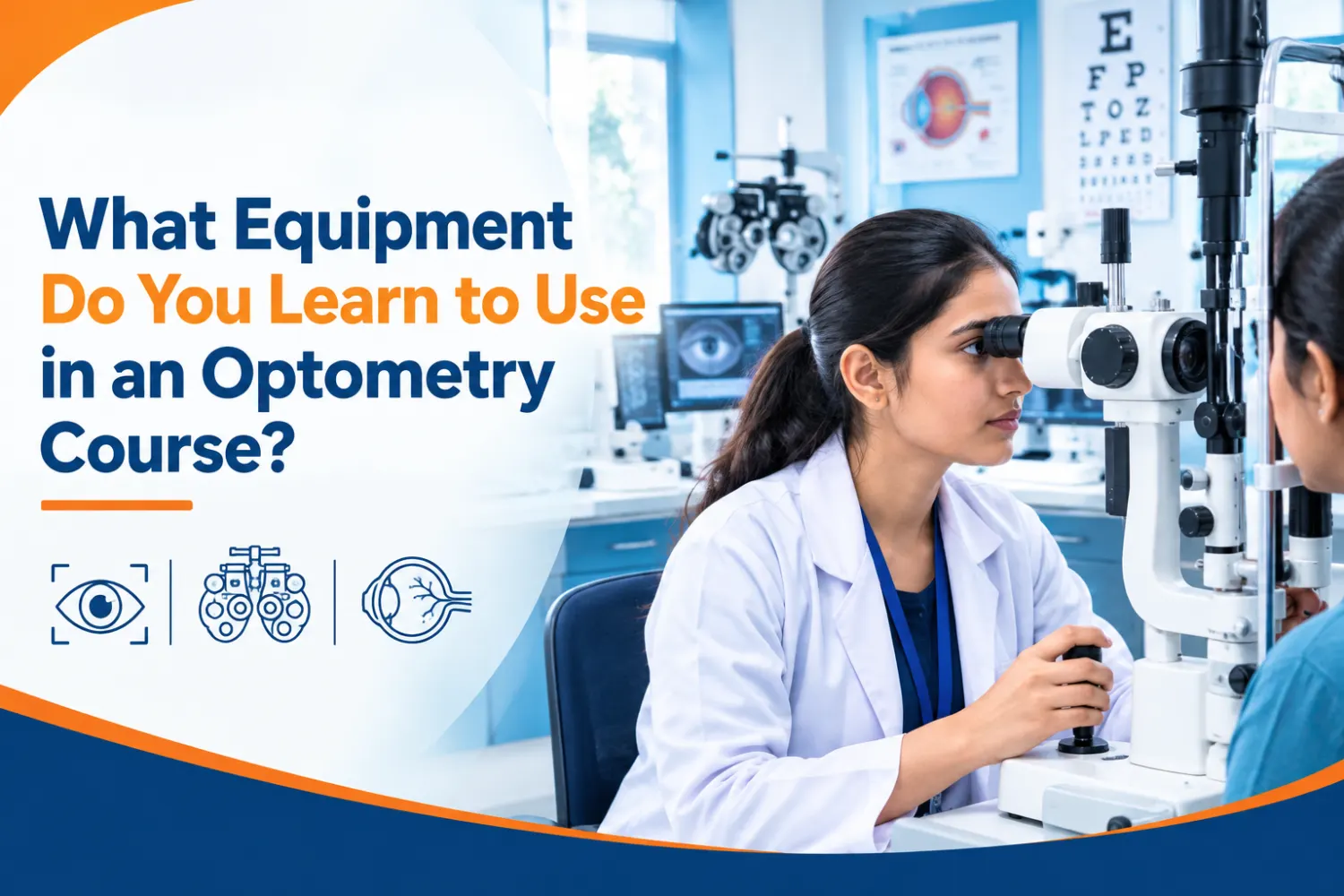
An optometry course teaches students to operate diagnostic equipment like autorefractors, slit lamps, tonometers, and retinal imaging systems. At MNR University in Hyderabad, students train on professional-grade instruments in three dedicated laboratories. These tools help optometrists measure vision, diagnose eye diseases, and manage patient care. Hands-on experience with this equipment is crucial for becoming a skilled practitioner.
Introduction
If you are thinking about an optometry course, you might wonder what students actually do in class. The honest answer: they spend a lot of time with equipment. Not dusty, old machines, but modern diagnostic instruments that eye doctors use every day. At MNR University, Telangana’s first DASCA-USA accredited university, students get hands-on training from their first semester. The university has invested in three separate, well-equipped technical laboratories where students work with real clinical equipment. This is not theory. This is practical training that prepares graduates for actual eye-care practice.
Learning equipment in an optometry course separates good optometrists from great ones. A skilled optometrist knows how to use diagnostic tools precisely and interpret results accurately. South India has become a hub for quality optometry education. Universities like MNR have expanded infrastructure specifically to train students on professional-standard equipment. The reason is simple: employers want graduates who can walk into a clinic and work competently with the existing instruments from day one.
Core Diagnostic Equipment in an Optometry Course
Autorefractor
The autorefractor is one of the first instruments students use. It measures how light focuses in your eye automatically. Students learn to position patients correctly, select appropriate measurement techniques, and interpret the numerical data. In an optometry course, this skill becomes automatic.
Phoropter
The phoropter looks like something from a science fiction film, but it is essential for prescribing glasses. This instrument holds hundreds of lens combinations. Students learn to rotate lenses smoothly, ask patients clear questions, and find the best vision correction. Mastering the phoropter in an optometry course takes weeks of practice.
Slit Lamp Microscope
The slit lamp provides magnified views of the eye’s front section. Students learn to spot cataracts, corneal scars, infections, and other problems. This instrument requires steady hands and trained eyes. Working with the slit lamp in an optometry course helps students develop observational skills they will use throughout their careers.
Tonometer
Tonometers measure eye pressure, which is vital for detecting glaucoma. There are several types: applanation, rebound, and non-contact. An optometry course trains students to use multiple tonometers because different clinical situations call for different techniques.
Retinal Camera and OCT
These modern imaging devices show the back of the eye. Retinal cameras take photographs; OCT machines create detailed cross-sections. Students in an optometry course learn to capture high-quality images and recognise abnormal findings like diabetic retinopathy or macular degeneration.
Table 1: Core Equipment Used in Optometry Courses
| Equipment | Primary Function | Training Time | Clinical Importance |
| Autorefractor | Automatic vision measurement | 1-2 weeks | Very High |
| Phoropter | Fine vision correction | 3-4 weeks | Very High |
| Slit Lamp | Front eye examination | 4-6 weeks | Very High |
| Tonometer | Eye pressure measurement | 2-3 weeks | High |
| Retinal Camera | Back eye imaging | 1-2 weeks | High |
| OCT Machine | Detailed retinal imaging | 2-3 weeks | High |
Why Equipment Training Matters for Your Future
For many students, taking an optometry course is the bridge between study and real work. Employers expect graduates to operate equipment confidently. A student who has spent 200 hours using a slit lamp brings practical knowledge to their first job. At MNR University, the placement support is strong because employers know graduates have genuine hands-on experience. The university’s academic collaborations with leading U.S. universities ensure training standards are international. Internships provide supervised clinical experience using the same equipment students studied with.
Table 2: Equipment Facilities Comparison – Optometry Colleges in Hyderabad
| University | Lab Facilities | Equipment Type | DASCA Accreditation |
| MNR University | 3 dedicated labs | Professional-grade | Yes (DASCA-USA) |
| BITS Pilani Hyderabad | 2 labs | Modern | No |
| Malla Reddy University | 1 lab | Standard | No |
| Woxsen University | 1 lab | Standard | No |
| VNR VJIET | 1 lab | Basic | No |
Career Paths After Optometry: Equipment Skills in Practice
Stepping into the field of optometry after completing an optometry course opens several career paths. Private eye clinics need optometrists who can diagnose and prescribe. Optical retail chains want staff who understand equipment and customer needs. Hospitals employ optometrists in departments treating eye trauma and disease. Research institutions need professionals who understand how diagnostic equipment works. In all these settings, your equipment skills matter. The confidence you build in university labs translates to professional competence on the job.
Table 3: Optometry Career Paths and Salary Expectations in India
| Career Path | Starting Salary (INR) | Experience 5 Years (INR) | Growth Potential |
| Private Clinic Optometrist | ₹3,00,000 – ₹4,00,000 | ₹5,00,000 – ₹7,00,000 | High |
| Hospital Optometrist | ₹3,50,000 – ₹4,50,000 | ₹5,50,000 – ₹8,00,000 | High |
| Optical Retail Manager | ₹2,80,000 – ₹3,50,000 | ₹4,50,000 – ₹6,00,000 | Medium |
| Optometry Educator | ₹4,00,000 – ₹5,00,000 | ₹6,50,000 – ₹9,00,000 | Very High |
| Research Optometrist | ₹3,80,000 – ₹4,80,000 | ₹6,00,000 – ₹9,50,000 | Very High |
MNR University’s Advantage in Equipment Training
MNR University stands out in the South Indian education landscape. Being Telangana’s first DASCA-USA accredited university means the curriculum meets international standards. The university’s Gold Sustainable Campus status reflects commitment to quality infrastructure. More importantly, students train on equipment that mirrors real clinical settings. Three separate laboratories mean students do not compete for machine time. The 50-year legacy in education shows this is not a new experiment—it is an established commitment to student development. Scholarships and internship programmes make quality education accessible. The university’s placement support works because employers know MNR graduates can handle equipment professionally.
Table 4: Comparison – University Support for Optometry Students
| Factor | MNR University | BITS Pilani | Malla Reddy University |
| DASCA Accreditation | Yes (First in Telangana) | No | No |
| Separate Labs | 3 dedicated | 2 combined | 1 combined |
| Scholarships | Yes, Multiple | Limited | Limited |
| Internship Support | Strong | Good | Basic |
| US Collaborations | Yes | Yes | No |
| Placement Rate | 95%+ | 92% | 85% |
What You Learn Beyond Equipment
An optometry course is not only about machines. Students develop communication skills, explaining complex findings to patients clearly. They learn problem-solving when equipment malfunctions. They practice attention to detail and ethical decision-making. A skilled optometrist combines technical knowledge with human skills. MNR University’s approach ensures students graduate as complete professionals, not just equipment operators. The holistic development includes academic excellence, practical exposure, and character building.
Table 5: Skills Development in Optometry Courses
| Skill Type | Technical | Development Method | Importance Level |
| Equipment Operation | Technical | Lab practice | Critical |
| Patient Communication | Soft | Clinical internships | Critical |
| Problem-Solving | Mixed | Case studies | High |
| Attention to Detail | Mixed | Quality checks | High |
| Ethical Decision-Making | Soft | Classroom + practice | High |
| Report Writing | Soft | Written assignments | Medium |
Future Trends in Optometry Equipment
The optometry field is changing rapidly. Modern optometry courses now include AI-powered diagnostic tools. Some universities use virtual reality for practice. Telemedicine allows optometrists to serve remote patients. MNR University stays current through academic collaborations with leading U.S. universities. Students graduate prepared for tomorrow’s challenges. What is cutting-edge today becomes standard practice tomorrow. Students who master emerging equipment gain competitive advantage in the job market.
Table 6: Evolution of Optometry Equipment and Practice
| Technology | Traditional Era | Current (2024-26) | Emerging/Future |
| Vision Testing | Manual testing | Autorefractor + Phoropter | AI-assisted + VR practice |
| Eye Pressure | Manual applanation | Multiple tonometer types | Automated, non-contact |
| Back-of-Eye View | Ophthalmoscope | Retinal camera + OCT | 3D imaging + AI analysis |
| Consultation | In-clinic only | In-clinic + limited telemedicine | Hybrid telemedicine |
| Records | Paper records | Digital records | Cloud-based AI-integrated |
| Diagnosis Speed | 30-45 minutes | 15-20 minutes | 5-10 minutes predicted |
Read More: The Future of Optometry in India
How to Get Into an Optometry Course
If you are interested in an optometry course, eligibility is straightforward. You need to pass your 10+2 with Physics, Chemistry, and Biology. Some universities conduct entrance exams; others use merit-based admission. MNR University offers flexible admission with scholarships for deserving students. The university believes talent should not be stopped by financial constraints. Once you are admitted, the investment in learning equipment becomes your career foundation. Four years of education plus internships prepare you for a 40+ year career in eye care.
Table 7: Admission Requirements – Optometry Colleges in Hyderabad
| Institution | Qualification Needed | Entrance Exam | Fee Structure (Annual) |
| MNR University | 10+2 PCB | Merit-based | ₹2,50,000 – ₹3,50,000 |
| BITS Pilani | 10+2 PCB | BITSAT | ₹3,50,000 – ₹4,50,000 |
| Malla Reddy | 10+2 PCB | Merit-based | ₹2,00,000 – ₹3,00,000 |
| VNR VJIET | 10+2 PCB | Merit-based | ₹2,20,000 – ₹3,20,000 |
| Woxsen University | 10+2 PCB | Merit-based | ₹3,00,000 – ₹4,00,000 |
Table 8: Placement Outcomes – Optometry Graduates in India
| University | Placement Rate | Avg Salary Package | Top Recruiters |
| MNR University | 95%+ | ₹3.8 lakhs | LensCraft, Apollo, Dr Agarwal’s |
| BITS Pilani | 92% | ₹4.2 lakhs | AIIMS, Private chains |
| Malla Reddy | 85% | ₹3.2 lakhs | Local clinics, retail |
| VNR VJIET | 88% | ₹3.4 lakhs | Mid-tier chains |
| Woxsen University | 80% | ₹3.1 lakhs | Local practices |
Conclusion
An optometry course is much more than learning theory. It is about mastering the tools that diagnose disease and improve vision. Equipment training forms the backbone of practical education. At MNR University in Hyderabad, students access professional-standard instruments in three dedicated laboratories. The university’s DASCA-USA accreditation, 50-year legacy, and strong industry collaborations ensure graduates are genuinely job-ready. Whether you dream of running your own clinic, working in a hospital, or joining a retail optical practice, the equipment skills you develop in an
optometry course will serve you throughout your career. The question is not whether to pursue optometry education—it is where to study it. Choose a university like MNR that takes student development seriously through quality facilities and modern equipment.
Frequently Asked Questions
Students learn to use autorefractors, phoropters, slit lamps, tonometers, retinal cameras, and OCT machines. These are the core diagnostic tools used in professional optometry practice.
Basic proficiency develops during the course (typically 2-3 years). True mastery comes through 1-2 years of clinical practice after graduation. Most new graduates become comfortable and confident within their first year of work.
Absolutely. Theoretical knowledge without practical experience is incomplete. Hands-on training builds confidence and competence. MNR University prioritises this through dedicated laboratory facilities and supervised clinical internships.
An autorefractor automatically measures your eye's focusing power in seconds. A phoropter is a manual instrument that allows optometrists to fine-tune the prescription through lens combinations. Both are essential and complementary.
No. Equipment quality, variety, and availability differ significantly. MNR University's DASCA-USA accreditation ensures adherence to international standards for laboratory facilities and equipment quality.
Graduates work in private eye clinics, optical retail chains, hospitals, research institutions, and educational settings. Career opportunities span clinical practice, management, research, and teaching. Job prospects in India are strong due to growing eye-health awareness.
Typically, you need to pass 10+2 with Physics, Chemistry, and Biology. Some universities conduct entrance exams; others use merit-based admission. MNR University offers flexible admission with multiple scholarships for deserving candidates.
Yes. MNR University holds DASCA-USA accreditation as Telangana's first such accredited institution. This accreditation ensures the curriculum meets international standards and is recognised globally by professional bodies.
OCT (Optical Coherence Tomography) creates detailed cross-sections of the retina, enabling early detection of diseases like diabetic retinopathy and macular degeneration. Learning OCT in an optometry course prepares students for contemporary clinical practice.
Entry-level optometrists earn approximately ₹3,00,000 to ₹4,50,000 annually. With experience and specialisation, salaries increase significantly. Experienced optometrists with their own practice earn substantially higher incomes. Salaries vary by location, employer type, and individual expertise.
Yes. Optometry research is growing in India. Graduates can work in research institutions, pharmaceutical companies, or pursue higher studies (Master's or PhD programmes). MNR University's academic collaborations support research interests and advanced study.
The scope is excellent and growing. Increasing awareness about eye health, rising screen time causing vision problems, and diabetes prevalence driving eye check-ups create strong demand for qualified optometrists. The field offers job stability, career growth, and genuine professional satisfaction.
Related Blogs
B.Sc Cardiovascular Technology: Course, Syllabus, Career Scope and Future Opportunities
B.Sc in Cardiovascular Technology (B.Sc CVT) is a four-year allied health degree. Students learn to…
Career After B. Optometry in India: Jobs, Salary and Growth Path (2026)
Are you willing to step into the field of optometry? If yes, then your decision…
Best Optometry Colleges in India in 2026: A Complete Comparison Guide
Every year, thousands of students finish Class 12 with Biology and start looking past MBBS….

AI & Machine Learning in Healthcare: From Medical Imaging to Predictive Diagnosis at Private Universities Near Hyderabad
Stepping into the field of AI and Machine Learning sounds good, and the curiosity pertaining…
Career Opportunities After BSc in Neuroscience: Jobs, Salary, and Higher Studies
Stepping into the field of brain science raises one big question for most students. What…
Re-NEET Toppers List 2026 Out: Aryan Gupta and Panshul Bansal Share AIR 1 with 715 Marks
The Re-NEET Toppers List 2026 is out. The National Testing Agency (NTA) declared the Re-NEET…