
Cardiovascular Technology Course After 12th: Eligibility, Subjects, Skills and Career Scope
Home / MNR University / Cardiovascular Technology Course After 12th: Eligibility, Subjects, Skills and Career Scope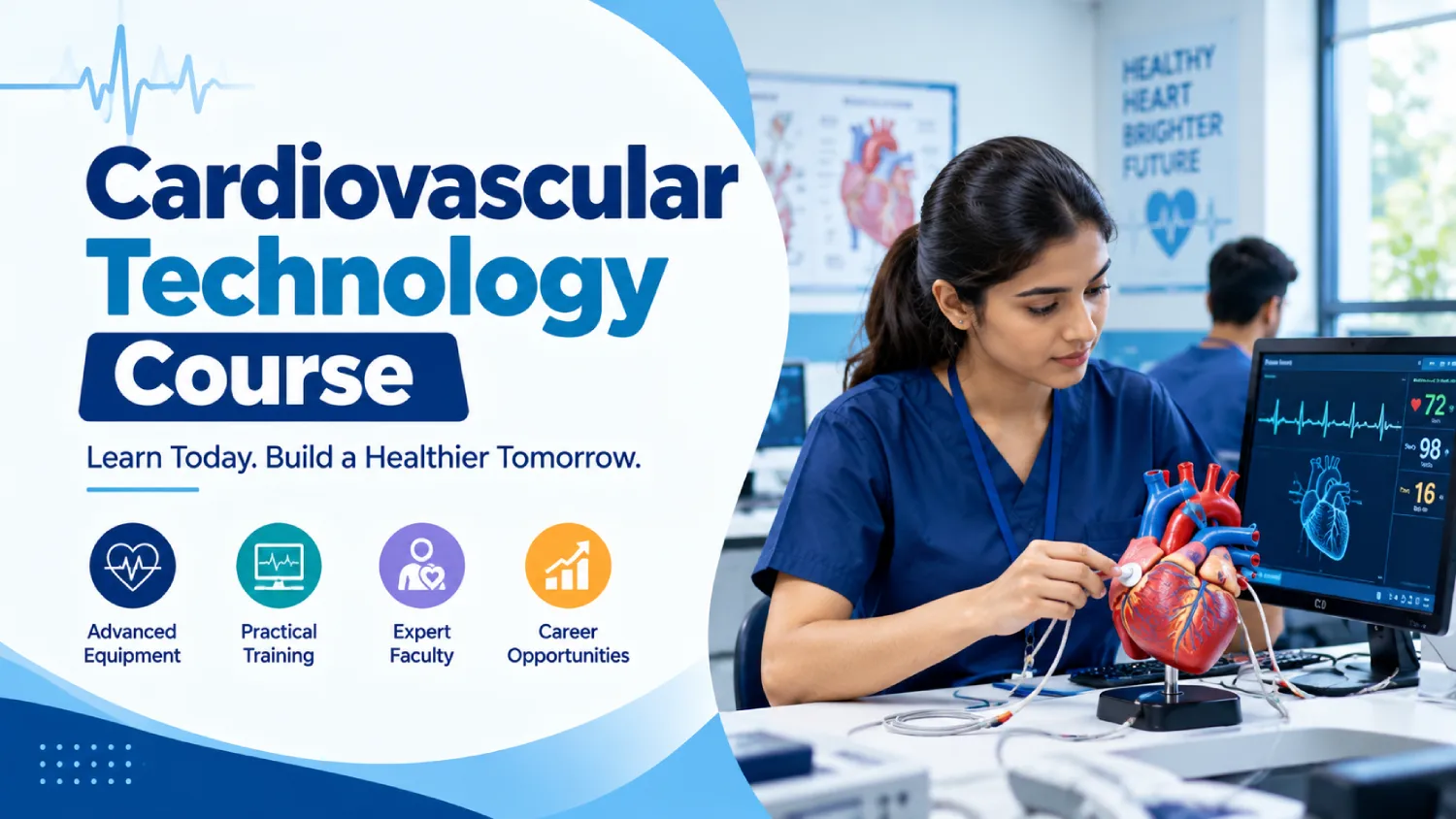
A cardiovascular technology course is a B.Sc degree that trains students to run heart tests such as ECG, echocardiography, treadmill stress tests and cath lab procedures. Students who pass Class 12 with BiPC or MPC can apply. At MNR University, Hyderabad, the B.Sc Cardiovascular Technology (B.Sc CVT) lasts four years, tuition is ₹1,50,000 a year, and merit scholarships cut it by up to 40%. Graduates work as cardiac technologists, echo technicians and cath lab technologists, with average pay in India of about ₹3–4 lakh a year at the start.
Introduction
For many students, the first big career question arrives right after the Class 12 results. Medicine looks like the obvious road, but MBBS seats are limited and the race is tough. It is quite common to hear parents ask whether there is another hospital career that is respected, pays well and is not overcrowded. One answer that keeps coming up is the cardiovascular technology course.
Stepping into the field of heart care sounds good, and the curiosity about future career possibilities hovers in the mind of every aspirant. What will be studied? Who can apply? Is there a real job at the end of it? This guide answers each question in plain words, using data from the World Health Organization, the US Bureau of Labor Statistics and Indian salary surveys. It also explains how MNR University in Greater Hyderabad runs its four-year B.Sc Cardiovascular Technology programme.
What Is a Cardiovascular Technology Course?
This degree teaches students how the heart and blood vessels work and how to test them with medical machines. Graduates are called cardiovascular technologists, or CVTs. They work side by side with cardiologists and heart surgeons.
In simple terms, the cardiologist decides the treatment. The cardiovascular technologist runs the tests that help the doctor reach that decision. Without clean ECG readings, sharp echo images and a well-prepared cath lab, a heart team cannot work safely.
Not everyone is aware that this is now a legally recognised profession in India. The National Commission for Allied and Healthcare Professions (NCAHP) Act, 2021 lists the cardiovascular technologist in its Cardio-vascular, Neuroscience and Pulmonary Technology category. The Act covers 56 allied health professions across 10 categories.
What Does a Cardiovascular Technologist Do in a Day?
- Records ECGs (electrocardiograms) to check the rhythm of the heart.
- Performs or assists with echocardiography, which is an ultrasound scan of the heart.
- Runs treadmill (TMT) stress tests and fits Holter monitors that track the heart for 24 hours.
- Prepares patients and machines in the cath lab for angiography, angioplasty and pacemaker procedures.
- Watches heart signals during procedures and keeps accurate patient records.
Why India Needs Trained Heart Technologists
A closer look at the numbers shows why hospitals keep hiring for these roles. Heart disease is the world’s biggest killer, and India carries a heavy share of it.
Table 1: Heart Disease Burden, Global and India
| Indicator | Figure |
| Deaths from cardiovascular disease worldwide (2022) | 19.8 million, about 32% of all deaths |
| CVD deaths caused by heart attack and stroke | 85% |
| Share of all deaths in India from CVD | 28.1% in 2016, up from 15.2% in 1990 |
| Indian CVD deaths among people under 70 (2016) | 53.4% |
| Age-standardised CVD death rate, India vs world | 272 vs 235 per 1,00,000 people |
Source: see the named sources in the table and the Sources list below.
It is worth noting that over half of India’s heart disease deaths in 2016 happened in people younger than 70. Younger patients mean more tests, more follow-ups and more years of care. Every cath lab, echo room and cardiac ICU needs trained technologists to keep running.
Cardiovascular Technology Course Eligibility After 12th
One question that often comes up is whether only Biology students can apply. The answer depends on the university. At MNR University, both science streams are welcome.
Who Can Apply at MNR University?
- A pass in 10+2 with BiPC (Biology, Physics, Chemistry) or MPC (Maths, Physics, Chemistry) from a recognised board.
- Or Class 10 plus a 2- or 3-year diploma in a relevant technology.
- Admission on merit or on valid state, national or international entrance test scores.
- A minimum age of 17 years as on 31 December of the admission year.
Several other colleges accept only PCB students, often with 45–50% marks. Students who took Maths in Class 12 should keep this point in mind while shortlisting.
How Cardiovascular Technology Admissions Work at MNR
- Register on the MNR admissions portal with basic details.
- Open the verification link sent to the registered email address.
- Click ‘Verify and Start Your Application’ and submit the form with documents.
- Pay the application fee of ₹1,500, and the admission confirmation fee of ₹15,000 once selected.
- The university checks marks and scores, then confirms the scholarship percentage in writing.
Full steps are listed on the admission process and guidelines page.
Fees and Scholarships for the Cardiovascular Technology Course at MNR
Table 2: MNR University B.Sc CVT at a Glance (2026–27)
| Detail | Information |
| Programme | B.Sc Cardiovascular Technology (B.Sc CVT) |
| School | School of Allied and Healthcare Sciences |
| Duration | 4 years |
| Annual tuition fee | ₹1,50,000 |
| Semester fee in Year 1 (tuition plus services) | ₹84,000 |
| Merit scholarship | 10% to 40% of tuition |
| Tuition after a 40% scholarship | ₹90,000 a year |
| Scores for the top scholarship | 85% or above in Intermediate, CGPA 8.0+, NEET 70+ percentile, CUET 75+ percentile or state CET rank up to 2,000 |
| Campus | MNR Nagar, Fasalwadi, Sangareddy district, Greater Hyderabad – 502294 |
| Further study on campus | M.Sc Cardiovascular Technology (2 years) |
Source: MNR University official website (B.Sc CVT, Fee Structure and Scholarships pages)
The full breakdown sits on the MNR University fee structure page, and the score bands are on the merit scholarships page.
Subjects Studied in B.Sc Cardiovascular Technology
The syllabus moves from basic body science to real heart machines. The exact list differs between universities, so students should read the official MNR syllabus at the time of admission. In practical terms, most four-year programmes in India follow a pattern like this:
Table 3: Typical Year-wise Subjects
| Year | Focus | Typical subjects |
| Year 1 | Body basics | Human anatomy, physiology, biochemistry, basic pathology and microbiology, English and communication |
| Year 2 | Heart science | Cardiac anatomy and physiology, pharmacology, ECG and basic cardiology, medical instruments |
| Year 3 | Test methods | Echocardiography, stress testing (TMT), Holter monitoring, vascular studies, cath lab techniques |
| Year 4 | Clinical practice | Supervised hospital work in cardiology and cardiothoracic units, a project, patient care and ethics |
Based on common B.Sc CVT syllabi in India; the MNR University syllabus is final.
Skills That Make a Good Cardiovascular Technologist
Ask any experienced professional in the field, and they will tell you that machines are only half the job. The other half is people.
- Steady hands and sharp eyes for reading ECG waves and echo images.
- A calm head, since cath labs and emergency rooms move quickly.
- Clear, kind words for frightened patients and their families.
- Basic computer skills for reporting software and patient records.
- Teamwork with cardiologists, nurses and surgeons.
- Care with hygiene, safety and record keeping.
From an employer’s point of view, a technologist who can read a rhythm strip correctly at 3 a.m. is worth a great deal. These skills grow through practice, which is why lab hours and hospital postings matter so much during the degree.
Cardiovascular Technology Career Scope and Salary
The cardiovascular technology career scope covers hospitals, heart institutes, diagnostic centres, medical device firms and teaching. This is where things become interesting, because the same degree opens doors both in India and abroad.
Job Roles After B.Sc CVT
- Cardiovascular technologist or cardiac technologist
- ECG technician
- Echocardiography technician (echo tech)
- Cath lab technologist
- TMT and Holter technician
- Cardiac sonographer, after further training
- Clinical application specialist with medical device companies
- Tutor or lecturer, after an M.Sc
Read More : Career Scope After a B.Sc. in Cardiac Perfusion Technology
How Much Does a Cardiovascular Technologist Earn?
Table 4: Salary Comparison, India and USA (in INR)
| Role and market | Pay (INR) |
| Cardiac technician, India (average) | about ₹4.1 lakh a year |
| Cardiac technician, India (top 10%) | up to about ₹20 lakh a year |
| Cardiac technologist, India (average) | about ₹3.2 lakh a year |
| Cardiovascular technologists, USA (median, May 2024) | $67,260 = about ₹64.8 lakh a year |
| Cardiovascular technologists, USA (top 10%) | $121,350 = about ₹1.17 crore a year |
US figures converted at ₹96.3 per US dollar (rate on 4 October 2026, MTFX). Living costs abroad are much higher, so these are for comparison only.
For the most part, pay in India starts modestly and rises with skill. Echo and cath lab specialists, and those who add an M.Sc, tend to earn the most. In the USA, about 64,700 people worked as cardiovascular technologists in 2024, and roughly 3,800 job openings a year are expected up to 2034.
Cardiovascular Technology Colleges in India and Hyderabad Compared
Students looking at cardiovascular technology colleges in India often compare large universities in Karnataka with options closer to home. For families in Telangana and Andhra Pradesh, cardiovascular technology colleges in Hyderabad save on travel and living costs.
Table 5: B.Sc CVT Fees and Seats at Selected Institutions
| Institution | Location | Duration | Tuition (full course, approx.) | Admission route |
| MNR University | Sangareddy, Greater Hyderabad | 4 years | ₹6,00,000 (₹3,60,000 after 40% scholarship) | Merit or entrance scores; BiPC or MPC |
| NIMS | Panjagutta, Hyderabad | 3 years + 1-year internship | about ₹1.31 lakh (only 12 seats) | TG EAPCET merit |
| Malla Reddy University | Hyderabad | 4 years | ₹6,00,000 | Merit-based |
| KIMS | Hyderabad | Check with college | about ₹2.25 lakh | Merit-based |
| Manipal College of Health Professions (MAHE) | Manipal, Karnataka | 4 years, incl. internship | ₹7.29 lakh | Entrance or merit |
Fees change every year. Figures are from the sources listed at the end of this article and should be confirmed with each institution.
Looking at the broader picture, government seats such as those at NIMS cost the least but are very few. Private universities fill the gap with more seats, scholarships and campus facilities.
Why Students Are Searching for MNR University
There is a general notion that South India is ahead in healthcare education, with large hospital chains and medical device firms offering a plethora of jobs. Fathoming this, private universities have expanded their infrastructure to attract students from different regions. MNR University is one name that keeps appearing in these searches, for practical reasons:
- A 50+ year legacy in education through the MNR Educational Trust.
- Telangana’s first DASCA-USA accredited university (see accreditation and rankings).
- Academic collaborations with US universities such as Emporia State, Wayland, Faulkner, Campbellsville, St. Francis and Cumberland.
- A Gold Sustainable Campus award.
- Merit scholarships of up to 40% for allied health programmes.
- Fully fitted technical laboratories, including three separate labs that mirror the hardware and software graduates use at work.
- Internships and a placement cell that prepares students for hospital interviews.
- A clear study ladder on one campus: B.Sc CVT, then M.Sc CVT, with B.Sc Cardiac and Perfusion Technology as a related option.
All allied health programmes sit under the School of Allied and Healthcare Sciences, and outstation students can check the hostel facilities before applying.
Is a Cardiovascular Technology Course the Right Fit?
There is little doubt that this path suits a certain kind of student. It works well for those who:
- enjoy Biology and like knowing how the body works,
- feel at ease around hospitals and patients,
- like working with machines and screens,
- want to start earning after four years of study,
- may later wish to work abroad or move into teaching.
It may not suit someone who dislikes night shifts or the sight of medical procedures. Many parents and students still believe that only doctors build respected hospital careers. The reality on the ground is somewhat different. A heart team simply cannot function without its technologists.
Conclusion
A cardiovascular technology course after 12th offers a clear route into one of the busiest departments of any hospital. Eligibility is simple, the subjects build step by step, and the skills are used every day from the first hospital posting. With heart disease behind nearly a third of all deaths worldwide, trained technologists will keep finding work.
For students in Telangana and beyond, MNR University’s four-year B.Sc CVT, with merit scholarships, US academic links and an M.Sc pathway, is a sensible place to start. The next step is easy: read the programme page, compare fees, and visit the campus before seats fill up.
Follow Us: Facebook | Instagram
Frequently Asked Questions
B.Sc Cardiovascular Technology (B.Sc CVT) is an allied health degree that trains students to run heart tests such as ECG, echocardiography, stress tests and cath lab procedures. Graduates work as cardiovascular technologists alongside cardiologists and heart surgeons.
Yes, at MNR University. Students who pass 10+2 with BiPC or MPC from a recognised board are eligible, as are Class 10 students with a relevant 2- or 3-year diploma. Several other colleges accept only PCB, so the rules should be checked college by college.
No, NEET is not compulsory at MNR University. Admission is based on merit or valid entrance scores, and a good NEET, CUET or state CET score can raise the scholarship level. Government seats, such as those at NIMS Hyderabad, follow TG EAPCET merit.
The programme runs for four years at the School of Allied and Healthcare Sciences, MNR University, Greater Hyderabad.
The annual tuition fee for 2026–27 is ₹1,50,000. Merit scholarships of 10% to 40% apply, so a student with 85% or above in Intermediate pays ₹90,000 a year in tuition.
Typical subjects include anatomy, physiology, biochemistry, pharmacology, ECG, echocardiography, stress testing, Holter monitoring, vascular studies and cath lab techniques. The final phase usually involves supervised hospital work.
PayScale puts the average pay of a cardiac technician in India at about ₹4.1 lakh a year in 2026, and Glassdoor shows about ₹3.2 lakh for cardiac technologists. Experienced echo and cath lab specialists can earn several times this figure.
In the USA, cardiovascular technologists earned a median of $67,260 (about ₹64.8 lakh) in May 2024, according to the Bureau of Labor Statistics. Working abroad needs local registration and credentials such as RDCS or CCT, plus English tests where required.
Popular options include NIMS (government, very few seats), MNR University, Malla Reddy University and KIMS. Students usually compare fees, hospital training, scholarships and the chance to study further on the same campus.
Yes. The work is skill-based, hospital-based and open to everyone. Women work as echo technologists, cath lab technologists and cardiac technologists in India and abroad.
Cardiovascular technologists mainly run heart tests and support cath lab procedures. Perfusionists run the heart-lung machine during open-heart surgery. MNR University offers both programmes.
Graduates can take an M.Sc in Cardiovascular Technology, which MNR University offers as a two-year programme, or move into hospital administration, research or teaching later.
Related Blogs
B.Sc Radiology Colleges in India: Course, Jobs, Salary and Scope in 2026
Every hospital visit usually begins with a picture. A doctor studies an X-ray, a scan…

Emerging Technology Careers and Engineering Pathways in 2026
Technology shapes every modern industry across the globe today. Students entering higher education look for…
Radiology Career in India: Scope, Salary & Opportunities
Hospitals today feel very different from what they were even ten years ago. A…

Colleges for Data Science in India: What Should Students Check Before Choosing One?
Students comparing colleges for data science in India should check five things: the admission route,…

CBSE Board Result Out 2026: What to Do the Moment Your Score Is Live
The moment the CBSE board result out notification flashes on your screen, a thousand questions…
Will AI Replace Radiologists? Let’s Decode The Truth
Headlines lately sound like science fiction. You read about algorithms diagnosing diseases faster than humans,…