
B.Sc Cardiovascular Technology: Course, Syllabus, Career Scope and Future Opportunities
Home / MNR University / B.Sc Cardiovascular Technology: Course, Syllabus, Career Scope and Future Opportunities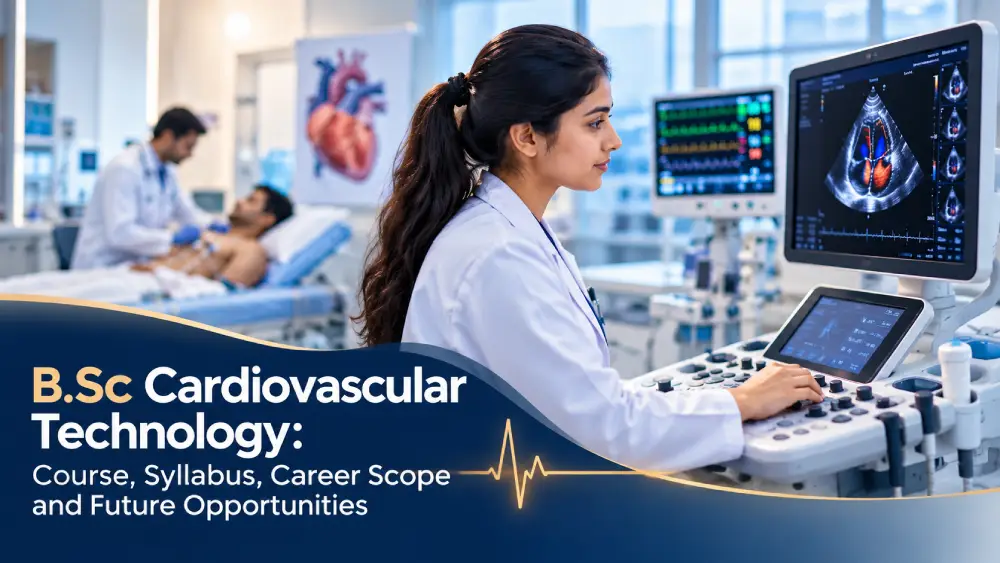
| B.Sc in Cardiovascular Technology (B.Sc CVT) is a four-year allied health degree. Students learn to record ECGs, perform echocardiograms, run treadmill tests and assist in cath lab procedures such as angiography and angioplasty. The syllabus moves from anatomy and physiology in Year 1 to echo and cath lab work by Year 3, followed by hospital training. At MNR University, Hyderabad, tuition is ₹1,50,000 a year with merit scholarships of up to 40%. Future demand looks steady: India ran about 2,200 cath labs in 2024 against an estimated need of 6,500. |
Introduction
For many students, the word ‘cardiology’ brings only one picture to mind: a doctor with a stethoscope. Behind that doctor, though, stands a team of trained technologists who run the heart tests, prepare the cath lab and watch the monitors during surgery. B.Sc cardiovascular technology is the degree that trains these people.
While the course is popular, there is much more to it than most people realise. Parents want to know what is taught in each year. Students want to know what the job looks like five or ten years from now. This guide covers both, using data from a 2026 study on cath labs in India, the US Bureau of Labor Statistics, NHS Employers and university syllabi. It also shows how MNR University in Greater Hyderabad runs its four-year B.Sc CVT programme.
What Is B.Sc Cardiovascular Technology?
It is an undergraduate allied health degree focused on the heart and blood vessels. Graduates are called cardiovascular technologists or cardiac technologists. They do not prescribe treatment. Instead, they run the tests and machines that help cardiologists diagnose and treat patients.
It is quite common to hear the course called by other names, such as B.Sc Cardiac Technology or B.Sc Cardiac Care Technology. The core content is much the same: ECG, echo, stress tests and cath lab work. A sister course, B.Sc Cardiac Perfusion Technology, is different. It trains students to run the heart-lung machine during open-heart surgery.
It is worth noting that this is a recognised profession under Indian law. The NCAHP Act, 2021 lists cardiovascular technologists in its Cardio-vascular, Neuroscience and Pulmonary Technology category. Graduates will register with the National Commission for Allied and Healthcare Professions as its registers come into force.
Table 1: The Course at a Glance (MNR University, 2026–27)
| Detail | Information |
| Degree | B.Sc CVT (Cardiovascular Technology) |
| School | School of Allied and Healthcare Sciences, MNR University |
| Duration | 4 years |
| Eligibility | 10+2 with BiPC or MPC, or Class 10 plus a 2/3-year diploma; minimum age 17 |
| Annual tuition fee | ₹1,50,000 |
| Merit scholarship | 10% to 40% of tuition (₹90,000 a year at the top band) |
| Further study on campus | M.Sc Cardiovascular Technology, 2 years |
| Campus | MNR Nagar, Fasalwadi, Sangareddy district, Greater Hyderabad – 502294 |
Source: MNR University official website (B.Sc CVT, Fee Structure and Scholarships pages)
Who Can Apply?
MNR University accepts students who pass 10+2 with BiPC or MPC, or Class 10 with a relevant diploma, and are at least 17 years old by 31 December of the admission year. A NEET score is not needed at MNR. A few government institutes, such as JIPMER in Puducherry, do admit through NEET-UG. NCAHP is also bringing in NEET appearance for courses whose new curricula it has notified, so students should check the latest rules each year. A full guide to eligibility is in the companion article, cardiovascular technology course after 12th.
B.Sc Cardiovascular Technology Syllabus: Semester by Semester
One question that often comes up is how much of the course is theory and how much is machine work. The answer changes year by year. The first year feels like a medical foundation course. By the third year, most of the time goes on heart tests and labs.
Syllabi differ a little between universities. The table below follows the published Pondicherry University syllabus for B.Sc Cardiac Technology, which is a good example of the common Indian pattern. MNR University’s own syllabus is final for MNR students.
Table 2: Sample Semester-wise Syllabus
| Semester | Main subjects | What students learn |
| Sem 1 | Anatomy, Physiology, Biochemistry, Communication Skills | How the body is built and how it works |
| Sem 2 | Applied Pathology, Applied Microbiology, Computer Applications, First Aid | How disease and infection affect the body |
| Sem 3 | Applied Anatomy and Physiology of the heart, Applied Pharmacology | Heart structure, blood flow and heart medicines |
| Sem 4 | Introduction to Cardiac Technology, Medical Disorders of the Heart | ECG basics and common heart diseases |
| Sem 5 | Cardiac Technology Applied I and II, Medical Ethics | Echo, treadmill tests, Holter monitoring |
| Sem 6 | Advanced Cardiac Technology I and II, Biostatistics and Research Methods | Cath lab procedures, pacemakers, research basics |
| Year 4 | Compulsory internship | Full-time hospital training (see Table 3) |
Source: Pondicherry University, B.Sc Cardiac Technology Syllabus 2022–23 (used as a reference pattern).
In practical terms, every theory class has a lab partner. Students first practise on simulators and lab machines, then move to supervised work in hospitals. At MNR University, three separate labs mirror the hardware and software that graduates will meet at work, so the move from campus to hospital feels less sudden.
What Happens in the Internship Year?
This is where things become interesting. The final year moves students out of the classroom and into hospital departments. They work under supervision on real patients and rotate through each heart unit.
Table 3: Sample Internship Rotation
| Department | Time | Main tasks |
| Cath lab | 3 months | Preparing patients and machines for angiography and angioplasty |
| Echocardiography | 3 months | Taking heart ultrasound images and measurements |
| ECG and treadmill (TMT) | 3 months | Recording ECGs and running stress tests |
| Intensive Coronary Care Unit | 2 months | Monitoring heart patients after attacks or procedures |
| Operation theatre | 1 month | Supporting heart surgery teams |
Source: Pondicherry University, B.Sc Cardiac Technology Syllabus 2022–23.
Skills Students Build Along the Way
- Reading ECG strips and spotting danger signs quickly.
- Handling echo probes and getting clear heart images.
- Keeping cath lab tools sterile and ready.
- Talking calmly to scared patients and their families.
- Writing short, accurate test reports on hospital software.
B.Sc Cardiovascular Technology Career and Future Opportunities
Stepping into the field of heart care sounds good, and the curiosity about future career possibilities hovers in the mind of every aspirant. A closer look at the industry shows a clear gap between need and supply.
Table 4: Heart Care Demand Indicators in India
| Indicator | Figure | Source |
| Operational cath labs in India | about 2,200 | JSCAI, March 2026 |
| Cath labs estimated to be needed | about 6,500 | JSCAI, March 2026 |
| Cath labs per million people | about 1.5 | JSCAI, March 2026 |
| Angioplasty (PCI) procedures, 2023 vs 2024 | 6,55,023 → 7,26,715 (up about 11%) | JSCAI, March 2026 |
| Cardiologists per million people | fewer than 5 | JSCAI, March 2026 |
| Share of deaths in India from heart and blood vessel disease (2016) | 28.1% | The Lancet Global Health |
JSCAI = Journal of the Society for Cardiovascular Angiography & Interventions.
There is little doubt that each new cath lab needs a team of trained technologists. The same study found that nearly 70% of districts in eastern, central and north-eastern India still have no cath lab at all. As hospitals open new units in smaller cities, jobs follow.
A Typical Day for a Cardiovascular Technologist
A working day in a busy Hyderabad hospital often starts in the ECG room, with a queue of outpatients. By mid-morning, the technologist may move to the echo room for scheduled scans. An emergency call from casualty can change everything. A patient with chest pain needs an ECG within minutes, and if a heart attack shows up, the cath lab team gets ready for an angioplasty. Shifts can be long, but the work is never dull, and every test helps a doctor make a faster decision.
Job Roles After the Degree
Table 5: Common Roles and Where They Lead
| Role | Where they work | Next step with experience |
| ECG and TMT technician | Hospitals, diagnostic centres | Holter and stress lab in-charge |
| Echocardiography technician | Hospitals, heart clinics | Senior echo technologist, cardiac sonographer |
| Cath lab technologist | Heart institutes, multi-speciality hospitals | Cath lab manager, electrophysiology lab |
| Clinical application specialist | Medical device companies | Product trainer, regional manager |
| Clinical research coordinator | Hospitals, research organisations | Research manager |
| Tutor or lecturer | Colleges and universities (after M.Sc) | Assistant professor |
Based on standard hospital and industry roles for cardiovascular technologists in India.
Where the Future Jobs Are
- Electrophysiology labs, which treat irregular heartbeats and fit pacemakers.
- Structural heart procedures, such as valve replacement through a catheter.
- AI-assisted ECG and echo reading, where technologists check and confirm machine results.
- Remote heart monitoring, using wearable ECG patches and home Holter devices.
- Overseas posts, such as cardiac physiologist roles in the UK.
Pay in India and Abroad
Table 6: Pay for Cardiovascular Technologists (in INR)
| Role and country | Pay | In INR (approx.) | Source |
| Cardiac technician, India (average, 2026) | ₹4,09,634 | ₹4.1 lakh | PayScale India |
| Cardiac technologist, India (average) | ₹3,19,866 | ₹3.2 lakh | Glassdoor India |
| Cardiovascular technologist, USA (median, May 2024) | $67,260 | ₹64.8 lakh | US BLS |
| NHS Band 5, UK (2026/27) | £32,073 – £39,043 | ₹40.9 – 49.8 lakh | NHS Employers |
| Cardiac Physiologist Band 5, London NHS trust (incl. London allowance) | £34,089 – £41,498 | ₹43.5 – 52.9 lakh | NHS Jobs advert |
Converted at ₹96.3 per US dollar and ₹127.56 per pound (3–4 October 2026, MTFX). Work abroad needs local registration and has far higher living costs.
For the most part, pay in India starts modestly and climbs with echo and cath lab skills. An M.Sc, which MNR University offers on the same campus, opens teaching and senior posts.
B.Sc Cardiovascular Technology Colleges in India Compared
From a student’s perspective, the right college balances cost, seats and hospital training. Government seats are cheap but very few. Private universities offer more seats, scholarships and campus life.
Table 7: B.Sc CVT at Selected Institutions
| Institution | Location | Duration | Fee (full course, approx.) | Admission | Source |
| MNR University | Greater Hyderabad | 4 years | ₹6,00,000 tuition (₹3,60,000 after 40% scholarship) | Merit or entrance scores | MNR University |
| JIPMER | Puducherry | 3 + 1 years | about ₹23,040 (5 seats) | NEET-UG | Collegedunia |
| NIMS | Hyderabad | 3 + 1 years | about ₹1.31 lakh (12 seats) | TG EAPCET | Collegedunia |
| Malla Reddy University | Hyderabad | 4 years | ₹6,00,000 tuition | Merit-based | Shiksha |
| Amrita Vishwa Vidyapeetham | Kochi | 3 years (as listed) | ₹6.66 lakh | Entrance (AEEL) | Collegedunia |
| MCHP, MAHE | Manipal | 4 years | ₹7.29 lakh tuition | Entrance or merit | Shiksha |
Fees change every year. Confirm with each institution before applying.
Where B.Sc Cardiovascular Technology Courses Fit in Hyderabad
There is a general notion that South India is ahead in healthcare, with large hospital chains offering a plethora of jobs. Fathoming this, private universities have expanded their infrastructure to attract students from different regions. Hyderabad, with its big heart hospitals, is a natural base. MNR University keeps appearing in student searches for practical reasons:
- A 50+ year legacy in education through the MNR Educational Trust.
- Telangana’s first DASCA-USA accredited university (see accreditation and rankings).
- Academic collaborations with US universities including Emporia State, Wayland and Cumberland.
- A Gold Sustainable Campus award.
- Merit scholarships of up to 40% for allied health courses.
- Fully fitted technical laboratories, including three separate labs that mirror the hardware and software graduates use at work.
- Internships and a placement cell that prepares students for hospital interviews.
- A clear ladder on one campus: B.Sc CVT, then M.Sc CVT, with B.Sc Cardiac and Perfusion Technology as a sister course.
Fee details sit on the MNR University fee structure page, and all allied health courses are listed under the School of Allied and Healthcare Sciences.
Is This Degree the Right Fit?
Ask any experienced professional in the field, and they will tell you that the best technologists are curious and calm. The degree suits students who like Biology, enjoy working with machines, and can stay steady when a patient’s heart rate drops. It may not suit those who dislike night shifts or hospital settings.
- Good fit: students who enjoy Biology and like knowing how the body works.
- Good fit: those who are comfortable with screens, wires and medical machines.
- Good fit: students who want a hospital career in four years, not five and a half.
- Think twice: those who feel uneasy around patients, needles or night duty.
Conclusion
B.Sc cardiovascular technology offers a clear four-year path from Class 12 to the cath lab. The syllabus builds step by step, the internship year gives real hospital practice, and the numbers point to steady demand as India adds cath labs. For students in Telangana and beyond, MNR University’s programme, with merit scholarships, US academic links and an M.Sc pathway, is a sensible place to begin. The next step is easy: read the programme page, compare fees, and visit the campus.
Frequently Asked Questions
B.Sc CVT, or B.Sc in Cardiovascular Technology, is a four-year allied health degree that trains students to run ECG, echocardiography, treadmill tests and cath lab procedures under a cardiologist's guidance.
The first year usually covers anatomy, physiology, biochemistry, pathology, microbiology, computer applications, first aid and communication skills.
ECG basics start in the second year. Echo, treadmill tests, Holter monitoring and cath lab work take up most of the third year, followed by a full year of hospital training.
No. MNR University admits students on merit or valid entrance scores. Some government institutes, such as JIPMER, use NEET-UG, and NCAHP rules are changing, so students should check each year.
The annual tuition fee for 2026–27 is ₹1,50,000. Merit scholarships of 10% to 40% apply, bringing tuition down to ₹90,000 a year at the top band.
A cath lab technologist prepares patients and machines for angiography, angioplasty and pacemaker procedures, and monitors heart signals during the procedure.
PayScale puts the average pay of a cardiac technician in India at about ₹4.1 lakh a year in 2026. Pay rises with echo and cath lab experience.
Yes, after meeting UK registration and English language rules. NHS cardiac physiologist posts usually start at Band 5, which pays £32,073 to £39,043 (about ₹40.9 to 49.8 lakh) in 2026/27.
Growing areas include electrophysiology labs, structural heart procedures, AI-assisted ECG and echo reading, remote heart monitoring and medical device companies.
Well-known options include JIPMER, NIMS, Manipal (MCHP), Amrita and private universities in Hyderabad such as MNR University and Malla Reddy University. Students compare fees, seats, hospital training and scholarships.
Graduates can take an M.Sc in Cardiovascular Technology, which MNR University offers as a two-year programme, or move into research, hospital administration or teaching.
Yes. CVT focuses on heart tests and cath lab support. Perfusion technology trains students to run the heart-lung machine during open-heart surgery. MNR University offers both.
Related Blogs
Optometrist Course Details After 12th: Eligibility, Duration, Fees, Salary and Career Scope in 2026
Stepping into the field of eye care after school can feel like a big step….
Why Skilled Medical Lab Technicians Are Rare Despite High Demand
A doctor looks at a patient, but a laboratory professional looks at the truth hidden…
From Surgery Lights to Wearable Pain Trackers: B.Sc. Anesthesia in Hyderabad
Ever walked into a hospital operating room and felt that hum of machines keeping everything…

10 Game-Changing Advantages of Internet of Things Every Engineering Student Must Know
Every smart watch that counts steps, every home speaker that answers a question, and every…

Emerging Technology Careers and Engineering Pathways in 2026
Technology shapes every modern industry across the globe today. Students entering higher education look for…

Top B.Optometry Colleges in Telangana 2026: Rankings, Fees and Admission Guide
Telangana has a growing number of colleges offering a Bachelor in Optometry. One of the…