
Exploring B.Sc in Radiology and Imaging Technology Courses, Eligibility & Career Paths
Home / School of Allied Sciences / Exploring B.Sc in Radiology and Imaging Technology Courses, Eligibility & Career Paths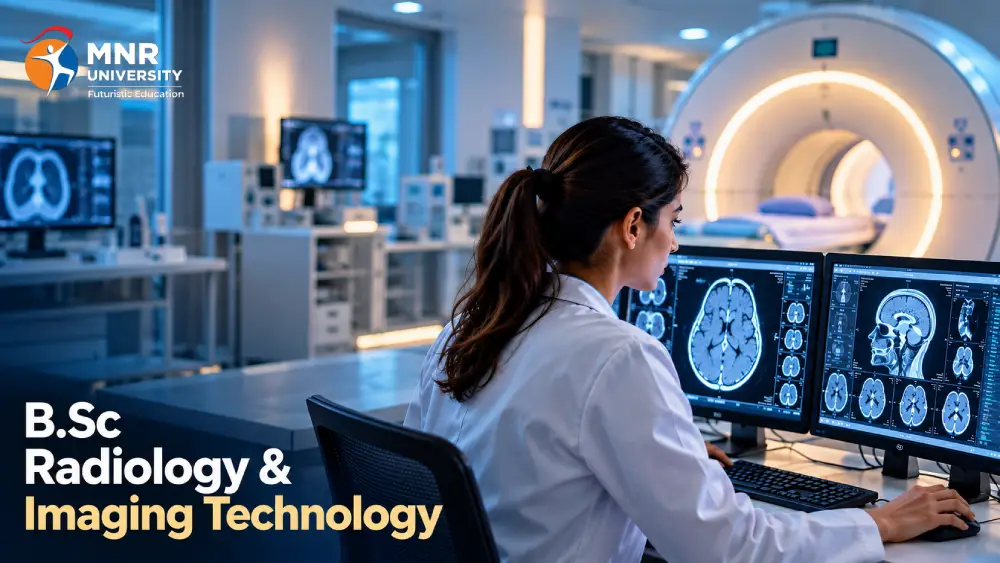
| Yes, for now. A student can join a B.Sc in radiology and imaging technology after Class 12 without a NEET score at many universities in 2026–27, including MNR University, Hyderabad, where admission runs on Class 12 marks or entrance scores. The course trains students to run X-ray, CT, MRI and ultrasound machines. It is not the same as becoming a radiologist, which needs NEET, MBBS and MD. National rules are changing, though. The National Commission for Allied and Healthcare Professions (NCAHP) has said most of its notified courses will ask students to appear for NEET, so sitting the exam is the safer plan. |
Introduction
At some point, most science students wonder whether a hospital career is possible without clearing NEET. Every year, lakhs of students sit the exam, and only a small share get an MBBS seat. It is quite common to hear parents say, “If not MBBS, then what?” One answer that keeps coming up is radiology, and in particular the B.Sc in radiology and imaging technology.
Stepping into the field of medical imaging sounds good, and the curiosity about future career possibilities hovers in the mind of every aspirant. Is NEET needed? Which course is right? What does the job pay? This guide answers each question in simple words. It uses data from NCAHP notices, the US Bureau of Labor Statistics, NHS Employers and Indian salary surveys. It also explains how MNR University in Greater Hyderabad runs its four-year Bachelor in Medical Radiology and Imaging Technology (B.MRIT).
Can You Really Study Radiology Without NEET?
The short answer depends on which ‘radiology’ a student means. A radiologist is a doctor who reads scans and writes the final report. That path needs NEET, then MBBS, then an MD in Radiodiagnosis. A radiographer or imaging technologist takes the scans. That path runs through an allied health degree, and most universities still do not ask for NEET.
What Do the NCAHP Rules Say Right Now?
The situation has changed considerably over the last few years. In April 2025, the Union Health Ministry and NCAHP released new competency-based curricula for 10 professions, and Medical Radiology and Imaging Technology was one of them. In a communication dated 19 November 2025, NCAHP said that most notified curricula list appearing in NEET as one eligibility condition from 2026–27. In February 2026, it pushed the NEET step for physiotherapy and occupational therapy to 2027–28.
The reality on the ground is somewhat different. For the 2026–27 session, many universities still admit students on Class 12 marks or their own tests. The table below shows how different routes work today.
Table 1: How Admissions to Radiology Technology Work in 2026–27
| Route | Is NEET asked for? | How seats are filled | Source |
| NCAHP national rule (notified curricula) | Appearing in NEET listed as a condition from 2026–27 | NEET appearance plus Class 12 criteria | Medical Dialogues (NCAHP notice, 19 Nov 2025) |
| BPT and BOT (for comparison) | Deferred to 2027–28 | Class 12 PCB marks for 2026–27 | Sartha (NCAHP notice, 5 Feb 2026) |
| NIMS Hyderabad (government) | No | Telangana EAMCET merit; only 10 seats | Careers360 |
| SRIHER, Chennai (deemed university) | No | University entrance test; PCB required | SRIHER Prospectus 2026–27 |
| MNR University, Hyderabad | No (NEET score can raise the scholarship) | Merit or entrance test scores | MNR University |
Rules are being updated. Students should check the NCAHP website and the chosen university before applying.
Radiologist vs Radiographer: Two Different Paths
Many parents and students still believe that radiology means only the doctor’s route. Not everyone is aware that several allied health degrees lead to imaging careers.
Table 2: Radiology-Related Courses After 12th Compared
| Course | Duration | NEET needed? | Main work | Source |
| MBBS + MD Radiodiagnosis (radiologist) | About 5.5 + 3 years | Yes, NEET-UG and NEET-PG | Reads scans, writes reports, guides treatment | National Medical Commission norms |
| B.MRIT / B.Sc Radiology and Imaging Technology | 4 years (incl. internship) | Not at most universities in 2026–27 | Runs X-ray, CT, MRI and ultrasound machines | MNR University; NCAHP curriculum |
| B.Sc Radiation Therapy Technology | 4 years | University rules apply | Delivers radiation treatment to cancer patients | MAHE fee schedule 2026–27 |
| B.Sc Nuclear Medicine Technology | 4 years | University rules apply | Handles PET and gamma camera scans | SRIHER Prospectus 2026–27 |
What Is a B.Sc in Radiology and Imaging Technology?
This allied health degree trains students to take clear, safe medical images of the human body. Graduates are called radiographers, imaging technologists or radiology technologists. They work with radiologists in hospitals and scan centres.
In simple terms, the radiologist reads the picture, and the technologist takes it. A blurred scan or a poorly placed patient can lead to a wrong report, so the technologist’s job carries real weight. The work also involves radiation safety. In India, the Atomic Energy Regulatory Board (AERB) sets the safety rules for X-ray and CT rooms.
Table 3: Imaging Machines a Radiology Technologist Learns to Use
| Machine | What it shows | Uses radiation? | Where it is used |
| X-ray | Bones, chest, joints | Yes (low dose) | Every hospital and clinic |
| CT scan | Cross-section pictures of the body | Yes | Emergency, stroke and cancer care |
| MRI | Brain, spine, muscles, soft tissue | No (magnets and radio waves) | Large hospitals and scan centres |
| Ultrasound | Pregnancy, abdomen, blood flow | No (sound waves) | Clinics, maternity units |
Source: MNR University B.Sc RIT programme page (modalities in training) and standard radiology practice.
B.Sc in Radiology and Imaging Technology Eligibility After 12th
One question that often comes up is whether a student needs top marks. The bar is reachable for most science students. MNR University publishes these criteria:
- A pass in 10+2 with BiPC or MPC from a recognised board.
- Or Class 10 plus a 2- or 3-year diploma in a relevant technology.
- Admission on merit or on valid state, national or international entrance scores.
- A minimum age of 17 years as on 31 December of the admission year.
Since national rules are being updated, students should confirm the latest criteria with the admissions office. Keeping Biology in Class 12 and sitting NEET keeps every door open. The full steps are on the admission process and guidelines page.
Fees and Scholarships for the B.Sc in Radiology and Imaging Technology at MNR
Table 4: MNR University B.MRIT at a Glance (2026–27)
| Detail | Information |
| Programme | Bachelor in Medical Radiology and Imaging Technology (B.MRIT) |
| School | School of Allied and Healthcare Sciences |
| Duration | 4 years |
| Annual tuition fee | ₹1,50,000 |
| Application / admission confirmation fee | ₹1,500 / ₹15,000 |
| Merit scholarship | 10% to 40% of tuition |
| Tuition after a 40% scholarship | ₹90,000 a year |
| Scores for the top scholarship | 85% or above in Intermediate, CGPA 8.0+, NEET 70+ percentile, CUET 75+ percentile or state CET rank up to 2,000 |
| Training areas | X-ray, CT, MRI, ultrasound, radiation safety, image reporting |
| Further study on campus | Master of Medical Radiology and Imaging Technology (MMRIT), 2 years |
| Campus | MNR Nagar, Fasalwadi, Sangareddy district, Greater Hyderabad – 502294 |
Source: MNR University official website (B.Sc RIT, Fee Structure and Scholarships pages)
The full breakdown sits on the MNR University fee structure page, and the score bands are on the merit scholarships page.
Subjects and Skills in Radiology and Imaging Technology
The syllabus moves from basic body science to real scanners. The exact list differs between universities, so students should read the official MNR syllabus at admission. In practical terms, most four-year programmes follow a pattern like this:
Table 5: Typical Year-wise Subjects
| Year | Focus | Typical subjects |
| Year 1 | Body basics | Anatomy, physiology, biochemistry, basic physics of radiation, English and communication |
| Year 2 | Imaging basics | Radiographic positioning, X-ray machines, darkroom and digital imaging, radiation protection |
| Year 3 | Advanced scans | CT, MRI, ultrasound, contrast studies, mammography, image quality and reporting software |
| Year 4 | Clinical practice | Supervised internship in hospital radiology departments, patient care, ethics, a project |
Based on common B.MRIT syllabi in India; the MNR University syllabus is final.
Skills That Matter in the Scan Room
Ask any experienced professional in the field, and they will tell you that a good scan starts with a calm patient. Machines matter, but people matter just as much.
- Correct patient positioning, so the first image is the right one.
- Sound knowledge of radiation safety for patients, staff and self.
- Computer skills for digital imaging and PACS software.
- Clear, kind words for patients who feel nervous inside a scanner.
- Attention to detail and steady work during emergency shifts.
Radiology and Imaging Technology Career Scope
A closer look at the industry shows a clear gap. India has roughly one radiologist for every 1,00,000 people, according to experts quoted by Medical Buyer. Scans keep rising while specialists stay few, so hospitals lean on skilled technologists to keep imaging departments running. This is where things become interesting for the radiology and imaging technology career scope.
- X-ray technologist or radiographer
- CT technologist
- MRI technologist
- Ultrasound and mammography assistant
- Radiation safety officer, after extra AERB training
- PACS administrator or application specialist with imaging companies
- Tutor or lecturer, after an MMRIT or M.Sc
Salary in India
Table 6: Radiology Technologist Pay in India
| Measure | Pay (INR) | Source |
| Radiology technician, average base pay (2026) | about ₹3.03 lakh a year | PayScale India |
| Radiology technician, pay range | ₹1.55 lakh to ₹10 lakh a year | PayScale India |
| Radiologic technologist, average (Feb 2026) | about ₹1.79 lakh a year | Indeed India |
| Top-paying employer listed: Apollo Hospitals | about ₹3.6 lakh a year | Indeed India |
| Top-paying city listed: Kochi | about ₹5.96 lakh a year | Indeed India |
Pay rises with CT and MRI skills, experience and city. Freshers usually start at the lower end.
Salary Abroad (Converted to INR)
Table 7: Imaging Technologist Pay Abroad
| Role and country | Pay | In INR (approx.) | Source |
| Radiologic technologist, USA (median, May 2025) | $80,110 | ₹77.1 lakh | Tesla MR Institute, citing US BLS |
| MRI technologist, USA (median, May 2025) | $95,480 | ₹91.9 lakh | Tesla MR Institute, citing US BLS |
| Diagnostic radiographer, UK NHS Band 5 (2026/27) | £32,073 – £39,043 | ₹40.9 – 49.8 lakh | NHS Employers |
| Radiographer, UK NHS Band 6 (2026/27) | £39,959 – £48,117 | ₹51.0 – 61.4 lakh | NHS Employers |
Converted at ₹96.3 per US dollar and ₹127.56 per pound (rates on 3–4 October 2026, MTFX). Working abroad needs local registration, such as HCPC in the UK or ARRT in the USA, and living costs are far higher.
Radiology and Imaging Technology Colleges in India and Hyderabad
Students comparing radiology and imaging technology colleges in India often look at big names in Karnataka and Tamil Nadu first. For families in Telangana and Andhra Pradesh, radiology and imaging technology courses in Hyderabad save on travel and living costs, and the city’s large hospital network helps with internships. The table below sets several radiology and imaging technology colleges in Hyderabad beside well-known options elsewhere.
Table 8: B.Sc Radiology / Imaging Technology Fees at Selected Institutions
| Institution | Location | Duration | Total fee (approx.) | Admission route | Source |
| MNR University | Sangareddy, Greater Hyderabad | 4 years | ₹6,00,000 tuition (₹3,60,000 after 40% scholarship) | Merit or entrance scores | MNR University |
| NIMS | Panjagutta, Hyderabad | 4 years (incl. internship) | about ₹1.31 lakh (10 seats) | Telangana EAMCET; PCB | Careers360 |
| Malla Reddy Vishwavidyapeeth | Hyderabad | 4 years | ₹6,40,000 | 10+2 pass | GetMyUni |
| Apollo University | Chittoor, Andhra Pradesh | 4 years | ₹5,39,000 | University process | Apollo University |
| SRIHER | Chennai | 4 years | ₹8,00,000 (₹2 lakh a year; 20 seats) | Own entrance; PCB | SRIHER Prospectus |
| MCHP, MAHE | Manipal, Karnataka | 4 years | ₹7,21,000 | University process | MAHE fee schedule |
Fees change every year. Figures are from the sources listed at the end of this article and should be confirmed with each institution.
Looking at the broader picture, NIMS is the cheapest but has only 10 seats. Most students end up choosing between private universities, so scholarships, hospital tie-ups and campus facilities decide the final pick.
Why Students Are Searching for MNR University
There is a general notion that South India is ahead in healthcare, with large hospital chains and imaging companies offering a plethora of jobs. Fathoming this, private universities have expanded their infrastructure to attract students from different regions. MNR University keeps appearing in these searches for practical reasons:
- A 50+ year legacy in education through the MNR Educational Trust.
- Telangana’s first DASCA-USA accredited university (see accreditation and rankings).
- Academic collaborations with US universities such as Emporia State, Wayland, Faulkner, Campbellsville, St. Francis and Cumberland.
- A Gold Sustainable Campus award.
- Merit scholarships of up to 40% for allied health programmes, with NEET, CUET and CET scores all counted.
- Fully fitted technical laboratories, including three separate labs that mirror the hardware and software graduates use at work.
- Clinical internships and a placement cell that prepares students for hospital interviews.
- A study ladder on one campus: B.MRIT, then MMRIT, with B.Sc Cardiovascular Technology as a related option.
All allied health programmes sit under the School of Allied and Healthcare Sciences, and outstation students can check the hostel facilities before applying.
Is a B.Sc in Radiology and Imaging Technology the Right Choice?
There is little doubt that this path suits a certain kind of student. It works well for those who:
- enjoy Biology and Physics and like seeing how the body works,
- are comfortable with computers and machines,
- want a hospital career without waiting for an MBBS seat,
- hope to work abroad one day, where radiographers are in short supply,
- may later want to move into teaching or imaging company roles.
It may not suit someone who dislikes shift work or long hours on their feet. It would not be wrong to say that the job asks for patience as much as skill.
Conclusion
So, can a student study radiology after 12th without NEET? For the 2026–27 session, the answer is mostly yes. A B.Sc in radiology and imaging technology opens the door to X-ray, CT and MRI careers on Class 12 marks at many universities. National rules are moving towards NEET, so sitting the exam is a wise backup.
For students in Telangana and beyond, MNR University’s four-year B.MRIT, with merit scholarships, US academic links and an MMRIT pathway, is a sensible place to start. The next step is easy: read the programme page, compare fees, and visit the campus before seats fill up.
Frequently Asked Questions
Yes, for the 2026–27 session at many universities, including MNR University. A B.Sc or B.MRIT in radiology and imaging technology usually admits students on Class 12 marks or a university entrance test. NCAHP rules are moving towards NEET appearance, so sitting the exam is the safer plan.
NCAHP said in November 2025 that most notified allied health curricula list appearing in NEET as an eligibility condition from 2026–27. Many universities still admit on Class 12 marks this year, so students should check each university's current rules.
A radiologist is a doctor with MBBS and an MD who reads scans and writes reports. A radiographer, or imaging technologist, holds an allied health degree and runs the X-ray, CT, MRI and ultrasound machines.
The Bachelor in Medical Radiology and Imaging Technology at MNR University runs for four years at the School of Allied and Healthcare Sciences, Greater Hyderabad.
The annual tuition fee for 2026–27 is ₹1,50,000. Merit scholarships of 10% to 40% apply, so a student with 85% or above in Intermediate pays ₹90,000 a year in tuition.
MNR University's published eligibility accepts both BiPC and MPC. Several other colleges and the new NCAHP curriculum expect Biology, so students should confirm the latest rule with the admissions office.
Typical subjects include anatomy, physiology, radiation physics, radiographic positioning, CT, MRI, ultrasound, contrast studies, radiation protection and a hospital internship.
PayScale puts the average base pay of a radiology technician in India at about ₹3.03 lakh a year in 2026, with a range of ₹1.55 lakh to ₹10 lakh. CT and MRI specialists earn more with experience.
In the UK, NHS Band 5 radiographers earn £32,073 to £39,043 (about ₹40.9 to 49.8 lakh) in 2026/27. In the USA, the median for radiologic technologists was $80,110 (about ₹77.1 lakh) in May 2025. Both countries need local registration.
Popular options include NIMS (government, very few seats), MNR University and Malla Reddy Vishwavidyapeeth. Students usually compare fees, hospital training, scholarships and the chance to study further on the same campus.
Yes, when safety rules are followed. Technologists wear dosimeter badges, use lead shields and follow AERB rules. MRI and ultrasound do not use ionising radiation at all.
Graduates can take a Master of Medical Radiology and Imaging Technology (MMRIT), which MNR University offers as a two-year programme, or move into CT or MRI specialisation, research or teaching.
Related Blogs

Career Opportunities After BSc in Neuroscience: Jobs, Salary, and Higher Studies
Stepping into the field of brain science raises one big question for most students. What…

Which Are the Best AIML Colleges in Hyderabad for a Strong Career in 2026?
Stepping into the field of Artificial Intelligence and Machine Learning sounds exciting, and the curiosity…
Radiology Career in India: Scope, Salary & Opportunities
Hospitals today feel very different from what they were even ten years ago. A…
Top 10 Careers in Allied and Healthcare Sciences That Will Shape the Future of Healthcare
The world of healthcare is much bigger than doctors and nurses. Behind every diagnosis, surgery,…
Cardiovascular Technology Course After 12th: Eligibility, Subjects, Skills and Career Scope
A cardiovascular technology course is a B.Sc degree that trains students to run heart tests…
Geriatric Innovations: Physiotherapy Tackling Aging Challenges
India faces a massive demographic shift as life expectancy rises steadily. This transition creates an…