
Career Opportunities After BSc in Neuroscience: Jobs, Salary, and Higher Studies
Home / MNR University / Career Opportunities After BSc in Neuroscience: Jobs, Salary, and Higher Studies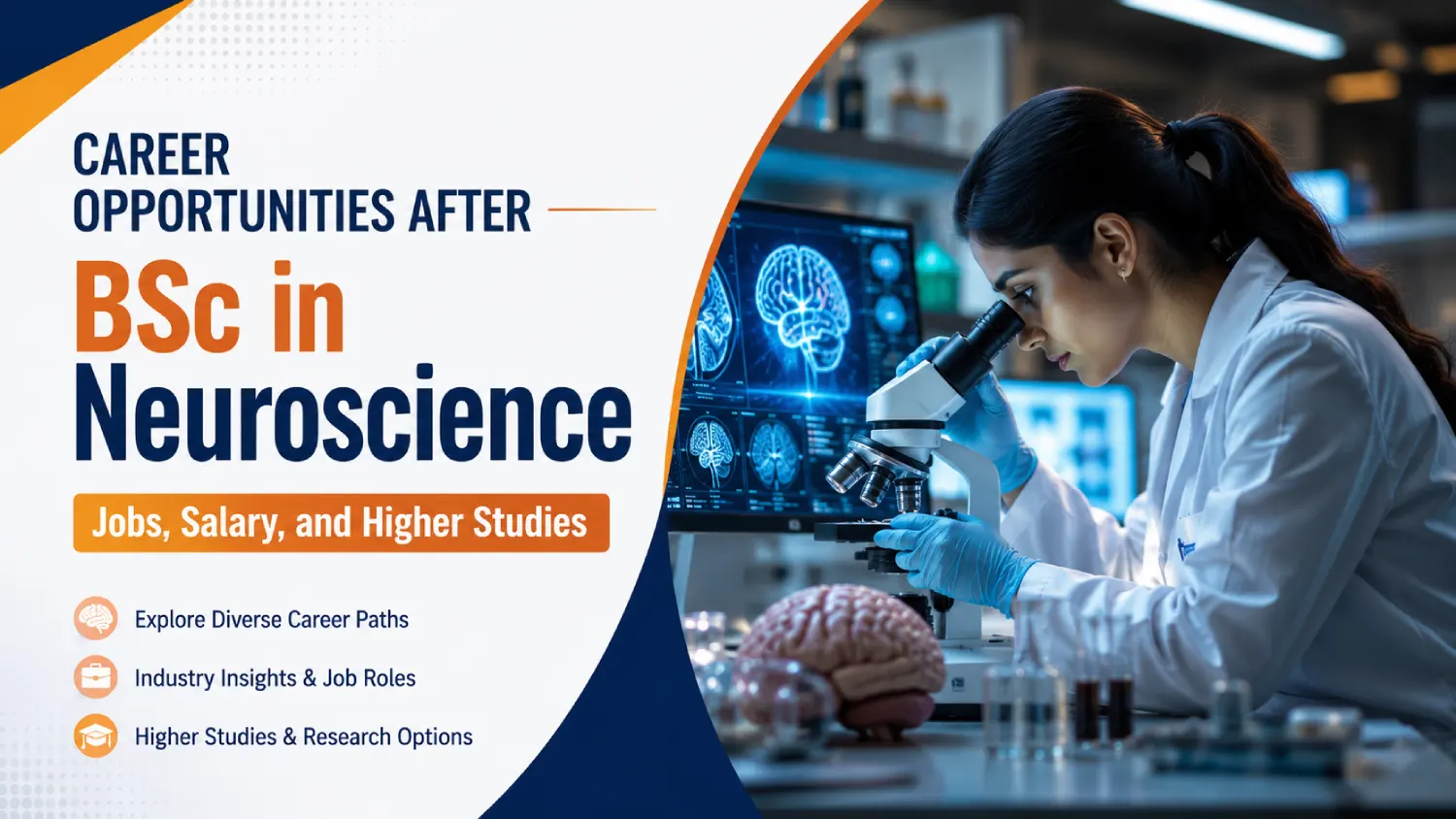
Stepping into the field of brain science raises one big question for most students. What happens after the degree? A BSc in neuroscience sounds interesting, and the curiosity about future jobs and career paths stays on the mind of many aspirants. This guide answers that in plain terms. It covers the jobs, the salary figures, and the higher study options that follow a BSc in neuroscience, with data and sources at each step.
There is a general notion that South India is quite ahead of other regions in science and technology, with a large number of research centres, hospitals, and technology firms based in cities like Hyderabad. A closer look at the industry shows that neuroscience now sits at the meeting point of medicine, psychology, artificial intelligence, and engineering. For many students, that mix opens more doors than a single subject ever could.
What does a BSc in neuroscience involve?
A BSc in neuroscience is the scientific study of the brain and the nervous system. Students learn how neurons talk to each other, how memory works, and why brain disorders such as Alzheimer’s and Parkinson’s occur. The course blends biology, chemistry, psychology, and a little computer science. It suits students who enjoy biology and want a science career without taking the MBBS route.
What jobs can students get right after a BSc in neuroscience?
A bachelor’s degree opens the door to several starter roles in laboratories, hospitals, and pharmaceutical firms. Most graduates begin in support or research roles and grow from there. Studies suggest that around 65% of neuroscience graduates find their first role within six months, mostly in research or clinical settings. These early jobs build practical skills and set up the next step. This is where a career after neuroscience degree really begins to take shape.
| Entry-level Role | What the Role Involves | Typical Workplace |
|---|---|---|
| Research Assistant | Runs experiments, collects and records data, helps write reports. | University and research labs |
| Laboratory Technician | Prepares samples, manages supplies, follows safety rules. | Hospitals and research labs |
| Clinical Research Associate | Helps run and monitor clinical trials and patient studies. | Pharma and clinical research firms |
| Data Analyst | Studies research data and prepares clear reports. | Research bodies and health-tech firms |
| Medical Sales Representative | Explains brain-related products to doctors and clinics. | Pharma and medical device firms |
| Science Writer | Writes clear articles on brain science and health. | Publishers, media, and health firms |
Some of these roles sit within clinical neuroscience careers, where graduates support patient studies and brain-related treatment research.
How much do BSc neuroscience jobs pay in India?
Salaries depend on the role, the city, and the level of study. Research and psychology roles usually start lower, while jobs that mix neuroscience with data or technology pay a good deal more. The table below shows typical pay for BSc neuroscience jobs and related careers in India.
| Role or Stage | Typical Annual Pay (India) | Source Basis |
|---|---|---|
| Fresh graduate roles (research/lab assistant) | Starts lower, rises with study | Common entry bands |
| Research and psychology roles | ₹6 – ₹15 lakh | MetierHunt |
| Neuroscientist (entry, 1–3 years) | ₹13 lakh (approx.) | ERI SalaryExpert |
| Neuroscientist (average, all levels) | ₹18 lakh (approx.) | ERI SalaryExpert |
| Neuroscientist (senior, 8+ years) | ₹21 – ₹22 lakh | ERI SalaryExpert |
| Neuro-AI, UX and neurotech roles | ₹20 – ₹40 lakh | MetierHunt |
It is worth noting that pay rises sharply with a master’s degree or a PhD. Salary survey data also shows that the earning figure for a neuroscientist in India can grow by roughly 30% over five years.
Which industries hire neuroscience graduates?
Neuroscience graduates are not limited to one sector. Their knowledge of the brain and behaviour is useful across healthcare, research, technology, and business. Many healthcare research careers start inside these industries.
| Industry | Example Roles and Employers |
|---|---|
| Healthcare and Mental Health | Clinical research associate, EEG technologist, hospital research roles |
| Pharmaceutical and Drug Research | Drug trial support, neuropharmacology research, medical sales |
| Artificial Intelligence and Technology | Neuro-AI support, UX and behaviour research, data roles |
| Research Institutes and Government | ICMR, DBT, DRDO, CSIR, and ISRO project and lab roles |
| Biotechnology | Laboratory research and biotech R&D support roles |
| Education and Counselling | Teaching support, science communication, career counselling |
What are the higher study options after a BSc in neuroscience?
For many students, a master’s degree is the natural next step. It leads to better roles, higher pay, and specialist work. A BSc in neuroscience connects to several postgraduate paths, both in India and abroad.
| Course | Focus | Best Suited For |
|---|---|---|
| MSc Neuroscience / Neurobiology | Advanced brain and nervous system study | Research and academic careers |
| MSc Cognitive Science | Mind, behaviour, and thinking | AI, UX, and research roles |
| MSc / MTech Biomedical Engineering | Medical devices and technology | Engineering and neurotech roles |
| MSc Psychology / Clinical Psychology | Behaviour and mental health | Counselling and clinical work |
| MBA (Healthcare or Pharma) | Management and business | Leadership roles in health firms |
| PhD in Neuroscience | Independent research | University teaching and senior research |
From a student’s perspective, a PhD is the route to research leadership, university teaching, and senior roles in biotech firms.
How do neuroscience careers in India compare with those abroad?
There is little doubt that neuroscience pays more abroad, mainly because foreign labs receive larger research grants. India, on the other hand, is catching up fast, with new roles in neuro-AI and neurotechnology. The table below sets the two side by side.
| Factor | India | Abroad |
|---|---|---|
| Research Pay | Lower, but rising | 4 to 6 times higher on average |
| Research Funding | Growing steadily | Large grants and full PhD funding |
| Fast-growing Roles | Neuro-AI and neurotech | AI, neurotech, and clinical research |
| Typical Research Salary | ₹6 – ₹15 lakh | USD 70,000 – 120,000 |
| Top-paying Technology Roles | ₹20 – ₹40 lakh | USD 120,000 – 200,000 |
What does the job market look like for neuroscience graduates?
Global data points to steady growth in brain and health research. In the United States, jobs for medical scientists, a group that includes many neuroscientists, are set to grow much faster than the average job. Roles that mix neuroscience with data science are growing even faster.
| Measure (US Data) | Figure | What It Means |
|---|---|---|
| Medical Scientist Job Growth, 2024–2034 | +9% | Much faster than the 3% average for all jobs |
| Yearly Openings, Medical Scientists | About 9,600 | Steady demand each year |
| Data Scientist Job Growth, 2024–2034 | +33.5% | Strong pull for neuro-AI skills |
| Median Pay, Science Occupations, 2024 | USD 78,980 | Higher than the all-job average |
Why consider MNR University for a BSc in neuroscience?
MNR University in Hyderabad brings a long record in higher education to the table. A BSc in neuroscience here comes with support that helps students move from classroom to career. A few points stand out.
- Telangana’s first DASCA-USA accredited university.
- More than fifty years of experience in education.
- Academic tie-ups with leading universities in the United States, useful for students who plan to study abroad.
- Scholarships, internships, and placement help.
- Well-equipped laboratories for practical work.
- A Gold-rated sustainable campus.
Final thoughts
A BSc in neuroscience opens a wide range of careers, from lab research and clinical work to roles in AI and healthcare. The field is growing, the pay improves with study, and the work stays useful for years. For students who are curious about the brain and enjoy science, a BSc in neuroscience is a strong choice with plenty of room to grow.
Frequently Asked Questions
Yes. Neuroscience is a growing field in India, with roles in research, healthcare, pharma, and AI. Pay improves with a master’s degree or a PhD, and demand for brain and health research keeps rising.
Fresh graduate roles usually start lower and grow with study. Research and psychology roles in India often range from ₹6 to ₹15 lakh a year, while a neuroscientist earns about ₹13 lakh at entry level, based on salary survey data.
You can get starter roles such as research assistant, lab technician, or clinical research associate right after the degree. Most senior and specialist roles need a master’s or a PhD.
Popular options include an MSc in Neuroscience or Cognitive Science, an MTech in Biomedical Engineering, an MSc in Psychology, an MBA in healthcare, or a PhD for research careers.
Healthcare, pharmaceuticals, research institutes, biotechnology, AI and technology firms, and education all hire neuroscience graduates. Government bodies such as ICMR and DRDO also recruit science graduates.
Yes, on average. Foreign labs receive larger research grants, so pay is often four to six times higher. India is catching up, with better pay in neuro-AI and neurotech roles.
Related Blogs

Geriatric Innovations: Physiotherapy Tackling Aging Challenges
India faces a massive demographic shift as life expectancy rises steadily. This transition creates an…

B. Optometry (Bachelor in Optometry) Course Details: Duration, Syllabus and Career Scope
Bachelor in Optometry is a four-year undergraduate healthcare degree that trains students to examine eyes,…

Why Hyderabad Is the Best City for Higher Education in India
There’s something about Hyderabad that doesn’t immediately announce itself. Hyderabad is a city that many…
What Makes Neurology Cases So Hard to Diagnose?
The human brain remains the most sophisticated and enigmatic structure in the known universe….
The Untold Code: Habits That Turn Average Students into CSE Toppers
The global technology landscape is shifting at a speed that requires a fresh perspective on…
Optometry Courses After 12th: Eligibility, Duration, Fees and Career Path (2026 Guide)
Many students don’t consider eye care as their first career option when they think about…