
Optometrist Course Details After 12th: Eligibility, Duration, Fees, Salary and Career Scope in 2026
Home / MNR University / Optometrist Course Details After 12th: Eligibility, Duration, Fees, Salary and Career Scope in 2026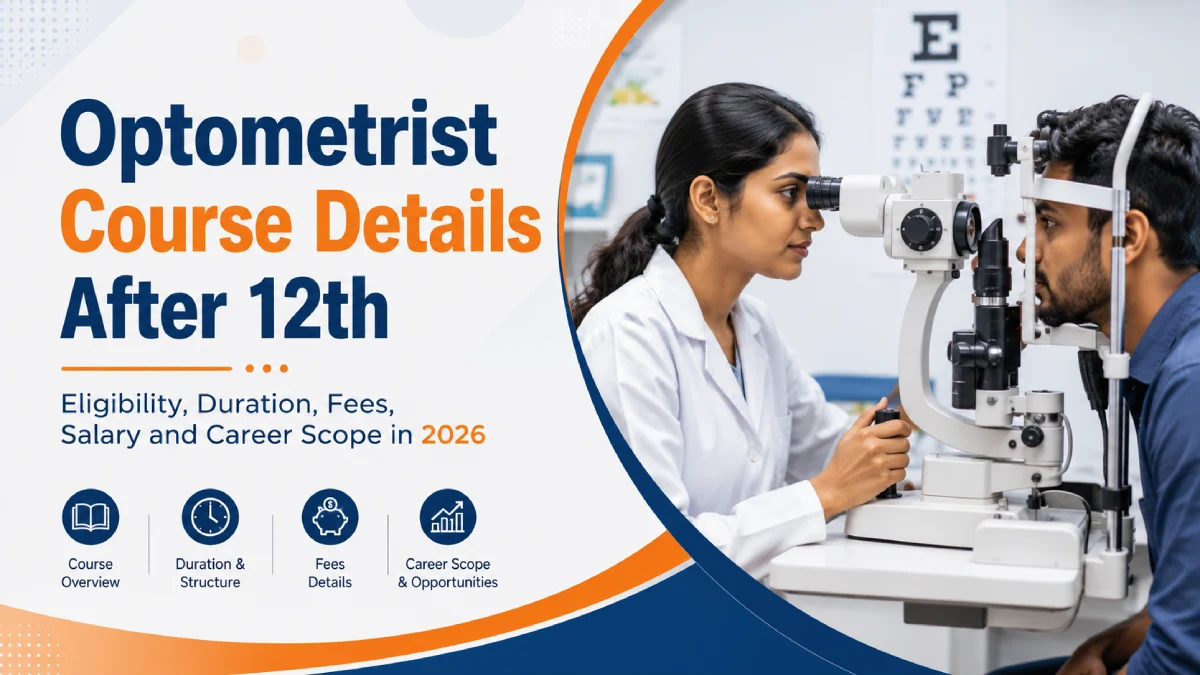
Stepping into the field of eye care after school can feel like a big step. Optometry sounds good, and the curiosity pertaining to the future and career possibilities hovers in the mind of aspirants. Good eyesight matters to every person, yet India does not have enough trained eye care staff to test and correct vision for its people. This is where a career in optometry starts to make real sense.
This guide sets out the full optometrist course details for students who have finished Class 12. It explains who can apply, how long the course runs, what it costs, what graduates earn, and where the work can take them. For many students, the choice becomes clearer once the plain facts sit in one place. While the course is popular, there is much more to it than most people realise.
Optometry course details at a glance
The table below gives a quick summary before the full details. It suits students who want the key points first.
|
What is optometry, and what does an optometrist do?
Optometry is the part of health care that deals with testing eyesight, prescribing spectacles and contact lenses, and spotting eye problems early. An optometrist is the trained professional who carries out this work. They check how well a person sees, measure the power needed for glasses, and refer patients with serious eye disease to an eye surgeon.
People often mix up three job roles in eye care. The table makes the difference clear, which is a common doubt among students and parents.
|
Why is demand for optometrists rising in India?
Demand is rising because India has far fewer optometrists than its people need, and eye care use keeps growing. Longer screen time, more diabetes, and an ageing population all add to the number of eye tests needed each year. The situation has changed considerably over the last few years. This is where things become interesting for a student picking a course.
The figures below show the gap in plain numbers.
|
What is the eligibility for an optometry course after 12th?
The optometrist course details begin with a simple entry rule. A student must have passed Class 12 in the science stream, usually with Physics, Chemistry, and Biology. Some universities also accept Mathematics in place of Biology. Most colleges ask for a pass mark of about 45 to 50 percent, and the minimum age is around 17 years.
There is more than one route into the field. The table compares the three common choices so students can pick the right level for their goals.
|
Looking at the broader picture, an optometry course after 12th is one of the steadier healthcare courses after 12th science, because eye care is needed in every town and city. From a student’s perspective, the degree route (B.Optom.) opens the most doors, since it allows post-graduate study and higher roles later.
How long is the optometry course, and how is it built?
One part of the optometrist course details that students ask about most is the length. In India, the Bachelor in Optometry usually runs for four years, and this often includes a one-year internship. Some universities, including MNR University, run it as a five-year programme with the internship built in. A diploma is shorter, at about two years.
The course mixes theory with practice. Early terms cover science subjects. Later terms move to eye testing and clinical optometry training, where students work with real patients under a senior optometrist. The final internship year places students inside eye hospitals and clinics so they build speed and confidence before their first job.
What does the optometry syllabus cover?
The optometry syllabus builds from basic science to full clinical work, year by year. Exact subjects differ between universities, but the pattern below is common across most B.Optom. programmes.
|
How much does an optometry course cost?
Fees form a big part of the optometrist course details, and they vary a lot between government and private colleges. Government seats cost the least. Private universities charge more but often add clinical training, internships, and help with placements. The table gives indicative figures so families can plan.
For MNR University, a one-time pre-admission amount also applies, made up of a 1,500-rupee application fee and a 15,000-rupee admission confirmation fee. A merit scholarship can lower the yearly tuition for students with strong Class 12 marks. What salary can an optometrist expect?The optometrist course details would not be complete without a look at pay. Ask any experienced professional in the field, and they will tell you that salary grows quickly with skill and specialisation. A fresher starts modestly, but a senior or specialist optometrist earns well, mainly in metro cities and large hospital chains.
|
Frequently Asked Questions
Yes. India has a shortage of trained optometrists, and eye care demand keeps rising with screen use and an ageing population. This makes it a steady healthcare career with room to grow.
Some universities accept Physics, Chemistry, and Mathematics in place of Biology, while many ask for Biology. A student should check the exact rule of each university before applying.
An optometrist tests eyesight and prescribes glasses and contact lenses. An ophthalmologist is a medical doctor who treats eye disease and performs surgery.
A Bachelor in Optometry usually takes four years, often including a one-year internship. At MNR University the programme runs for five years with the internship built in. A diploma takes about two years.
Freshers earn about 2.5 to 4 lakh rupees per year. Pay rises to 6 to 8 lakh and above with experience, specialisation, and work in metro cities.
Yes. MNR University in Hyderabad offers a Bachelor in Optometry (B.Optom.) and a Master in Optometry through its School of Allied and Healthcare Sciences.
Yes. A recognised optometry degree is accepted for eye care roles in the Gulf and several other countries, though some places require a local licence or extra exam.
Related Blogs
How B.Sc. Respiratory Therapy Course Prepares Graduates to Revolutionise Urban Air Quality Management
In growing megacities where every breath counts, a highly specialised wave of healthcare professionals is…

Best Healthcare Courses in Hyderabad: 20 Career-Ready Programmes at MNR University
Hyderabad has stepped into a fresh chapter of medical education, and students from every corner…

Is BPT a Good Career in 2026? The Future Scope of Physiotherapy in India
Healthcare in India places physiotherapy at the heart of patient recovery, and the best physiotherapy…
Top Career Opportunities After Physiotherapy in India & Abroad
The landscape of healthcare is shifting toward movement-based recovery, making the choice to study at…

5 Global Universities Waiting to Accept You Through MNR’s 2026 Exchange Program
Ten years back, earning a degree from a good university in your home city was…

10 Game-Changing Advantages of Internet of Things Every Engineering Student Must Know
Every smart watch that counts steps, every home speaker that answers a question, and every…