
Bachelor of Optometry (B.Optom) Course Details Explained
Home / School of Allied Sciences / Bachelor of Optometry (B.Optom) Course Details Explained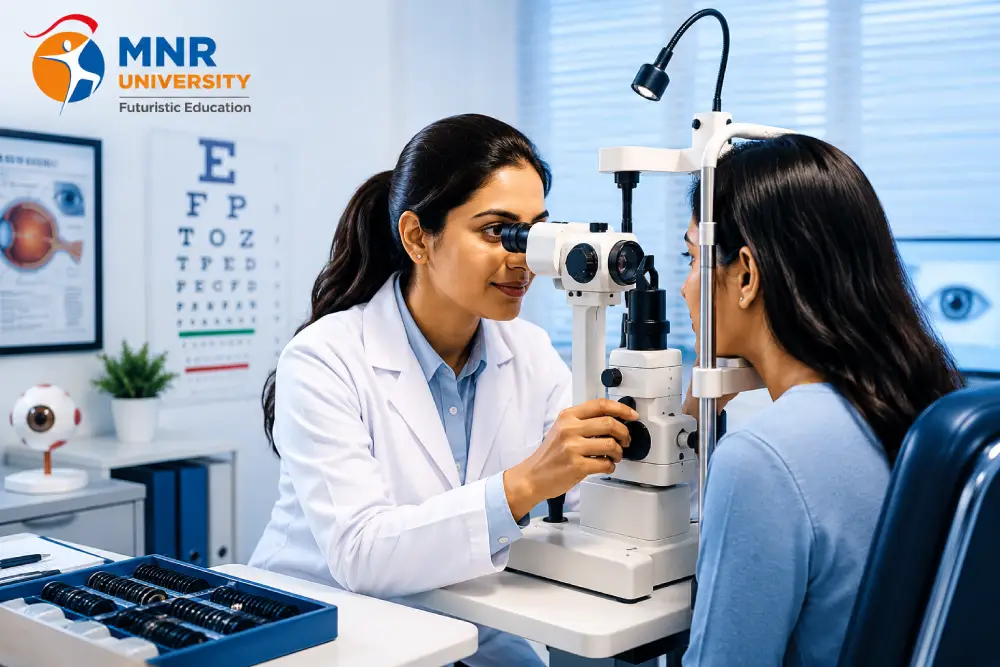
Stepping into the field of eye care sounds good, and the curiosity pertaining to the future and career possibilities hovers in the mind of aspirants. Then the confusion begins. One college calls the course B.Optom. The next one calls it B.Sc Optometry. One brochure says three years, another says five. Parents read all of it and quietly worry that their child will pick the wrong one and lose a year.
These bachelor of optometry course details clear most of that fog. India has rewritten the rules. From the 2026 academic year, optometry follows one national curriculum under the National Commission for Allied and Healthcare Professions, or NCAHP. Four years of study. One year of supervised internship. One recognised professional title at the end of it.
Here is the short answer for anyone in a hurry. A Bachelor of Optometry is a four-year undergraduate degree in eye and vision care, followed by a compulsory one-year clinical internship. A student needs 10+2 with Physics, Chemistry and Biology, or with Mathematics at several universities. NEET is not required at most institutions. The degree leads to registration as an optometrist, which is now the minimum qualification for that title.
The longer answer is where colleges start to differ from each other, and that part is worth reading before a single application fee is paid.
B.Optom vs BSc Optometry: Is There Really a Difference?
Many parents and students still believe these are two separate careers. They are not. Both names point to the same profession and the same registration route. The real difference sits in the university that awards the degree and, until recently, in how many years the course ran.
The situation has changed considerably over the last few years. The NCAHP Act, 2021 placed optometry under a national regulator for the first time. Under that Act, an optometrist must hold a baccalaureate degree of at least four years. Ophthalmic assistants and vision technicians, who train for two years, sit in a separate professional category with a separate international occupation code.
So the useful question is not “B.Optom or B.Sc Optometry?” The useful question is “How many years of study, and does the course include a full internship?” These b optometry course details are set out below.
B.Optom vs B.Sc Optometry vs Diploma in Optometry
| Point of comparison | Bachelor of Optometry (B.Optom) | B.Sc Optometry | Diploma in Optometry |
| Typical duration | 4 years of study plus 1 year internship | 3 to 4 years plus internship, varies by university | 2 years |
| Position from 2026 | Follows the NCAHP competency-based curriculum | Being aligned to the same NCAHP four-year standard | Trains ophthalmic assistants and vision technicians |
| Title on registration | Optometrist | Optometrist, where the degree meets the four-year norm | Ophthalmic assistant or vision technician |
| Occupation code (ISCO) | 2267 | 2267 | 3256 |
| Can head a refraction clinic | Yes, after the internship | Yes, where the four-year norm is met | No, works under supervision |
Source: NCAHP Act, 2021 summary published by Optician India; SRM Institute of Science and Technology allied health admissions page; ASIRA Health commentary on the NCAHP optometry curriculum.
It would not be wrong to say that the name on the certificate matters less than the structure behind it. A four-year degree with a full internship carries the same weight whichever of the two titles a university prints.
How Long Is the Course, and How Is It Structured?
Four years in classrooms and clinics, then one year of supervised internship. Five years from admission to registration.
Of all the bachelor of optometry course details a family compares, duration is the one that decides everything else. It fixes the registration category, the job titles a graduate can hold and the ceiling on the salary.
It is worth noting that the internship is not optional and it is not a summer project. It is a full year of rotating clinical duty inside a hospital or an eye care setup. A student who skips it does not complete the degree and cannot register.
Bachelor of Optometry course structure at a glance
| Feature | Detail |
| Full name | Bachelor of Optometry |
| Short form | B.Optom, also written B.Optom. |
| Level | Undergraduate professional degree |
| Academic duration | 4 years, usually 8 semesters |
| Internship | 1 year, supervised, compulsory |
| Total time to registration | 5 years |
| Minimum age | 17 years as on 31 December of the admission year |
| Regulator | National Commission for Allied and Healthcare Professions, Ministry of Health and Family Welfare |
| NEET needed? | Not mandatory at most institutions; a small number ask for it voluntarily |
| Common entry routes | Class 12 merit, CUET UG, state CETs, university entrance tests |
| Lateral entry | Possible into the second year for two-year optometry diploma holders at some universities |
Source: NCAHP Act, 2021 and the Competency-Based Curriculum for Optometry (Ministry of Health and Family Welfare, 2025); Propelld optometry course guide; MNR University B.Optometry programme page.
What Does the Year-wise Curriculum Cover?
The first two years build the science. The last two years build the clinician. Under the competency-based curriculum released in 2025, patient contact starts in the first year rather than the third.
Students usually read the syllabus last. Among bachelor of optometry course details, it deserves an earlier look, because it shows exactly when a college puts a student in front of a real patient.
Year-wise B.Optom curriculum overview
| Year | Main subject blocks | What a student actually does |
| Year 1 | General Anatomy, Physiology, Biochemistry, Geometrical Optics, Physical Optics, Basic Mathematics | Learns how light bends and how the body works; first supervised visits to the clinic |
| Year 2 | Ocular Anatomy, Ocular Physiology, Visual Optics, Clinical Optometry, Pathology, Microbiology | Starts retinoscopy and subjective refraction on real patients under supervision |
| Year 3 | Contact Lens Practice, Binocular Vision, Ocular Disease, Dispensing Optics, Low Vision Aids | Fits contact lenses, screens for squint and amblyopia, prescribes spectacles |
| Year 4 | Paediatric Optometry, Geriatric Optometry, Public Health Optometry, Optometric Instruments, Research Project | Runs community screening camps and completes a small research study |
| Year 5 | Rotating clinical internship across sub-specialities | Works full days in cornea, glaucoma, paediatric and low vision clinics |
Source: Competency-Based Curriculum for Optometry, NCAHP and Ministry of Health and Family Welfare (2025); Acharya Institute of Allied Health Sciences B.Sc Optometry syllabus; ASIRA Health analysis of the NCAHP curriculum.
From a student’s perspective, the change is easy to feel. Older syllabi kept students in lecture halls for two full years before letting them near a patient. The new one does not.
Who Can Apply? Eligibility Criteria for the Course
Eligibility sits among the few bachelor of optometry course details that still differ from one university to the next, so a student should read each prospectus rather than assume. The table below compares the published criteria at four institutions in and around Hyderabad.
Eligibility criteria compared across Hyderabad optometry providers
| Institution | Degree offered | Minimum qualification | Selection |
| MNR University, Sangareddy (Greater Hyderabad) | Bachelor in B.Optometry | 10+2 with BiPC or MPC, or Class 10 plus a two or three-year diploma in a relevant technology | Merit or a valid state, national or international entrance score; minimum age 17 |
| Malla Reddy University, Hyderabad | B.Sc (Hons) Optometry | 10+2 in relevant subjects with 50 per cent aggregate | Merit or a national or state level CET |
| Malla Reddy Vishwavidyapeeth, Hyderabad | B.Optom | 10+2 with Physics, Chemistry and Biology, 50 per cent | Merit |
| Bausch and Lomb School of Optometry, LVPEI, Hyderabad | B.S. Optometry, awarded with BITS Pilani | 10+2 with Physics, Chemistry and Mathematics or Biology | Written test and interview |
Source: MNR University B.Optometry page; Malla Reddy University course listing on Careers360 and Shiksha; Malla Reddy Vishwavidyapeeth B.Optom page; BITS Pilani B.S. Optometry (LVPEI Hyderabad) programme document.
Not everyone is aware that MPC students are eligible as well. Optics is physics before it is biology, and several universities in Telangana accept both the BiPC and MPC groups. Optometry courses after 12th are therefore open to a wider set of students than most people assume.
How Much Clinical Training and Internship Is Involved?
A closer look at the industry shows that clinical hours, not lecture hours, decide who gets hired. An employer wants to know how many refractions a fresher has done and whether that fresher has seen a diabetic retina outside a textbook.
Clinical hours rarely appear in a brochure summary, yet they are the bachelor of optometry course details an employer checks first.
This is where things become interesting for students shortlisting colleges in Hyderabad. Anyone searching for a BSc Optometry course in Hyderabad will meet aggregator lists that mix real providers with institutions that have never taught the subject. Several well-known names in the city do not run optometry at all. The table below separates the two groups.
Which well-known Hyderabad institutions actually run an optometry degree?
| Institution | Optometry degree? | Primary academic identity |
| MNR University | Yes, Bachelor in B.Optometry | Allied and healthcare sciences with a teaching hospital setup |
| Malla Reddy University | Yes, B.Sc (Hons) Optometry | School of Allied Health Sciences |
| Malla Reddy Vishwavidyapeeth | Yes, B.Optom and M.Optom | Health sciences university |
| Bausch and Lomb School of Optometry (LVPEI) | Yes, four-year B.S. Optometry | Hospital-run optometry school, WHO collaborating centre |
| BITS Pilani, Hyderabad Campus | Not on campus; the B.S. Optometry degree is awarded through the LVPEI collaboration | Engineering and sciences |
| Kaloji Narayana Rao University of Health Sciences | Affiliating and regulating body, not a direct provider | State health sciences university, Telangana |
| Woxsen University | No | Business, design and technology |
| VNR VJIET, Hyderabad | No | Engineering |
| Vasavi College of Engineering | No | Engineering |
| Mahindra University | No | Engineering and management |
| Anurag University | No | Engineering, pharmacy and sciences |
Source: Institutional websites; Shiksha and Careers360 course directories; BITS Pilani Work Integrated Learning Programmes documentation for B.S. Optometry at LVPEI Hyderabad. Checked August 2026.
Ask any experienced optometrist in Hyderabad, and they will tell you the same thing. A college attached to a working eye hospital gives a student far more patient volume than a college that sends students out for a few weeks each year.
Why Does the Four-Year Duration Matter for Independent Practice?
Because the length of the course decides what a graduate is legally allowed to call themselves and what work they can take charge of.
A two-year diploma holder assists. A four-year graduate examines, refracts, prescribes spectacles and contact lenses, screens for eye disease and refers on to an ophthalmologist. The four-year graduate can run a refraction clinic, take charge of an optical outlet or set up an independent practice for primary eye care. Surgery and prescription medicines remain with the ophthalmologist, and honest counselling on this point saves a lot of later disappointment.
The national numbers explain why the regulator pushed for the longer degree.
India’s optometrist workforce gap
| Measure | Figure | What it means |
| Optometrists with four-year training | About 9,000 | The pool that meets the global standard |
| Optometrists with two-year training | About 40,000 | Assist-level workforce |
| Four-year trained optometrists India needs | About 1,15,000 | A gap of roughly 12 times the present four-year trained pool |
| Ophthalmologists at secondary and tertiary level | 20,944 | AIIMS national survey count |
| Optometrists at secondary and tertiary level | 17,849 | AIIMS national survey count |
| Optometrist to ophthalmologist ratio | 0.85 | Support staff per eye surgeon |
| Vision 2020 target ratio | 3.0 | The gap the country is still trying to close |
Source: “The State of Optometric Education in India, 1958-2022”, Journal of Optometric Education, Winter/Spring 2025; AIIMS study “Human Resources and Infrastructure for Ophthalmic Services in India”, reported by Outlook India, November 2025.
The demand behind those numbers is not theoretical. It comes from a very large amount of correctable vision loss sitting untreated.
India’s eye health burden, and what optometrists can fix
| Indicator | Figure | Who addresses it |
| Share of blindness caused by cataract, age 50 and above | 66.2 per cent | Ophthalmologist, with optometrist screening and referral |
| Share of blindness caused by uncorrected refractive error | 18.6 per cent | Optometrist, directly |
| Share of blindness caused by glaucoma | 6.7 per cent | Ophthalmologist, with optometrist screening |
| Adults examined who had uncorrected refractive error | 11.5 per cent | Optometrist, directly |
| Adults examined who had uncorrected presbyopia | 74.2 per cent | Optometrist, directly |
| Blindness that is avoidable | 92.9 per cent | Preventable or treatable with timely eye care |
| Vision impairment that is avoidable | 97.4 per cent | Preventable or treatable with timely eye care |
Source: National Blindness and Visual Impairment Survey 2015-19, Ministry of Health and Family Welfare; “Blindness and visual impairment and their causes in India: results of a nationally representative survey”, PLOS ONE (2022).
Two of those seven lines are work an optometrist does without anyone else in the room. That is the honest case for the four-year degree.
What Career Paths Can a Student Explore After a B.Optom Course?
The obvious answer is an eye hospital. The fuller answer includes optical retail chains, contact lens and spectacle lens companies, refractive surgery centres, corporate vision screening, teaching, research and the armed forces. Anyone comparing optometry colleges in india should read the placement page with these roles in mind rather than a single headline package.
Salary tables are not usually printed alongside bachelor of optometry course details, which is a pity, because the two belong together. The figures below come from four separate salary databases and they disagree with each other, so they are best read as a range.
Career paths and indicative pay after a Bachelor of Optometry
| Career stage or role | Where the work happens | Indicative annual pay in INR |
| Fresher clinical optometrist | Eye hospitals, multi-speciality clinics | About 2.60 lakh (AmbitionBox data cited by GetMyUni) |
| Early-career optometrist, average | Hospitals and organised optical chains | 3.03 lakh, range 1.10 lakh to 5.12 lakh (PayScale India) |
| Entry level, all-India estimate | Mixed employers | About 4.27 lakh (WorldSalaries) |
| Median across all experience | Mixed employers | About 7.59 lakh (WorldSalaries) |
| Average across all experience | Mixed employers | About 10.77 lakh (Salary.com Global Salary IQ) |
| Contact lens specialist | Speciality clinics, lens companies | 2.50 lakh to 4.50 lakh (AmbitionBox data cited by GetMyUni) |
| Low vision specialist, 3 years plus | Rehabilitation centres, eye institutes | 5 lakh to 8 lakh (AmbitionBox data cited by GetMyUni) |
Source: PayScale India, Optometrist early-career pay (2026); Salary.com Global Salary IQ, Optometrist India; WorldSalaries Optometrist India (2026); AmbitionBox figures as compiled by GetMyUni. Figures vary widely by source and employer type, so treat them as a range and not a promise.
Looking at the broader picture, the money follows the market. India buys a great deal of eyewear, and every prescription behind that purchase starts with a refraction.
The Indian eyewear market that hires optometrists
| Measure | Value in USD | Value converted to INR at Rs 95 per USD |
| India eyewear market, 2025 | 11.09 billion | About Rs 1.05 lakh crore |
| India eyewear market, 2034 forecast | 20.86 billion | About Rs 1.98 lakh crore |
| Growth rate, 2026 to 2034 | 6.66 per cent CAGR | Not applicable |
| India smart eyewear market, 2024 | 87.85 million | About Rs 835 crore |
| India smart eyewear market, 2033 forecast | 1,047.16 million | About Rs 9,950 crore |
| Smart eyewear growth rate, 2025 to 2033 | 31.7 per cent CAGR | Not applicable |
Source: IMARC Group, India Eyewear Market Report and India Smart Eyewear Market Report. Conversion at the mid-market rate of Rs 95.10 per US dollar on 7 August 2026, rounded to Rs 95.
From an employer’s point of view, a fresher who can handle a slit lamp, an autorefractor and a difficult patient in the same hour is worth training further. That combination is built during the internship year, not during the last month before placements.
What Does MNR University’s Bachelor of Optometry Programme Offer?
MNR University runs its Bachelor in B.Optometry through the School of Allied and Healthcare Sciences at MNR Nagar, Fasalwadi, Sangareddy district, in Greater Hyderabad. For students comparing bachelor of optometry course details across Telangana, the published programme highlights are set out below.
MNR University Bachelor in B.Optometry at a glance
| Element | What the university publishes |
| Programme name | Bachelor in B.Optometry, School of Allied and Healthcare Sciences |
| Eligibility | 10+2 with BiPC or MPC from a recognised board, or Class 10 plus a two or three-year diploma in a relevant technology |
| Age | Minimum 17 years as on 31 December of the admission year |
| Admission basis | Merit, or a valid state, national or international entrance test score |
| Clinical component | Clinical practice in eye hospitals, internships in multi-speciality eye clinics |
| Instrumentation covered | Slit lamps, retinoscopes, autorefractors, tonometers |
| Speciality training | Refraction techniques, low vision rehabilitation workshops, ocular disease management |
| Accreditation claim | Telangana’s first DASCA-USA accredited university |
| Campus | Gold rated sustainable campus, MNR Nagar, Fasalwadi, Sangareddy district, Greater Hyderabad 502294 |
| Group legacy | More than 50 years in education |
| International links | Academic collaborations with United States universities |
| Support | Merit based scholarships, internships and placement assistance |
Why Are Students Searching for MNR University?
Three reasons come up again and again in enquiry calls.
- Location without the city premium. The campus sits in Sangareddy district inside Greater Hyderabad, which keeps living costs lower than a central Hyderabad address while keeping the city’s hospital network within reach.
- Allied health depth rather than a single course. Optometry sits alongside emergency medical technology and medical laboratory sciences in the same school, so laboratories, faculty and hospital tie-ups are shared across programmes.
- A newer university with an older group behind it. The MNR group has run educational and healthcare institutions for over five decades, which matters to parents weighing a private university against an established government-affiliated college.
There is little doubt that students also compare on fees and scholarships. Both are published on the university website, and both should be checked directly rather than through a listing portal.
The One Thing Worth Checking Before Paying a Fee
Ask the admissions office one written question: how many years of academic study, and how many months of internship? Then ask whether the syllabus follows the NCAHP competency-based curriculum from the 2026 intake. Any college confident about its bachelor of optometry course details will answer both in a single email.
A student who checks that one thing will not lose a year. A student who does not check may finish a three-year course and discover that the register wants four.
Frequently Asked Questions
In practical terms, yes. Both prepare a student for the same profession and the same registration as an optometrist. The difference is the title a university chooses to award. What matters is the structure behind the title, which should be four years of study plus a one-year clinical internship under the NCAHP standard.
Because the NCAHP Act, 2021 sets a minimum of four years of baccalaureate study for anyone registering as an optometrist. A two-year diploma leads to the ophthalmic assistant or vision technician category instead, which is a supporting role with a different occupation code and a lower ceiling.
A four-year graduate who has completed the internship can run a refraction clinic, prescribe spectacles and contact lenses, screen for eye disease and manage an optical practice. Surgery and prescription medicines stay with the ophthalmologist. So the practice is independent within the scope of primary eye care, not beyond it.
A pass in 10+2 with Physics, Chemistry and Biology is the common requirement. Several universities in Telangana, including MNR University, also accept the MPC group. Most institutions ask for around 50 per cent aggregate and a minimum age of 17 years as on 31 December of the admission year.
In and around Hyderabad, MNR University, Malla Reddy University, Malla Reddy Vishwavidyapeeth and the Bausch and Lomb School of Optometry at LV Prasad Eye Institute all run four-year optometry degrees. Several other well-known Hyderabad institutions listed on aggregator sites do not run optometry at all, so the prospectus should be checked directly.
No, not at most institutions. Optometry is regulated by the NCAHP and not by the National Medical Commission, so admission usually runs on Class 12 merit, CUET UG or a state or university entrance test. A small number of institutes ask for NEET voluntarily.
An ophthalmologist is a medical doctor who has completed MBBS followed by a postgraduate qualification in ophthalmology, and who performs eye surgery. An optometrist holds a four-year optometry degree, examines eyes, corrects refractive errors, fits contact lenses and refers disease cases onward. The two work as a team.
Published estimates vary a great deal by source. Fresher figures cluster around Rs 2.6 lakh to Rs 4.3 lakh a year, early-career averages sit near Rs 3 lakh with a wide range, and averages across all experience levels run from about Rs 7.6 lakh to Rs 10.8 lakh depending on the survey. Speciality roles such as low vision or contact lens practice pay above the general range.
Yes, at several universities. Optometry rests heavily on optics and mathematics, so institutions such as MNR University accept the MPC group alongside BiPC. A student should still confirm this in writing with the admissions office, because the rule is not universal.
The common routes are a Master of Optometry, a postgraduate diploma in optometry and vision sciences, a fellowship in a speciality such as contact lenses, paediatric optometry, low vision or binocular vision, and eventually a PhD in vision science. Hospital-based fellowships often carry a stipend.
The one-year internship is compulsory and forms part of the degree. Whether it carries a stipend depends on the institution and the hospital, so a student should ask about the stipend and the rotation plan during the admission enquiry rather than after joining.
Hyderabad has an unusual density of eye hospitals, optical retail chains and vision research institutes, which gives optometry students in the city more clinical postings and more local hiring options than most other Indian cities. It is one of the stronger places in the country to train for this profession.
Related Blogs
BSc Renal Dialysis Technology: Course Details, Scope, Salary & Career Opportunities in 2026
Stepping into the field of kidney care opens the door to a healthcare job that…

Best Healthcare Courses in Hyderabad: 20 Career-Ready Programmes at MNR University
Hyderabad has stepped into a fresh chapter of medical education, and students from every corner…
What Is the Career Scope After a B.Sc. in Cardiac Perfusion Technology?
A B.Sc cardiac perfusion technology degree leads to one of the most trusted roles in…
Advanced Ocular Therapeutics: Optometry in Laser and Virtual Reality
Human sight processes complex light patterns constantly, demanding absolute physical precision from our ocular systems….
CBSE Board Result Out 2026: What to Do the Moment Your Score Is Live
The moment the CBSE board result out notification flashes on your screen, a thousand questions…

Anaesthesiology: A Fundamental Pillar of Modern Surgery
Modern healthcare relies heavily on the steady hands and technical expertise of clinical specialists during…