
Best Healthcare Courses in Hyderabad: 20 Career-Ready Programmes at MNR University
Home / School of Allied Sciences / Best Healthcare Courses in Hyderabad: 20 Career-Ready Programmes at MNR University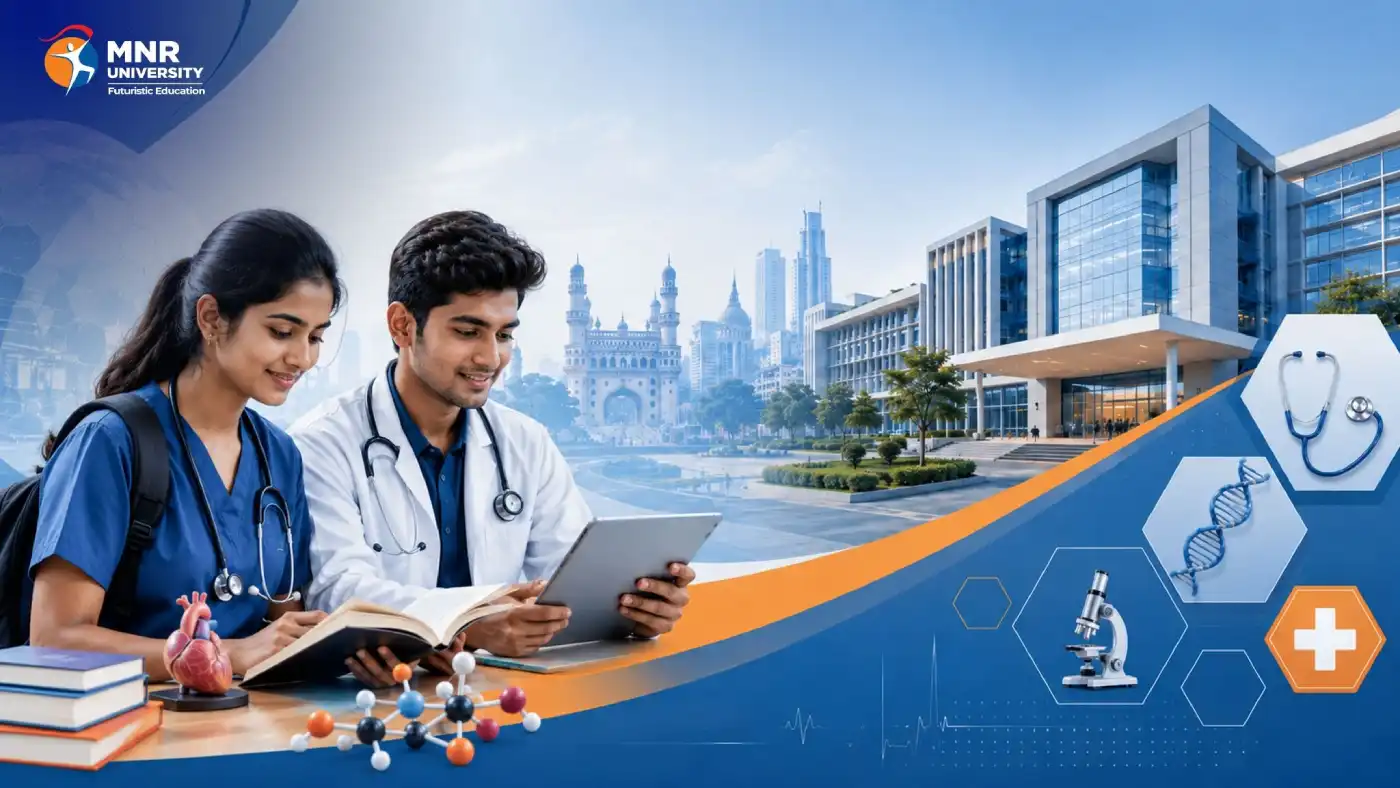
Hyderabad has stepped into a fresh chapter of medical education, and students from every corner of India are taking note. If you are scanning the best healthcare courses in Hyderabad after Class 12, MNR University offers a curriculum shaped around what hospitals, diagnostic labs, and pharmaceutical firms actually look for today. The School of Allied and Healthcare Sciences here runs twenty undergraduate programmes built for real, hands-on careers across patient care, laboratory science, public health, and hospital operations. What follows is a straight look at each pathway and where it can take a graduate after the degree wraps up.
What Makes MNR University a Strong Pick for Aspiring Healthcare Professionals?
MNR University brings together fifty years of academic credibility with a teaching model rooted in live hospital exposure. The university holds the rank of #5 across India and #2 in Telangana in the Times All India Engineering Institutes Ranking 2025, and became the first in the state to earn DASCA accreditation. Beyond the metrics, what sets the campus apart is the way classrooms connect with real wards, laboratories, and patients. The faculty includes practising clinicians, senior lab heads, and hospital administrators, which keeps the teaching anchored to current practice rather than outdated coursework.
The 20 Best Healthcare Courses in Hyderabad Offered at MNR University
The table below gives a quick view of each programme and the career direction it supports.
| # | Course | Where Graduates Work |
| 1 | B.Sc Nursing | Hospital wards, ICUs, overseas nursing roles |
| 2 | B.Sc Physiotherapy | Sports rehab, hospitals, private clinics |
| 3 | B.Sc Occupational Therapy | Paediatric care, injury recovery units |
| 4 | Audiology and Speech-Language Pathology | Hearing clinics, cochlear implant centres |
| 5 | Respiratory Therapy | Critical care, ventilator support |
| 6 | B.Sc Medical Lab Technology | Diagnostic chains, hospital laboratories |
| 7 | B.Sc Radiology and Imaging Technology | CT, MRI, and ultrasound departments |
| 8 | Cardiovascular Technology | Cath labs, cardiac care units |
| 9 | Dialysis Technology | Renal care, standalone dialysis centres |
| 10 | Operation Theatre Technology | Surgical theatres, multi-speciality hospitals |
| 11 | Anaesthesia Technology | OT support, surgical monitoring |
| 12 | B.Optometry | Eye hospitals, optical chains, private practice |
| 13 | Emergency and Trauma Care Technology | Ambulance services, emergency rooms |
| 14 | Health Information Management | Medical coding, hospital records, healthcare BPO |
| 15 | Hospital Administration | Hospital operations, healthcare management |
| 16 | Public Health | NGOs, government health bodies, policy roles |
| 17 | B.Sc Nutrition and Dietetics | Hospitals, wellness centres, sports nutrition |
| 18 | B.Pharmacy | Retail pharmacy, manufacturing, regulatory work |
| 19 | B.Sc Biotechnology | Research labs, pharma R&D, genetic diagnostics |
| 20 | Healthcare Technology and Bioinformatics | Health data analytics, AI-led diagnostics |
How Does the MNR Curriculum Prepare Students for Real Job Roles?
The teaching plan moves well beyond classroom lectures. Each programme is mapped to specific job roles seen across hospitals, diagnostic chains, pharmaceutical firms, and public health bodies. Students rotate through wards, laboratories, operation theatres, and imaging suites during the semester itself, which means a graduate steps out with trained hands and not merely a folder of notes.
Skill development is built into the degree timeline rather than being saved for the end. Soft skills such as patient communication, electronic record handling, equipment operation, and team coordination are taught alongside the technical syllabus, so that learners build job-ready abilities within the span of the degree.
Key strengths of the curriculum include:
- Live hospital and laboratory training from the early semesters
- Industry-aligned modules reviewed every academic year
- Patient communication and case-handling workshops
- Internships at reputed multi-speciality hospitals across the city
This is the reason families across Telangana and Andhra Pradesh place MNR among the best healthcare universities in Hyderabad when they draw up their shortlist of options.
Which Global Partnerships Add Value at MNR University?
Modern healthcare follows global protocols, and students benefit when their degree carries international exposure. MNR University has built academic ties with reputed universities abroad to widen learning opportunities, support credit transfers, and create smoother pathways into postgraduate study overseas.
The university currently collaborates with:
- Cumberland University
- Wayland Baptist University
- Faulkner University
- Campbellsville University
- St. Francis College
These tie-ups also bring exposure to global research methods, modern clinical practices, and international healthcare management systems, which adds visible weight to a fresher’s profile during placement interviews and admissions abroad.
Why Is MNR Counted Among the Best Healthcare Universities in Hyderabad?
The answer lies in how the campus runs day to day. Hospitals are not a side arrangement attached to the institution; they sit at the centre of how learning happens. Students see real cases, real shift patterns, and real diagnostic workflows from the very first year. Pair that with twenty structured programmes, faculty drawn from active practice, and a strong placement network, and it becomes easier to see why so many describe it as the best healthcare university in Hyderabad in student forums and parent groups.
A Final Word Before You Decide
The course you pick after Class 12 sets the tone for the next several years of your professional life. For students serious about a healthcare future without writing NEET again, the best healthcare courses in Hyderabad are well within reach at MNR University, supported by a curriculum, faculty, and hospital network designed for real outcomes. Visit the campus, sit through a counselling session, and speak with senior students before locking your decision. That short effort often saves a great deal of second-thinking later on.
Frequently Asked Questions
Most allied health programmes at MNR University do not require a NEET score. Admission is based on Class 12 marks in the science stream along with the university's own counselling process.
Yes. Every undergraduate course under the School of Allied and Healthcare Sciences carries a mandatory internship at affiliated hospitals during the final phase of the degree.
The placement cell at MNR University works closely with hospitals, diagnostic chains, and pharmaceutical firms, offering resume guidance, mock interviews, and recruiter drives during the final semester.
Most undergraduate healthcare programmes run for three to four years, with the supervised internship included within the final stretch.
Yes. Through partnerships with Cumberland University, Wayland Baptist University, Faulkner University, Campbellsville University, and St. Francis College, students can move into credit transfers and postgraduate pathways overseas.
Related Blogs

Top B.Optometry Colleges in Telangana 2026: Rankings, Fees and Admission Guide
Telangana has a growing number of colleges offering a Bachelor in Optometry. One of the…

Emerging Science Careers in India: Degrees That Employers Will Value in the Next Decade
Science has always drawn curious minds. Yet the kind of science jobs that pay well…
Optometry Courses After 12th: Eligibility, Duration, Fees and Career Path (2026 Guide)
Many students don’t consider eye care as their first career option when they think about…
Top BSc Optometry Colleges in Telangana 2026: Rankings, Fees and Admission Guide
Are you looking for the best BSc Optometry colleges in Telangana? Telangana has a growing…
Can Average Students Build a Career in Neurosciences?
Neuroscience is one of the most rewarding fields of study in India today, and students…
Radiology Career in India: Scope, Salary & Opportunities
Hospitals today feel very different from what they were even ten years ago. A…