
Optometry Courses After 12th: Eligibility, Duration, Fees and Career Path (2026 Guide)
Home / MNR University / Optometry Courses After 12th: Eligibility, Duration, Fees and Career Path (2026 Guide)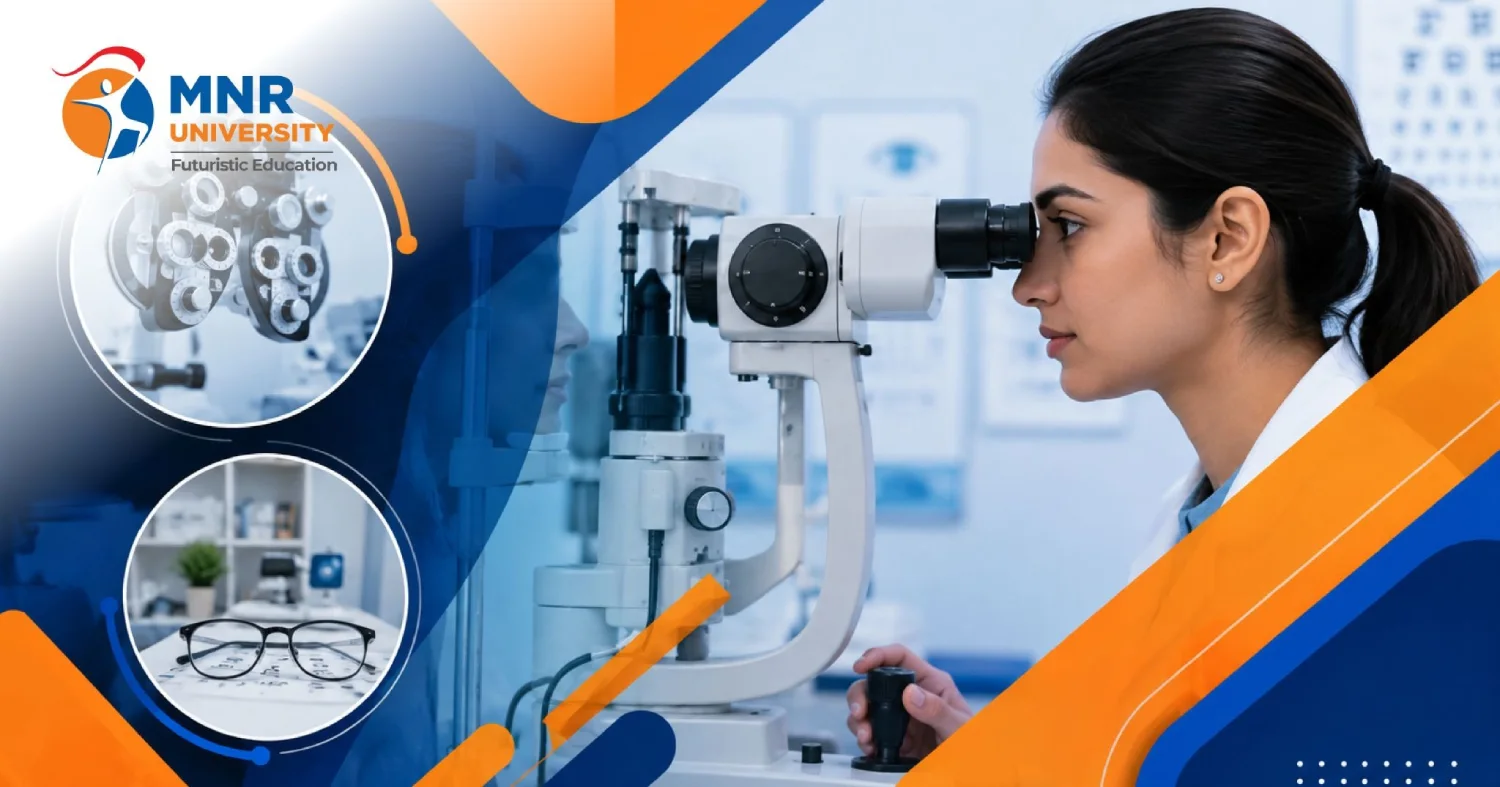
Many students don’t consider eye care as their first career option when they think about after Class 12. However, optometry is one of those healthcare fields that can be considered by students from both PCB and PCM backgrounds. Optometry courses after 12th include everything from a two year diploma programme to a four to five year degree courses, with each option offering a different route into the eye care profession. This guide covers the main course options, eligibility requirements, admission process, expected fees at government and private colleges and the factors students should consider when choosing a college. It also takes a closer look at the BSc Optometry programme offered by MNR University in Hyderabad. The aim is to give students comparing their options for the first time, as well as parents planning for the next admission cycle, a clear understanding of what to expect before making a decision.
What Is Optometry as a Career Choice
Optometry is the branch of eye care that deals with testing vision, prescribing glasses or contact lenses which can spot early signs of eye disease. An optometrist is not the same as an ophthalmologist. An ophthalmologist is a medical doctor who can operate on the eye, while an optometrist handles vision testing, corrective lenses and referral to a specialist when needed. It is quite common to hear parents assume the two are one and the same but the training, the degree and routine work differ. India’s eye care sector runs on a shortage of trained optometrists relative to the number of hospitals, optical stores and clinics opening each year which keeps demand for fresh graduates fairly steady.
List of Optometry Courses Available After Class 12
The students can enter optometry courses after 12th at three different levels, depending on how much time and money they want to put in before starting work. Each route leads to a different job title and salary band.
Certificate and Diploma in Optometry
A certificate or diploma in optometry runs for about one to two years and is the fastest way into the field. It is very suitable for students who want to start earning early, typically for an optometry assistant or technician with the option to upgrade to a full degree later through a lateral entry route at some colleges.
B.Optom (Bachelor of Optometry)
B.Optom is a four year degree at most universities although a small number of institutions, including MNR University can run it as a five year programme with a clinical internship. It covers ocular anatomy, optics, refraction, contact lenses and practical training with diagnostic equipment such as slit lamps and retinoscopes.
BSc Optometry (4 Year Degree)
BSc Optometry is largely the same course as B.Optom under a different naming convention and most colleges use the two titles interchangeably. It is a four year degree in most universities which combines classroom study with clinical placements in eye hospitals during the final year.
Eligibility Criteria (Stream, Subjects and Minimum Marks)
Eligibility for optometry courses after 12th is set by each university but the pattern across colleges is fairly consistent. A student needs a Class 12 pass with Physics, Chemistry and Biology (the PCB group) or Physics, Chemistry and Mathematics (the PCM group) from a recognised board, with an aggregate that usually sits between 45% and 50%. Some colleges also ask for a minimum age of 17 as of 31 December in the admission year. A diploma course tends to have a slightly lower marks requirement than a full degree.
Eligibility and Duration by Course Level
| Course Level | Accepted Stream | Typical Minimum Marks | Typical Duration |
|---|---|---|---|
| Certificate/Diploma in Optometry | PCB or PCM | 40% to 45% | 1 to 2 years |
| B.Optom | PCB or PCM | 45% to 50% | 4 to 5 years |
| BSc Optometry | PCB or PCM | 45% to 50% | 4 years |
Admission Process: Merit based vs Entrance Exam based
Not everyone is aware that admission to most optometry courses in India runs on Class 12 marks rather than a national entrance exam. NEET, the exam required for MBBS and BDS, is not compulsory for optometry at most universities. Instead, colleges either admit students directly on merit, or ask them to appear for a university-specific test such as GITAM GAT, or a state level exam such as CUET, KCET or IPU CET, depending on the state and the college.
MNR University follows a merit based route: candidates register, verify their documents and Class 12 scorecard and confirm their seat.
Admission Routes for Optometry Courses in India
| Admission Route | Applies To | How It Works |
|---|---|---|
| Based on Merit (Class 12 marks) | Most private and deemed universities | Direct admission after document verification, no separate entrance test |
| University specific entrance test | Select private universities | Test such as GITAM GAT, followed by counselling |
| State level entrance exam | Some state and affiliated colleges | CUET, KCET, IPU CET or an equivalent state test, followed by counselling |
Fee Range Across Government and Private Institutions
Fees for optometry courses after 12th vary sharply between government and private colleges. A government college keeps the annual fee well under a lakh because the state covers part of the running cost. A private or deemed university charges more, since it funds its own labs, equipment and clinical tie-ups. Across India, the reported range runs from about ₹6,000 a year at the most affordable government colleges to ₹2,00,000 a year at some private universities, with the diploma route generally cheaper than a full degree at any given college.
Fee Range Across Government and Private Institutions (2026)
| Institution Type | Approx. Annual Fee | Approx. Total Course Fee | Source |
|---|---|---|---|
| Government colleges | ₹6,000 – ₹85,000 | ₹50,000 – ₹2,00,000 | Wing Educations, Shiksha |
| Private colleges (general) | ₹1,00,000 – ₹2,00,000 | ₹2,50,000 – ₹6,00,000 | Kollegeapply |
| MNR University, Hyderabad (BSc Optometry) | ₹1,50,000 | ₹7,50,000 (5-year course) | MNR University official fee page |
Top Eye Colleges in Hyderabad
Hyderabad hosts a mix of government, deemed and private universities that offer eye care programmes, which is part of why students across Telangana and neighbouring states search for top eye colleges in Hyderabad when planning their admission.
LV Prasad Eye Institute is well known in the city for specialist eye care and training, while the University of Hyderabad, MNR University, Malla Reddy Vishwavidyapeeth and GITAM School of Science all run degree level optometry or eye care programmes.
Top Eye Colleges in Hyderabad Offering Optometry Programmes (2026)
| Institution | Programme Offered | Category | Source |
|---|---|---|---|
| MNR University, Hyderabad | B.Optometry (5 years) | Private university | MNR University official site |
| Malla Reddy Vishwavidyapeeth | B.Optom | Deemed university | GetMyUni |
| GITAM School of Science, Hyderabad | B.Optom | Deemed university | GetMyUni |
| University of Hyderabad | BSc Optometry | Central university | GetMyUni |
| KNRUHS-affiliated colleges | BSc Optometry | State government-affiliated | Shiksha |
Which Optometry Course Should You Choose After 12th
One question that often comes up is which level of optometry courses after 12th is worth the time. A diploma suits a student who wants to start working within two years and is comfortable starting in a support role. A B.Optom or BSc Optometry degree takes longer, but opens up a wider range of roles, a higher starting salary and the option to specialise or study further later on. For most students aiming at a long term career in eye care rather than an entry level job, the four or five year degree route tends to work out better.
Read more: BSc Optometry Course Details
What Career Paths You Can Explore After an Optometry Course
A career after optometry course completion usually starts as a staff optometrist in a hospital, an eye clinic or an optical retail chain such as Lenskart or GKB. From there, graduates move into roles with organisations including Essilor, Carl Zeiss, and government eye departments, or set up independent practice after gaining a few years of clinical experience. The entry level pay typically sits between ₹3 lakh and ₹6 lakh a year, rising with experience, specialisation, or a move into private practice.
Why Choose MNR University’s BSc Optometry Programme
MNR University is Telangana’s first DASCA-USA accredited university, runs on a Gold rated sustainable campus and carries over a 50 year legacy in education. Its BSc Optometry programme sits within the School of Allied and Healthcare Sciences and covers ocular anatomy, refraction technique and low vision rehabilitation, with training on diagnostic equipment including slit lamps, retinoscopes and autorefractors.
Students get clinical exposure through internships in multi speciality eye clinics and the university’s academic collaborations with U.S. universities add an international reference point to the curriculum.
Scholarships are available for students who score well in their qualifying exam, which brings the effective cost of the five year programme below the ₹7,50,000 headline figure for eligible candidates.
How to Apply?
Applying to MNR University’s BSc Optometry programme follows three steps.
- First, register with basic details through the official admissions portal.
- Second, check the registered email for a link to start the application.
- Third, verify the details and submit the completed application form to move into the merit review and seat confirmation stage.
Conclusion
Choosing between optometry courses after 12th comes down to how much time a student can give before starting work and how far they want to take the career. A diploma is the fastest route in a B.Optom or BSc Optometry degree, such as the one MNR University offers in Hyderabad, takes longer but builds toward a wider set of roles and a stronger starting salary. Comparing eligibility, fees and the college’s clinical exposure side by side, rather than looking at one factor alone, gives a student the clearest picture before the next admission cycle opens.
Frequently Asked Questions
Yes. Most universities accept both the PCB (Physics, Chemistry, Biology) and PCM (Physics, Chemistry, Mathematics) groups for optometry courses after 12th, though PCB is more common among applicants.
Most colleges ask for a minimum aggregate of 45% to 50% in Class 12, with a slightly lower requirement, around 40% to 45%, for certificate or diploma-level optometry courses.
It is a reasonable option for a student interested in healthcare but not set on a medical degree. It offers a shorter course length than MBBS, a clear clinical role, and starting salaries generally between ₹3 lakh and ₹6 lakh a year.
BSc Optometry generally runs for four years at most universities. A small number of institutions, including MNR University, run their B.Optometry programme over five years with a built-in internship.
No. NEET is not required for optometry admission at most universities. Admission usually runs on Class 12 merit, or a university-specific or state-level entrance test.
The two are largely the same course under different names, and most universities use them interchangeably. Both cover ocular anatomy, refraction, and clinical training, with the duration and exact curriculum set by the individual university.
Graduates typically start as staff optometrists in hospitals, eye clinics, or optical retail chains, and move on to roles with eyewear and lens companies, government eye departments, or independent practice after gaining clinical experience.
MNR University, Malla Reddy Vishwavidyapeeth, GITAM School of Science, the University of Hyderabad, and KNRUHS-affiliated colleges are among the main institutions in Hyderabad offering degree-level optometry programmes.
Fees range from about ₹6,000 a year at the most affordable government colleges to around ₹2,00,000 a year at private universities, with MNR University's BSc Optometry programme charging ₹1,50,000 a year.
Yes, most universities accept the PCM group alongside PCB for optometry admission, though it is worth checking the specific requirement of the college a student plans to apply to.
Related Blogs
BSc MLT Under NCAHP: Advancing Clinical Diagnostics
Clinical diagnostics form the absolute backbone of modern medical interventions, where precise laboratory results directly…
Are Generic Physiotherapy Degrees Teaching What Clinics Actually Need?
Rehabilitation is not the same anymore. We are seeing a massive change in how hospitals,…

Wearable Sensors for Circulation: The Future Role of the Perfusionist
A Bachelor of Science (B.Sc.) in Perfusion Technology introduces students to a rapidly advancing field…

Why Hyderabad Is the Best City for Higher Education in India
There’s something about Hyderabad that doesn’t immediately announce itself. Hyderabad is a city that many…
Career Opportunities After BSc in Neuroscience: Jobs, Salary, and Higher Studies
Stepping into the field of brain science raises one big question for most students. What…
What Is an Anaesthesia Technology Course? Scope, Syllabus & Career Paths in India
Healthcare is one of the fastest-growing sectors in India. New hospitals, specialised clinics, trauma centres,…