
After Class 12 Science: Which Degree Offers the Best Career Opportunities in 2026?
Home / School of Allied Sciences / After Class 12 Science: Which Degree Offers the Best Career Opportunities in 2026?
Stepping into the final year of Class 12 Science brings a mix of pride and worry. The board exams feel close. And one big question sits quietly at the back of the mind: which degree should come next?
For many students, this single choice feels heavier than any exam paper. Parents share their own views. Friends pick different subjects. The list of courses grows longer each year. So the search begins for clear answers and, just as often, for the best colleges for science that can turn a degree into a steady career.
This blog looks at the strongest career options after science in 2026. It compares popular degrees on scope, salary and job growth. It also explains how students can pick the best colleges for science without stress. The aim is simple. By the end, a student should know which path suits them and where to study it.
What are the main career options after science in 2026?
After Class 12 Science, the path splits mainly by the subjects a student picked. Those with Biology often lean towards medicine, allied health and life sciences. Those with Mathematics usually move towards engineering, computing and data roles. Students who took both keep every door open.
The good news is that the choice is far wider than it was ten years ago. New fields have grown around health, biology and technology. A closer look at the industry shows that many of these fields now hire in large numbers. In practical terms, this means more room for students from different backgrounds.
The table below shows how each science stream links to popular degrees.
Science streams and the degrees they open
| Science Stream | Core Subjects | Popular Degrees It Opens |
|---|---|---|
| PCB | Physics, Chemistry, Biology | MBBS, BDS, BPT, B.Sc Nursing, B.Sc Biotechnology, B.Sc Medical Laboratory Technology, B.Pharm |
| PCM | Physics, Chemistry, Maths | B.Tech/B.E., B.Sc Computer Science, B.Sc Data Science, B.Arch |
| PCMB | Physics, Chemistry, Maths, Biology | Both medical and engineering pathways, along with most B.Sc degree programmes |
Which science degrees offer the best career opportunities in 2026?
Some degrees stand out for both demand and pay in 2026. Here is a closer look at the fields that most students ask about.
Healthcare careers: medicine, dentistry and nursing
Healthcare careers remain the first choice for many Biology students. Doctors, dentists and nurses are needed across cities, towns and villages. The demand is not a passing trend. India’s health system is still short of trained staff.
The numbers make this clear. India’s healthcare workforce crossed six million by 2024. The sector may add over six million fresh jobs by 2030. India also needs about 1.6 lakh more doctors and 6.5 lakh more nurses by the end of the decade.
Degrees here include MBBS for medicine, BDS for dentistry and B.Sc Nursing for nursing care. Each takes a different route, but all lead to secure work. Nursing, in particular, opens doors in India and abroad.
Physiotherapy careers: a fast-rising option
Physiotherapy careers have moved from the sidelines to the spotlight. Ask any experienced professional in the field, and they will tell you the demand keeps rising. An ageing population, sports injuries and desk-job pain all add to the need.
There is little doubt that supply has not kept pace. India has fewer than one physiotherapist for every 10,000 people. This sits below the level the World Health Organisation recommends. For a student, this gap points to steady work for years to come.
The main degree is the Bachelor of Physiotherapy, known as BPT. It runs for four and a half years, including internship. Graduates work in hospitals, sports teams, clinics and rehabilitation centres. Many also start their own practice.
Biotechnology careers: where biology meets industry
Biotechnology careers suit students who enjoy biology but prefer laboratory work over clinical practice. This field mixes living science with real products, from vaccines to better crops.
India’s bioeconomy has grown fast. It reached about 165.7 billion US dollars in 2024, up from just 10 billion in 2014. Reports suggest the sector could create around 35 million jobs by 2030. Telangana is already one of the leading states for this work.
Students can study B.Sc Biotechnology or B.Tech Biotechnology. Roles include research assistant, quality analyst and production associate. Higher study opens the door to research and product development.
Laboratory sciences: the engine behind every diagnosis
Every blood test and health check depends on laboratory sciences. Behind each report sits a trained technologist who runs the sample and checks the result. It would not be wrong to say that no hospital can work without them.
This field is growing along with the testing industry. India’s diagnostic labs market was worth about 18.4 billion US dollars in 2024. It may reach about 34.7 billion by 2030. Reports also point to a shortage of skilled laboratory staff, which is good news for new graduates.
The common degree is B.Sc in Medical Laboratory Technology, often called BMLT. Graduates work in pathology labs, hospitals and research centres. The work is steady, and the skills travel well across the country.
Engineering, computer science and data roles
Students with Mathematics often pick engineering. The field is broad, and 2026 has clear favourites. Computer science, artificial intelligence and data science lead the list.
The demand here is large. India already has about 5.8 million technology workers. Reports suggest the country will need over one million extra professionals with artificial intelligence skills by 2026. Many of these jobs sit in Hyderabad, Bengaluru and Pune.
Popular degrees include B.Tech in Computer Science, B.Tech in Artificial Intelligence and Data Science, and B.Sc Data Science. Good laboratory practice matters a lot here. Students who train on the same hardware and software used at work settle into jobs faster.
Pharmacy: a steady science career
Pharmacy sits between healthcare and industry. India is a large maker of medicines for the world, so trained pharmacists stay in demand. The main degree is B.Pharm, which runs for four years. Graduates work in drug companies, hospitals, quality control and retail pharmacy.
Table 2: Popular science degrees at a glance
| Degree | Typical Duration | Basic Eligibility | Indicative Starting Salary (Per Year) |
|---|---|---|---|
| MBBS | 5.5 years (with internship) | Class 12 with PCB and NEET | Varies widely by role and sector |
| BPT (Physiotherapy) | 4.5 years (with internship) | Class 12 with PCB | Rs 2.5 to 4.5 lakh |
| B.Sc Nursing | 4 years | Class 12 with PCB | Rs 2.5 to 4 lakh |
| B.Sc or B.Tech Biotechnology | 3 to 4 years | Class 12 with PCB or PCM | Rs 2.5 to 4.5 lakh |
| B.Sc Medical Lab Technology | 3 to 3.5 years | Class 12 with PCB | Rs 2 to 3.5 lakh |
| B.Pharm | 4 years | Class 12 with PCB or PCM | Rs 2.5 to 4 lakh |
| B.Tech (CSE, AI or Data Science) | 4 years | Class 12 with PCM and entrance | Rs 4 to 8 lakh |
How do these science careers compare on job growth?
Salary matters, but job growth matters more over a full career. A field that keeps hiring gives a graduate room to move and grow. The table below sets the main fields side by side with their sources.
| Field | Key Demand Signal | By When | Source |
|---|---|---|---|
| Healthcare | Over 6.3 million additional jobs expected | By 2030 | IBEF |
| Biotechnology | Around 35 million jobs projected | By 2030 | India BioEconomy Report / PIB |
| Diagnostics and Laboratory Sciences | Market may grow from $18.4 billion to $34.7 billion | By 2030 | Expert Market Research |
| Physiotherapy | Fewer than one physiotherapist per 10,000 people today | Current Gap | Physiopedia |
| Data Science and AI | Over one million extra skilled professionals needed | By 2026 | NASSCOM / Deloitte |
Looking at the broader picture, health, biology and technology all point the same way. Each field expects more workers, not fewer. In many ways, this makes 2026 a good year to start a science degree.
A simple guide to which field may suit you
| Field | Best for Students Who | Work Setting | Scope for Own Practice |
|---|---|---|---|
| Medicine and Dentistry | Want to treat patients directly | Hospitals and clinics | High (after experience) |
| Physiotherapy | Like movement, sport and recovery | Clinics, sports, rehabilitation | High |
| Biotechnology | Enjoy laboratory research and products | Laboratories and companies | Medium |
| Laboratory Sciences | Like precise, detailed laboratory work | Pathology labs and hospitals | Medium |
| Engineering and Data | Like maths, coding and building | Offices and technology firms | High (through start-ups) |
Why does studying in South India, especially Hyderabad, help science students?
There is a general notion that South India is quite ahead of others in science education. The reason is simple. The region hosts a large group of health, pharma and technology firms. Hyderabad, in particular, is a well-known hub for biotechnology, medicines and software.
Fathoming the weight of this fact, many private universities have expanded their labs and facilities. They want to attract students from different regions to study science and explore the possibilities. For a student, studying near these firms brings real gains. Internships are closer. Guest experts visit more often. And the first job may be just a short distance away.
This is one reason students search hard for the best colleges for science in and around Hyderabad. A solid local base can shape the first five years of a career.
How can students choose the best colleges for science?
Picking a college is not only about the name on the certificate. A few practical checks help a student find the best colleges for science for their goals. The points below work as a simple guide.
What to check when comparing science colleges
| What to Check | Why It Matters |
|---|---|
| Accreditation and approvals | Shows the course meets set quality standards. |
| Laboratory quality | Good labs mean better practice on real equipment. |
| Placement record | A steady record points to close links with employers. |
| Scholarships | Support that lowers the cost of study. |
| Internships | Early work experience that builds a CV. |
| Location | Being near industry brings jobs and mentors closer. |
It is worth noting that labs deserve special attention for science students. A course with weak labs leaves gaps that are hard to fill later. So the best colleges for science usually invest heavily in their laboratories.
Where does MNR University fit for science students?
MNR University in Hyderabad is one option that science students often consider. It sits within the MNR Educational Trust, which has run schools and colleges since 1974. That gives it a long track record behind its degrees.
The university has earned accreditation from the Data Science Council of America, known as DASCA, in the United States. MNR states it is Telangana’s first DASCA-USA accredited university. It has also received a Gold rating for a sustainable campus. For students in computing and data fields, the DASCA link points to course content that follows a global standard.
MNR University also reports academic collaborations with leading universities in the United States. It offers scholarships, internships and placement support, which ease both the cost and the path to a first job.
Laboratories are a real plus here. The university runs well-equipped technical labs for science students. In its computing courses, three separate labs reflect the hardware and software that graduates will use at work. This is the kind of practice that helps a fresh graduate settle into a job quickly. For a science student weighing the best colleges for science, these features matter.
MNR University at a glance for science students
| Feature | What it Means for a Science Student |
|---|---|
| DASCA (USA) accreditation | Data and computing courses align with a global standard. |
| Gold sustainable campus | A green, planned setting that supports a healthy learning environment. |
| Over 50 years of education legacy | A long-standing reputation and proven academic excellence. |
| US university collaborations | Access to global teaching partnerships and international exposure. |
| Scholarships and internships | Reduced education costs and valuable industry experience. |
| Three dedicated computing labs | Hands-on practice using industry-relevant software and technologies. |
Final Thoughts:
The years after Class 12 Science open many doors. Healthcare, physiotherapy, biotechnology, laboratory sciences and technology all offer steady work in 2026. Each field expects to hire, and each rewards students who train well.
The choice of degree should match a student’s interest, not just the salary chart. A subject that feels dull on day one rarely gets easier over four years. So the first step is honest self-study. The second step is finding the best colleges for science that back the chosen course with good labs, real internships and fair fees.
There are many good career options after science today. With a clear plan and the best colleges for science behind them, students can step into 2026 with confidence rather than doubt.
Frequently Asked Questions
There is no single best degree. Healthcare, biotechnology, laboratory sciences, physiotherapy and data science all show strong demand in 2026. The right pick depends on whether a student prefers biology, patient care or technology.
Biology students can choose MBBS, BDS, BPT, B.Sc Nursing, B.Sc Biotechnology, B.Sc Medical Laboratory Technology or B.Pharm. These lead to work in hospitals, labs, sports centres and drug companies.
Yes. India has fewer than one physiotherapist per 10,000 people, so demand is high. A BPT degree leads to work in hospitals, sports teams, clinics and private practice.
Technology roles such as computer science, artificial intelligence and data science often pay the highest starting salaries. Actual pay still depends on skills, city and employer.
Check accreditation, laboratory quality, placement record, scholarships, internships and how close the campus is to industry. The best options put money into good labs and keep close ties with employers.
Yes. Hyderabad hosts many health, pharma and technology firms. Studying nearby brings internships, guest experts and first jobs closer.
Biotechnology focuses on making products such as vaccines and improved crops. Laboratory sciences focus on running medical tests and reading results. Both involve lab work, but the daily tasks differ.
Related Blogs

Best Healthcare Courses in Hyderabad: 20 Career-Ready Programmes at MNR University
Hyderabad has stepped into a fresh chapter of medical education, and students from every corner…

Top Career Opportunities After Physiotherapy in India & Abroad
The landscape of healthcare is shifting toward movement-based recovery, making the choice to study at…
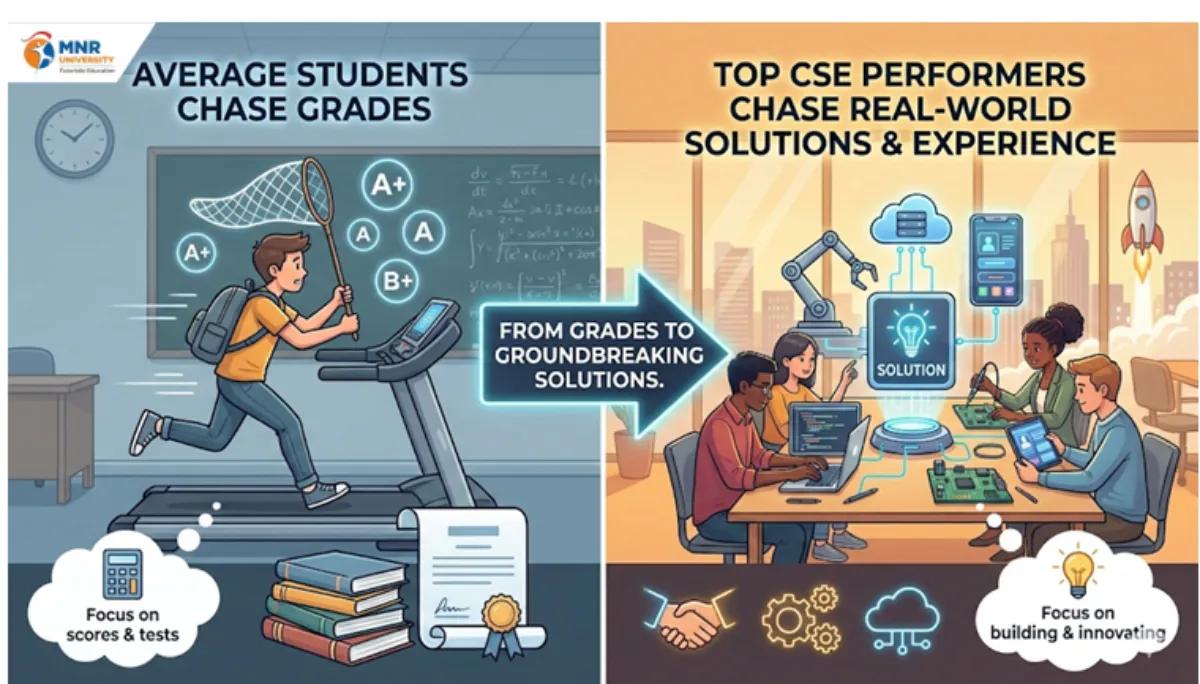
The Untold Code: Habits That Turn Average Students into CSE Toppers
The global technology landscape is shifting at a speed that requires a fresh perspective on…

Is Machine Learning More About Maths Than Coding?
We often look at applications like ChatGPT or self-driving cars and assume they run…

CBSE Board Result Out 2026: What to Do the Moment Your Score Is Live
The moment the CBSE board result out notification flashes on your screen, a thousand questions…

Top B.Optometry Colleges in Telangana 2026: Rankings, Fees and Admission Guide
Telangana has a growing number of colleges offering a Bachelor in Optometry. One of the…