
BSc Renal Dialysis Technology: Course Details, Scope, Salary & Career Opportunities in 2026
Home / School of Allied Sciences / BSc Renal Dialysis Technology: Course Details, Scope, Salary & Career Opportunities in 2026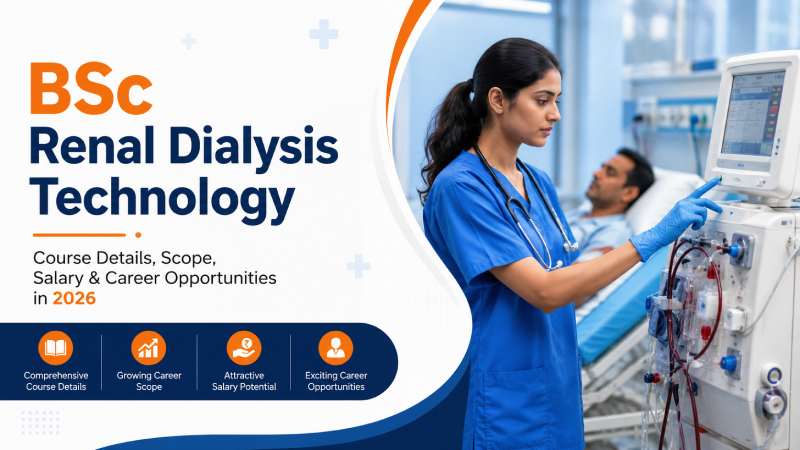
Stepping into the field of kidney care opens the door to a healthcare job that stays in demand year after year. Kidney disease is rising quickly across India, and hospitals need trained people who can run dialysis machines safely. This is where a BSc renal dialysis technology degree fits in.
The course sounds good, and the curiosity pertaining to the future and career possibilities hovers in the mind of aspirants. This guide explains the course in plain words. It covers what students learn, the money they can earn, and the jobs waiting for them in 2026.
What is BSc renal dialysis technology?
BSc renal dialysis technology is a three-year undergraduate degree in allied health sciences. Students learn to operate dialysis machines that clean the blood of patients whose kidneys have stopped working well.
The human body uses two kidneys to remove waste and extra water. When the kidneys fail, a machine must do that job instead. A dialysis technologist sets up the machine, checks the patient, and watches the treatment from start to finish. The work sits where medical science, technology and patient care meet. It is one of the more people-facing allied health sciences courses, because technicians spend hours with the same patients each week.
There are two main methods. Haemodialysis uses a machine and a special filter to clean the blood outside the body. Peritoneal dialysis uses the lining of the abdomen to do the same work. Students learn both during the course.
Why are dialysis technicians in such high demand?
The simple reason is that kidney disease is growing, and every patient on dialysis needs a trained technician. A closer look at the industry shows that the numbers are large and rising fast.
| Indicator | Figure | Source |
| Indian adults with chronic kidney disease | Around 13% (up from 11.12% in 2011-17 to 16.38% in 2018-23) | Talukdar et al., Nephrology (Wiley), 2025 |
| New end-stage kidney failure patients each year | About 2.2 lakh | PMNDP, Ministry of Health & Family Welfare |
| Extra dialysis sessions needed each year | About 3.4 crore | PMNDP, Ministry of Health & Family Welfare |
| People given free dialysis under the national scheme (to Dec 2022) | Over 17.27 lakh | Press Information Bureau, Govt. of India |
| India’s global rank in total kidney disease cases (2023) | Second highest (after China) | Global Burden of Disease study, 2023 |
It would not be wrong to say that few healthcare jobs have such a clear and steady need. Diabetes and high blood pressure are the main causes of kidney damage, and both are common in India. As these conditions rise, kidney failure rises with them. Government schemes have opened dialysis units in hundreds of districts, and each unit needs staff. For many students, this steady demand is the main reason to pick a dialysis technician course over other options.
What are the course details and who can apply?
A student who has passed Class 12 with Physics, Chemistry and Biology can apply for this course. Most colleges ask for 45 to 50 percent marks. Admission to BSc renal dialysis technology is usually based on Class 12 results, though some colleges also accept entrance exam scores.
| Feature | Detail |
| Course level | Undergraduate degree (BSc / BSc Hons) |
| Duration | 3 years across six semesters; final year includes a hospital internship |
| Eligibility | Class 12 (10+2) with Physics, Chemistry and Biology |
| Minimum marks | Usually 45 to 50 percent (varies by college and category) |
| Admission | Merit on Class 12 marks; some colleges also accept entrance scores |
| Average course fee (India) | About Rs 20,000 to Rs 2.5 lakh per year |
| Average starting salary | About Rs 1.5 to 3 lakh per year |
| Governing body | National Commission for Allied and Healthcare Professions (NCAHP) |
The teaching mixes classroom study with practical work on real machines. In the early terms, students study the body and how it works. Later, they move to dialysis methods, machine care and patient safety. The final year is spent inside a hospital, working with patients under supervision. This is the stage where dialysis machine operation becomes second nature.
| Stage | Main focus | Example subjects |
| Year 1 | How the body works | Anatomy, Physiology, Biochemistry, Microbiology |
| Year 2 | Dialysis science | Pathology, Pharmacology, Haemodialysis, Dialyser set-up, Water treatment |
| Year 3 | Hospital practice | Peritoneal dialysis, ICU care, Patient management, Clinical internship |
Once qualified, technicians can register with the National Commission for Allied and Healthcare Professions, which now sets the standard for the field in India. This registration adds weight to the degree and reassures employers.
What career opportunities open up after the course?
Graduates mostly work as dialysis technicians in hospitals and dialysis centres, but the door does not stop there. The BSc renal dialysis technology degree opens more doors than many students expect. Renal dialysis technology career opportunities cover clinics, home-care services, machine companies and teaching.
| Job role | Typical workplace |
| Dialysis technician / technologist | Hospitals and dialysis centres |
| Dialysis unit supervisor | Large hospitals and dialysis chains |
| Clinical coordinator | Nephrology departments |
| Transplant coordinator | Kidney transplant units |
| Application / product specialist | Dialysis machine companies |
| Trainer / lecturer | Colleges and training institutes |
From an employer’s point of view, a well-trained technician is hard to replace. The role needs human judgement, calm hands and care for the patient, so machines cannot take it over. Many nephrology healthcare careers begin with this degree and grow into supervisor, trainer or centre-manager roles. Some graduates even set up their own dialysis units. Renal dialysis technology career opportunities also reach abroad, where trained Indian technicians find work in the Gulf and beyond.
How much can a dialysis technician earn?
A fresher can expect around fifteen to twenty-two thousand rupees a month, and pay climbs with experience. Salary depends on the city, the hospital and the person’s skill.
| Experience level | Approx. monthly pay | Approx. yearly pay |
| Fresher (0-1 year) | Rs 15,000 to 22,000 | Rs 1.5 to 2.8 lakh |
| Mid-level (2-5 years) | Rs 20,000 to 35,000 | Rs 2.5 to 4 lakh |
| Senior (5+ years) | Rs 40,000 to 60,000 | Rs 5 to 7 lakh |
| Government units (AIIMS / RRB) | Rs 30,000 to 45,000 | Rs 3.6 to 5.4 lakh |
| Gulf / abroad | Higher, varies by country | Varies |
In practical terms, a degree holder starts higher than a diploma holder and reaches senior pay sooner. Government dialysis units and large private hospital chains tend to pay the most. Night shifts and extra skills, such as machine maintenance and water treatment, also lift the pay.
How does this course compare with other allied health courses?
Compared with other allied health sciences courses, renal dialysis technology offers steady demand and a short path into a hospital job. Each course leads to a different corner of healthcare.
| Course | Duration | Main area | Starting pay (per month) |
| BSc Renal Dialysis Technology | 3 years | Kidney care and dialysis machines | Rs 15,000 to 22,000 |
| BSc Medical Lab Technology | 3 years | Diagnostic lab tests | Rs 15,000 to 25,000 |
| BSc Radiology & Imaging | 3 years | X-ray, CT and MRI imaging | Rs 18,000 to 30,000 |
| BSc Respiratory Therapy | 3 years | Breathing and ICU support | Rs 18,000 to 28,000 |
| BSc Cardiac & Perfusion Technology | 3 to 4 years | Heart care and bypass machines | Rs 20,000 to 35,000 |
For the most part, students pick the field that matches their interest. Those drawn to kidney care and long-term patient contact tend to choose this route. A kidney care technology course like this one suits students who want a clear job at the end of three years.
Why should students choose MNR University for BSc renal dialysis technology?
MNR University in Hyderabad runs this degree inside its allied health school, with training on modern dialysis machines and clinical practice in busy hospitals. The university carries a legacy of over fifty years in education, backed by a large network of teaching hospitals and health colleges.
Its BSc renal dialysis technology programme places students on working dialysis machines from early on, then sends them into partner hospitals and nephrology centres for close patient work. Students also learn electronic records, remote dialysis and telehealth tools that newer units now use. The university offers scholarships, internships and help finding a first job once the course ends.
Hyderabad is a growing health hub, with many hospitals and dialysis centres close by. This gives students plenty of places to train and, later, to work. From a student’s perspective, a mix of steady teaching, working machines and hospital practice makes the campus a sensible place to study kidney care. Choosing BSc renal dialysis technology at a settled campus can make the first job easier to reach.
Is BSc renal dialysis technology worth it in 2026?
A BSc renal dialysis technology degree is a solid choice for students who want a caring, secure healthcare job without training to become a doctor. Kidney disease is not slowing down, so trained technicians will stay in demand for years to come.
The pay grows steadily, the work matters, and the path from classroom to hospital is short. For a student weighing the options in 2026, a BSc renal dialysis technology graduate leaves with a clear job and a skill that helps real people every single day.
Frequently Asked Questions
The course runs for three years across six semesters. The final year includes a supervised hospital internship. A few universities spread it as three years of study plus a one-year internship.
A student must pass Class 12 (10+2) with Physics, Chemistry and Biology. Most colleges ask for 45 to 50 percent marks, and some accept entrance exam scores.
Yes. Kidney disease is rising in India, and every dialysis patient needs a trained technician. This keeps demand steady and the job secure.
A fresher usually earns about fifteen to twenty-two thousand rupees a month. Pay rises to forty to sixty thousand rupees a month for senior technicians.
Common roles include dialysis technician, dialysis unit supervisor, clinical coordinator, transplant coordinator, machine application specialist and trainer.
Yes. MNR University, Hyderabad offers this degree under its allied health programmes, with training on dialysis machines and clinical practice in hospitals.
Related Blogs

Top Career Opportunities After Physiotherapy in India & Abroad
The landscape of healthcare is shifting toward movement-based recovery, making the choice to study at…

Radiology Career: Why AI Will Never Replace Human Experts
Artificial intelligence continues to reshape modern healthcare systems at an unprecedented pace. Students entering the…

How B.Sc. Respiratory Therapy Course Prepares Graduates to Revolutionise Urban Air Quality Management
In growing megacities where every breath counts, a highly specialised wave of healthcare professionals is…
BSc Radiology Admission Process 2026: A Step-by-Step Guide for Students and Parents
Every March, a familiar scene plays out in Telangana homes. The Intermediate exams finish, the…

Optometry as a Career: What You Need to Know in 2026
There is a quiet shift happening in healthcare, and it is easy to notice if…

After Class 12 Science: Which Degree Offers the Best Career Opportunities in 2026?
Stepping into the final year of Class 12 Science brings a mix of pride and…