
Admission in BPT 2026: Eligibility, Fees, Career Scope and How to Choose the Right Physiotherapy College
Home / School of Allied Sciences / Admission in BPT 2026: Eligibility, Fees, Career Scope and How to Choose the Right Physiotherapy College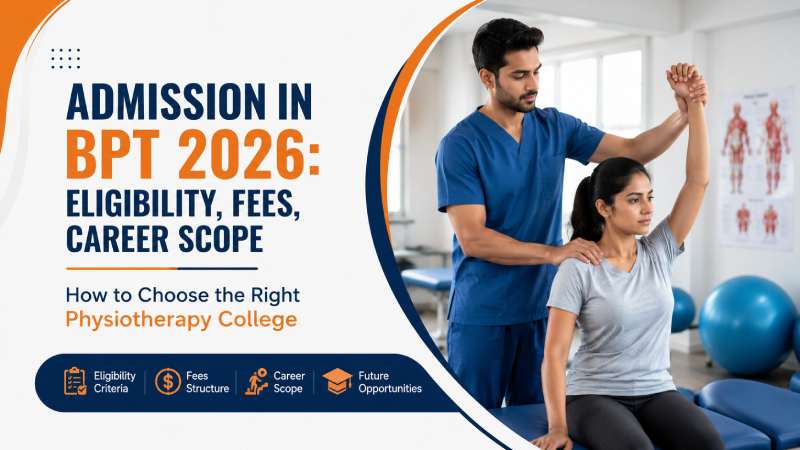
Physiotherapy has grown into one of the most in-demand health careers in India. Every year, thousands of Class 12 students look for a course that mixes science, patient care, and steady job growth. For many of them, admission in BPT is the first real step towards that goal. This guide sets out the eligibility, the fees, the career scope, and the way to pick a good college, so students and parents can plan the next move with confidence.
Stepping into the field of physiotherapy raises many fair questions. What marks are needed? How much does the course cost? Which jobs come after it? The sections below answer each one in plain terms.
What is a BPT course?
BPT stands for Bachelor of Physiotherapy. It is an undergraduate medical degree. It trains students to treat pain, injury, and movement problems without medicine or surgery. The course runs for four and a half years, which includes a six-month clinical internship in a hospital. Every year, a growing number of students plan for admission in BPT right after school.
A closer look at the field shows why. India has about 0.6 physiotherapists for every 10,000 people. The World Health Organisation suggests one for every 10,000. This shortage keeps demand high. It is one reason a physiotherapy course after 12th has become a safe career choice.
| Detail | Information |
| Full form | Bachelor of Physiotherapy (BPT) |
| Level | Undergraduate medical degree |
| Duration | 4.5 years (4 years study + 6-month internship) |
| Subjects needed in Class 12 | Physics, Chemistry, Biology, English |
| Minimum marks | Around 50% in science subjects (relaxation for reserved categories) |
| Minimum age | 17 years at the time of admission |
| Common job fields | Hospitals, sports, rehabilitation, wellness |
What is the eligibility for admission in BPT in 2026?
The rules for admission in BPT are simple for most students. A candidate must pass Class 12 with Physics, Chemistry, and Biology from a recognised board. A pass in English is also needed. Most colleges ask for at least 50 percent marks in the science subjects. Reserved category students usually get a small relaxation.
Not everyone is aware that there is an age rule as well. A student must be at least 17 years old at the time of admission. Under current national guidelines, there is no upper age limit.
| Criteria | General category | Reserved category (SC/ST/OBC/PwD) |
| Class 12 subjects | Physics, Chemistry, Biology | Physics, Chemistry, Biology |
| Minimum marks in science | 50% aggregate | 40% to 45% aggregate |
| English | Pass required | Pass required |
| Minimum age | 17 years | 17 years |
| Upper age limit | None | None |
How does the BPT admission 2026 process work?
The BPT admission 2026 process is easy to follow. A student applies to a college, submits Class 12 mark sheets and identity proof, and completes any counselling step. Some colleges admit students on board marks alone. Others use a state common entrance test or their own entrance step.
This is where things become interesting. In February 2026, the National Commission for Allied and Healthcare Professions ruled that NEET will not be needed for BPT in the 2026 to 2027 session. The rule now applies from 2027 to 2028. So most students can still gain admission in BPT on the strength of their Class 12 results. State rules can differ, so families should confirm the current position with their college.
| Admission route | How it works | Best suited for |
| Direct merit | Seat on Class 12 science marks | Most private colleges and universities |
| State common entrance test | Rank in a state CET decides the seat | Government and top state colleges |
| College entrance step | College holds its own test or interview | Some private universities |
What are the BPT course fees in India?
One question that often comes up is the cost. BPT fees change a lot across India. Government colleges can charge as little as 20,000 rupees a year. Private colleges and deemed universities charge more, often between 50,000 and 2,00,000 rupees a year. The city and the campus facilities shape the final figure.
Scholarships can bring these figures down. Many private universities offer merit awards that cut a large part of the tuition fee. Students should ask the admissions office for the current fee and scholarship details before they apply.
| College type | Indicative fee per year | Notes |
| Government | Rs 20,000 to Rs 60,000 | Lowest fees, limited seats |
| Private university | Rs 50,000 to Rs 1,50,000 | Varies by campus and city |
| Deemed university | Rs 1,00,000 to Rs 2,00,000+ | Higher fees, added facilities |
What is the career scope after BPT?
Career scope is the part most students care about. A physiotherapy degree opens doors in hospitals, clinics, sports academies, rehabilitation centres, and wellness studios. Ask any experienced professional in the field, and they will tell you the work is steady and the roles keep growing.
Two paths draw the most interest. A sports physiotherapy career suits those who love games and fitness. These physiotherapists work with athletes, teams, and gyms. They treat injuries and help players move better. Clinical physiotherapy training prepares students for hospital and rehabilitation work with patients of every age. Both paths pay well and offer room to grow.
Pay grows with skill and experience. A fresh physiotherapist in India earns around 2.5 to 4 lakh rupees a year. With a few years of practice and a postgraduate specialisation, this can rise to 6 to 10 lakh rupees. Physiotherapists who clear the licence exam abroad, in countries such as the United Kingdom, Australia, and Canada, earn far higher packages.
| Role | Where they work | Indicative starting pay (India) |
| Clinical physiotherapist | Hospitals, clinics | Rs 2.5 to Rs 4 lakh a year |
| Sports physiotherapist | Teams, academies, gyms | Rs 2.5 to Rs 4 lakh a year |
| Neuro or ortho physiotherapist | Rehabilitation centres | Rs 2.5 to Rs 4 lakh a year |
| Senior or MPT specialist | Multi-speciality hospitals | Rs 6 to Rs 10 lakh a year |
| Abroad (UK, Australia, Canada) | Hospitals and clinics | Higher, by role and country |
How can students pick the right physiotherapy college?
Choosing a college is a big decision for any family. From a student’s perspective, the college should offer good teaching, real patient practice, and steady help at the end of the course. From an employer’s point of view, graduates who trained in busy hospitals settle into jobs faster.
A few simple checks help students compare options before they seek admission in BPT. The table below lists the points that matter most.
| What to check | Why it helps |
| College recognition and affiliation | Confirms the degree is valid for jobs and higher study |
| On-campus or tie-up hospital | Gives students real patient practice during the course |
| Physiotherapy labs (exercise and electrotherapy) | Lets students practise skills before they treat patients |
| Faculty and internship record | Better guidance and a smoother start to work |
| Scholarships and total cost | Keeps the course within a family’s budget |
| Help with placements and further study | Supports the move from college to a first job |
Why do students consider MNR University for admission in BPT?
There is a general notion that South India stays ahead of many regions in health education, with Hyderabad among its leading centres. Fathoming the consequence of this fact, private universities in the region have grown their campuses and clinics to draw students from across the country. MNR University, Hyderabad, is one name that comes up often for a bachelor of physiotherapy admission.
The university runs its School of Physiotherapy on a large campus near Greater Hyderabad, with teaching hospitals on the same grounds. Students learn in exercise therapy and electrotherapy labs, then move into real patient care through clinical postings. The BPT programme lasts four and a half years, with a six-month internship, in line with national norms.
MNR University also brings a record of over fifty years in education, along with academic ties to universities in the United States. It stands among the first universities in Telangana to earn a DASCA United States accreditation, and its green campus holds a Gold rating. The university offers full and partial merit scholarships, and top scorers can qualify for a full tuition waiver. These points make it a college worth a place on any student’s shortlist for admission in BPT.
What should students remember about admission in BPT?
Physiotherapy offers a stable and respected path for students who like science and care about people. The demand is real, the pay grows with skill, and the work feels rewarding day to day. For students planning BPT admission 2026, admission in BPT is a smart move. With clear eligibility, fair fees, and wide career options, a bachelor of physiotherapy degree is a strong choice. A college with good clinical training, such as MNR University, gives students a solid place to begin.
Frequently Asked Questions
No. For the 2026 to 2027 session, NEET is not required for BPT in most colleges. The rule now applies from the 2027 to 2028 session. Students should still confirm with their chosen college, as some state rules can differ.
Most colleges ask for at least 50 percent marks in Physics, Chemistry, and Biology in Class 12. Reserved category students often receive a relaxation of about 5 to 10 percent.
The BPT course runs for four and a half years. This includes four years of study and a six-month clinical internship in a hospital.
A fresh physiotherapist in India usually earns about 2.5 to 4 lakh rupees a year. Pay rises with experience and a postgraduate specialisation.
Yes. Physiotherapy is a recognised profession in many countries. After passing the local licence exam, BPT graduates can work in places such as the United Kingdom, Australia, Canada, and the Gulf region.
Students can study a Master of Physiotherapy (MPT) and specialise in areas such as sports, orthopaedics, neurology, or cardiopulmonary care.
Related Blogs
Radiology vs Physiotherapy vs Nursing: Which Healthcare Career is Better?
Healthcare in India is expanding at a remarkable pace, and the scope of radiology, physiotherapy,…

Emerging Science Careers in India: Degrees That Employers Will Value in the Next Decade
Science has always drawn curious minds. Yet the kind of science jobs that pay well…
BSc Radiology Admission Process 2026: A Step-by-Step Guide for Students and Parents
Every March, a familiar scene plays out in Telangana homes. The Intermediate exams finish, the…
Physiotherapy Course in Hyderabad: Your Complete Guide to a Rewarding Healthcare Career
Stepping into the field of physiotherapy is a choice many young students in India are…
BSc MLT Under NCAHP: Advancing Clinical Diagnostics
Clinical diagnostics form the absolute backbone of modern medical interventions, where precise laboratory results directly…
Optometrist Course Details After 12th: Eligibility, Duration, Fees, Salary and Career Scope in 2026
Stepping into the field of eye care after school can feel like a big step….