
How Artificial Intelligence Is Transforming BSc Medical Laboratory Technology in 2026
Home / MNR University / How Artificial Intelligence Is Transforming BSc Medical Laboratory Technology in 2026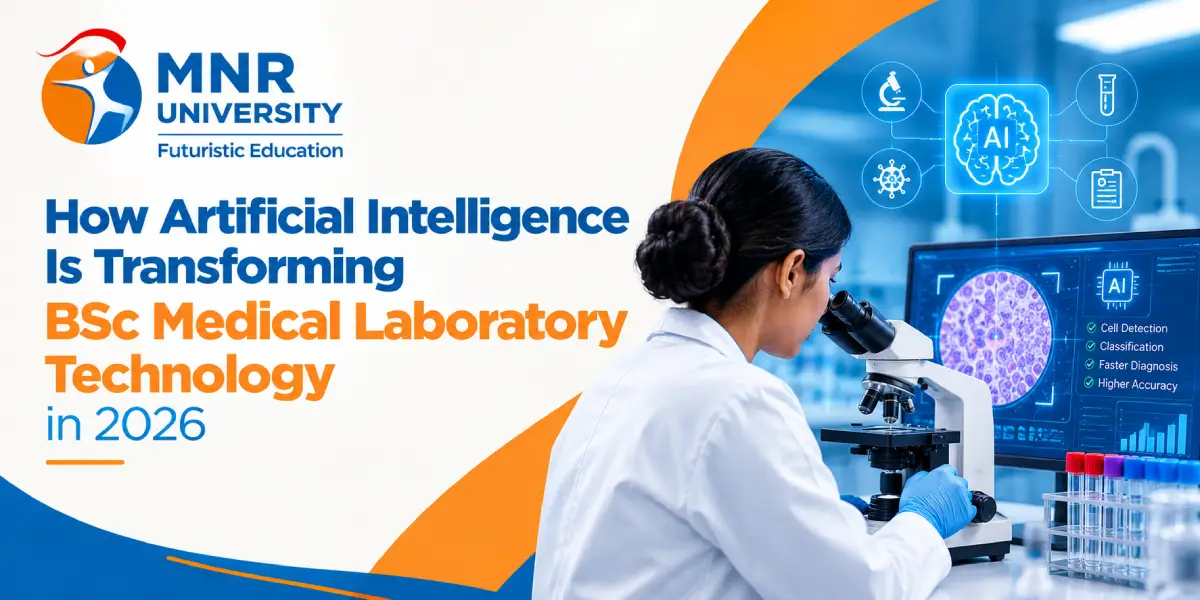
A blood sample reaches a hospital laboratory in Hyderabad at nine in the morning. By half past nine a machine has counted the cells, marked one that looks odd, and pushed the image to a screen. A young technologist studies it, agrees, and the report leaves the lab. Ten years ago the same job meant an hour bent over a microscope.
That small scene says a great deal about where laboratory science is heading. Software now sorts slides, spots patterns and cuts reporting time inside diagnostic labs across India. It has not taken the white coat off anyone. It has changed what the person wearing it does all day.
For students planning a BSc Medical Laboratory Technology admission in 2026, this matters more than it might seem. Syllabi are picking up new topics. Employers are asking for new skills. Pay is moving for those who have them.
This article covers what AI actually does inside a laboratory, which skills now carry weight, what MNR University offers, how the course compares with other options in Telangana, and what a family should check before paying a fee.
What Does Artificial Intelligence Actually Do Inside a Medical Laboratory?
In plain words, AI in a laboratory is software that has learnt from thousands of past samples and then points out what looks unusual in a new one.
It works at three points. Before the test, it sorts samples and decides which ones need priority. During the test, it reads images like blood films, tissue sections, culture plates and marks suspicious areas. After the test, it compares the result with the patient’s earlier reports and raises a warning when something does not fit.
A closer look at the industry shows this is no longer a pilot project.
| Laboratory area | What the AI tool does | Reported performance | Source |
|---|---|---|---|
| Histopathology slide reading | Scans whole-slide images and marks areas that look cancerous | Mean sensitivity 96.3%, specificity 93.3% across 152,000+ slides | npj Digital Medicine (Nature), 2024 |
| Lymph node metastasis | Spots cancer spread that is easy to miss by eye | 92.4% sensitivity for AI vs 73.2% for pathologists | Oncology Reports review, PMC, 2026 |
| Lymphoma subtyping | Separates subtypes from stained tissue images | Up to 100% accuracy vs 74.39% for human readers | Oncology Reports review, PMC, 2026 |
| Prostate biopsy screening | Pre-sorts biopsy cores so staff stain only what is needed | Extra IHC staining cut by 44.4% across 15 labs in 11 countries | Oncology Reports review, PMC, 2026 |
| Regulator-cleared tools overall | AI software now legally approved for clinical use | 1,451 AI-enabled devices authorised by the US FDA up to Dec 2025 (64 in 2020) | US FDA AI-Enabled Devices List; The Imaging Wire, 2026 |
| Pathology and microbiology share | Slide and culture work is still early in its AI journey | Only 9 pathology and 6 microbiology devices among 1,430 analysed | JMIR / PMC longitudinal analysis, 2026 |
It is worth noting that pathology and microbiology still hold a small share of those approvals. Imaging is far ahead. For a student entering the field in 2026, that gap is the opening, not the discouragement.
Why Are So Many Students Searching for BSc Medical Laboratory Technology Hyderabad in 2026?
One question that often comes up is why Hyderabad in particular. The answer sits in the city’s hospitals and laboratories. Large multi-speciality chains, NABL-accredited reference labs, vaccine makers and a thick belt of pharmaceutical units all operate here. A student who trains in this city rarely has to move for a first job.
The numbers behind that demand are worth reading slowly.
| What the number measures | Figure (with INR value) | Period | Source |
|---|---|---|---|
| Share of medical decisions that rest on a lab test | About 70% | 2019 | US Centers for Disease Control and Prevention (CDC) |
| India diagnostic labs market | USD 18.55 bn (about ₹1.63 lakh crore) rising to USD 37.13 bn (about ₹3.27 lakh crore) | 2025 → 2032 | MarkNtel Advisors, 2026 |
| India pathology lab services market | USD 19.5 bn (about ₹1.72 lakh crore) rising to USD 45.4 bn (about ₹4.00 lakh crore) | 2025 → 2034 | IMARC Group, 2026 |
| Shortage of allied and healthcare professionals in India | About 6.5 million people | 2026 | NCAHP sector commentary, Indian Pharma Post |
| Health workers per 10,000 people in India | About 20, against the WHO mark of 44.5 | 2026 | WHO threshold; Indian Pharma Post |
| Global AI in healthcare market | USD 36.7 bn (about ₹3.23 lakh crore) rising to USD 505.6 bn (about ₹44.5 lakh crore) | 2025 → 2033 | Grand View Research, 2026 |
| Global AI in diagnostics market | USD 5.44 bn (about ₹47,900 crore) by 2030, growing 22.46% a year | 2024 → 2030 | Grand View Research, 2025 |
Many parents and students still believe that laboratory work is a fallback for those who miss MBBS. The figures suggest otherwise. India runs short of roughly 6.5 million allied and healthcare professionals, and laboratory roles sit right in the middle of that shortage.
How Is the Job of a Lab Technologist Changing Because of AI?
This is where things become interesting. The machine does the counting. The person does the deciding.
Older laboratory work rewarded speed and steady hands. A technologist screened slides for hours and called out anything odd. In 2026 the software makes the first pass and hands over a shortlist. The technologist then judges whether the software got it right.
| Daily task | How it was done earlier | How it works in 2026 | What the student must now learn |
|---|---|---|---|
| Screening blood films | Manual scanning of every slide under a microscope | Digital scanner reads the film; software flags odd cells | Confirming or rejecting a software flag with reasons |
| Cell counting | Manual counting chambers and long tallies | Analyser counts and classifies automatically | Reading analyser scattergrams and error codes |
| Tissue slide review | Full slide viewed by eye, region by region | Heat maps point to suspicious regions first | Digital pathology viewers and slide quality checks |
| Result validation | Manual comparison with earlier reports | Rules engine compares with patient history and warns | Judging when the warning is genuine |
| Quality control | Paper registers and manual Levey-Jennings charts | Live dashboards flag drift as it happens | Reading QC charts and acting on a breach |
| Reporting | Typed manually into a register or sheet | Results flow into the LIS and reach the doctor directly | LIS or LIMS handling and data entry discipline |
From an employer’s point of view, the second job is harder than the first. A careless “yes” to a software flag can send a healthy patient for a biopsy. A careless “no” can miss a cancer. Judgement, not typing speed, now decides who gets promoted.
Which New Skills Do Employers Now Expect from MLT Graduates?
Not everyone is aware that almost all of these skills fit inside an ordinary three or four-year degree. None of them needs a computer science background.
| Skill an employer asks for | Why it carries weight now | How deeply a B.Sc MLT student needs it |
|---|---|---|
| Careful sample collection and handling | Most lab errors still happen before the test begins, and no AI fixes a bad sample | Very deep — this stays the core skill |
| Reading AI flags critically | Software gives a shortlist, not a verdict | Deep — daily judgement work |
| LIS / LIMS operation | Every report now travels through lab software | Deep — practical, taught on the job and in college |
| Quality control and NABL norms | Accredited labs must prove accuracy on paper | Deep — needed for supervisory roles |
| Basic data literacy | Reading charts, averages, drift and error rates | Moderate — spreadsheet level is enough |
| Understanding how a model is trained | Helps a technologist explain why a tool failed on one sample | Light — awareness, not coding |
| Biosafety and waste handling | Legal requirement in every diagnostic setting | Deep — non-negotiable |
| Clear communication with clinicians | A flagged result must be explained in plain words | Moderate — improves with practice |
In practical terms, a graduate who can run a haematology analyser, read its flags, log the result in the laboratory information system and explain a failed control to a pathologist is worth far above one who can only run the analyser.
What Does the BSc Medical Laboratory Technology at MNR University Cover?
MNR University sits at MNR Nagar, Fasalwadi, in Sangareddy district on the Hyderabad side. Its School of Allied and Healthcare Sciences runs the BSc (Hons) in Medical Laboratory Technology. Families comparing a BSc Medical Laboratory Technology admission usually want the same six facts in one place, so they are set out below.
| Particular | Detail | Source |
|---|---|---|
| Course name | B.Sc (Hons) in Medical Laboratory Technology | MNR University |
| School | School of Allied and Healthcare Sciences | MNR University |
| Duration | 4 years (includes compulsory internship) | MNR University / KNRUHS pattern |
| Eligibility | 10+2 with BiPC or MPC from a recognised board, or Class 10 plus a 2 or 3-year diploma in a related technology | MNR University |
| Minimum age | 17 years as on 31 December of the admission year | MNR University |
| Admission basis | Merit, or a valid state, national or international entrance test score | MNR University |
| Seats | 120 | Shiksha course listing |
| Indicative total tuition | About ₹2.60 lakh for the full course | Shiksha course listing |
| Core subjects | Pathology, microbiology, clinical biochemistry, haematology, immunology, blood banking | MNR University |
| Campus | MNR Nagar, Fasalwadi, Sangareddy district, Greater Hyderabad | MNR University |
| University recognition | Telangana’s first university accredited by the Data Science Council of America (DASCA), USA — granted 7 April 2026, valid to 6 April 2032 | DASCA newsroom |
What do three separate laboratories mean for a student?
The university runs three separate teaching laboratories that mirror the hardware and the software a graduate meets on the first day of a job. A student practises on the analyser model, the reporting screen and the quality-control routine that a working hospital actually uses. From a student’s perspective, that removes the awkward first month where a fresher learns the machine instead of the medicine.
MNR is also Telangana’s first university accredited by the Data Science Council of America, a body based in the United States. That accreditation covers its data science and artificial intelligence programmes, and the same faculty pool supports AI teaching across schools. The campus holds a gold rating for sustainability, and the MNR group has run health-science education in this region for over fifty years. Academic tie-ups with universities in the United States, along with scholarships and internship support, sit alongside that record.
How does MNR University compare with other institutions in Hyderabad?
| Institution (Hyderabad region) | Runs B.Sc MLT? | Type | Indicative total tuition | Point worth noting |
|---|---|---|---|---|
| MNR University | Yes | Private state university | About ₹2.60 lakh | Allied health school on a campus with a group teaching hospital; DASCA-accredited university |
| Malla Reddy University | Yes | Private state university | Varies by intake year | 3 years plus a 6-month to 1-year internship |
| Anurag University | Yes (allied health B.Sc streams) | Private state university | B.Sc programmes from about ₹1.5 lakh upward | Allied health specialisations rather than a single MLT track |
| CMR Institute of Health Sciences | Yes (allied health) | Private institute | Set under state counselling norms | Admission largely through KNRUHS allied health counselling |
| KNRUHS, Telangana | Yes — and it runs state counselling | State health sciences university | About ₹85,000 | 50 seats across its BMLT listings; the low-cost government route |
| BITS Pilani, Hyderabad Campus | No | Private deemed university | Not applicable | Engineering, pharmacy and sciences focus |
| Woxsen University | No | Private state university | Not applicable | Business, design and technology focus |
| Mahindra University | No | Private state university | Not applicable | Engineering and management focus |
| VNR VJIET | No | Autonomous engineering college | Not applicable | Engineering programmes only |
| Vasavi College of Engineering | No | Autonomous engineering college | Not applicable | Engineering programmes only |
Five names that students often shortlist alongside MNR are BITS Pilani Hyderabad, Woxsen University, Mahindra University, VNR VJIET and Vasavi College of Engineering — do not run a B.Sc MLT programme at all. They sit in engineering, management and design. That single fact narrows a confusing shortlist very quickly.
What Career Paths Can Students Explore After B.Sc MLT?
Stepping into the field of medical laboratory technology sounds good, and the curiosity about the future hovers in the mind of every aspirant. The roles are wider than most families expect, and a B.Sc Medical Laboratory Technology Hyderabad graduate is not limited to a bench job.
| Role after BSc Medical Laboratory Technology | What the work involves | Where AI touches it | Indicative pay (₹ per year) |
|---|---|---|---|
| Medical lab technologist, hospital | Runs routine tests across departments | Analyser flags and rule-based validation | ₹1.8 – 2.5 lakh as a fresher |
| Technologist, diagnostic chain | High-volume testing in a reference lab | Automated sorting and auto-verification | ₹1.5 – 2.2 lakh as a fresher |
| Histopathology / cytology technician | Prepares and stains tissue sections | Digital slide scanning and heat maps | ₹2 – 3.5 lakh, rising with skill |
| Microbiology technologist | Culture, sensitivity and identification work | Automated plate reading and ID systems | ₹2 – 3.5 lakh |
| Blood bank technologist | Grouping, cross-matching and storage | Inventory prediction software | ₹2 – 3.5 lakh |
| Quality control / NABL coordinator | Keeps the lab audit-ready | Live QC dashboards and drift alerts | ₹4.5 – 6.5 lakh with experience |
| Application specialist, IVD company | Installs analysers and trains hospital staff | Sells and supports the AI features directly | ₹4 – 8 lakh, often with travel |
| Laboratory manager | Runs staffing, costing and compliance | Uses dashboards to plan workload | ₹6 – 10 lakh and above |
| Higher study route (M.Sc MLT, PhD) | Research, teaching or specialist practice | Opens work in AI validation studies | Depends on the path chosen |
It would not be wrong to say that the best-paid roles now sit where laboratory science meets equipment and software. Diagnostic companies hire MLT graduates as application specialists to install analysers and train hospital staff. Those jobs pay well and travel widely.
How Much Does a BSc Medical Laboratory Technology Hyderabad Degree Cost, and What Comes Back?
| Study route | Indicative total tuition | Duration | Typical fresher pay band | Rough time to recover tuition |
|---|---|---|---|---|
| KNRUHS-affiliated government route | About ₹85,000 | 4 years with internship | ₹1.8 – 2.5 lakh a year | Under one year of earnings |
| MNR University, Hyderabad | About ₹2.60 lakh | 4 years with internship | ₹1.8 – 2.5 lakh a year | Roughly 1 to 1.5 years of earnings |
| Other private universities in the region | Varies, commonly ₹1.5 lakh upward | 3 to 4 years plus internship | ₹1.5 – 2.5 lakh a year | Varies with the fee charged |
| DMLT diploma route | Lower, but shorter and narrower | 2 years | ₹1.2 – 1.8 lakh a year | Fast, though the ceiling is lower |
Fees vary widely. The government route through KNRUHS counselling is the cheapest, though seats are few and competition is sharp. Private universities charge more and usually set merit scholarships against that fee. MNR University publishes both its fee structure and its scholarship rules online, so a family can work out the real figure before applying rather than after.
What Should Students Check Before Taking Admission in 2026?
At some point, most students wonder whether a brochure is telling the whole story. Seven questions sort that out quickly.
| Question to ask before paying a fee | Why it matters | Where to check it |
|---|---|---|
| Is the programme registered under the NCAHP framework? | Registration shapes how a qualification is recognised across states | University admission office and state council |
| Does the course include a full clinical internship? | The internship, not the classroom, builds employability | Course page and prospectus |
| Is there a hospital or reference lab attached? | Daily sample volume decides how much a student actually sees | Campus visit |
| How many students share one analyser? | Practice time per student matters far above brochure photographs | Lab visit during counselling |
| Is any digital pathology or LIS work included? | This is the skill gap employers now complain about | Syllabus copy |
| What scholarships apply, and on what condition? | Merit waivers can change the real cost sharply | University scholarship page |
| Where did last year’s batch go? | Placement patterns say more than placement claims | Placement cell |
Is BSc Medical Laboratory Technology Hyderabad Still Worth Choosing in 2026?
For the most part, yes and for a better reason than before. AI has taken away the dull part of laboratory work and left the thinking part behind. Samples still need careful hands. Results still need a human signature. Quality still needs someone who understands why a control failed.
A degree taken at a university that teaches both the bench and the software puts a graduate on the right side of that shift. Students who treat the course as a science degree rather than a technician certificate will find the coming ten years kind to them.
Frequently Asked Questions
B.Sc Medical Laboratory Technology is an undergraduate science degree that trains students to run medical tests on blood, tissue, urine and other samples. Graduates work in hospital labs, diagnostic chains, blood banks and research units. The course mixes classroom theory with laboratory practice and a clinical internship.
Yes, for students who like biology and precise work. Lab results guide about 70% of medical decisions, and India runs short of roughly 6.5 million allied and healthcare professionals. Demand is steady rather than seasonal.
No. AI sorts, counts and flags. A qualified person still collects the sample, checks that the machine behaved correctly, approves the report and answers the clinician. AI has removed repetitive scanning work and added a layer of judgement work on top.
A candidate must have passed 10+2 with BiPC or MPC from a recognised board, or completed Class 10 followed by a 2 or 3-year diploma in a related technology. The minimum age is 17 years as on 31 December of the admission year. Selection is on merit or a valid entrance test score.
The programme runs for four years, which includes the compulsory internship period. The internship is where most students pick up real sample handling and reporting confidence.
Fees vary widely by route. The KNRUHS-affiliated government route is listed at about ₹85,000 in total. At MNR University, the indicative total tuition is about ₹2.60 lakh for the full course. Private universities usually offer merit scholarships against their published fee.
The main subjects are pathology, microbiology, clinical biochemistry, haematology, immunology and blood banking. Anatomy, physiology, laboratory safety and quality control run alongside. Newer syllabi add laboratory information systems and digital pathology basics.
Common roles include hospital laboratory technologist, diagnostic chain technologist, histopathology or cytology technician, microbiology technologist, blood bank technologist, quality control coordinator, application specialist with a diagnostic equipment company, and laboratory manager after a few years.
Freshers in hospital labs commonly start between ₹1.8 lakh and ₹2.5 lakh a year. Diagnostic chains start slightly lower. Quality control and supervisory roles move to ₹4.5 lakh to ₹6.5 lakh, and laboratory managers cross ₹6 lakh to ₹10 lakh. Salary survey averages for the role in India sit near ₹3.87 lakh.
No. Employers ask for the ability to read an AI flag, check it against the sample and explain the decision. Spreadsheet-level data comfort and LIS handling are enough. Coding helps only for students who later move into research or product roles.
Admission rules differ by institution. Under KNRUHS, allied health courses including B.Sc MLT have been admitted through a state merit and counselling process rather than NEET in recent cycles. Private universities such as MNR University admit on merit or a valid entrance test score. Candidates should confirm the current year’s notification before applying.
There is no single answer, because it depends on budget and access. The KNRUHS route is the cheapest but has few seats. Among private options, MNR University runs the course through its School of Allied and Healthcare Sciences on a campus with a group teaching hospital. Several institutions students shortlist, including BITS Pilani Hyderabad, Woxsen, Mahindra University, VNR VJIET and Vasavi College of Engineering, do not run this course at all.
Yes, though each country has its own licensing route. Gulf countries, the United Kingdom, Australia and Canada all hire laboratory staff, usually after a registration exam or a credential check. A degree plus documented internship hours makes that paperwork simpler than a diploma alone.
DMLT is a two-year diploma that prepares a person for technician work. B.Sc MLT is a full degree of three to four years with deeper theory, research exposure and a wider promotion ceiling. Supervisory, quality control and postgraduate routes generally need the degree.
MNR University publishes merit-based scholarship rules and a separate fee structure on its website. Families should read both pages together, since a merit waiver can change the real cost of a B.Sc Medical Laboratory Technology Hyderabad admission considerably.
Related Blogs
BSc Renal Dialysis Technology: Course Details, Scope, Salary & Career Opportunities in 2026
Stepping into the field of kidney care opens the door to a healthcare job that…
What Is an Anaesthesia Technology Course? Scope, Syllabus & Career Paths in India
Healthcare is one of the fastest-growing sectors in India. New hospitals, specialised clinics, trauma centres,…
AI in Physiotherapy: How Artificial Intelligence Is Changing Rehabilitation
AI in physiotherapy means using cameras, wearable sensors and software that learn from data to…
CBSE Board Result Out 2026: What to Do the Moment Your Score Is Live
The moment the CBSE board result out notification flashes on your screen, a thousand questions…
Top 10 Careers in Allied and Healthcare Sciences That Will Shape the Future of Healthcare
The world of healthcare is much bigger than doctors and nurses. Behind every diagnosis, surgery,…

Top BSc Optometry Colleges in Telangana 2026: Rankings, Fees and Admission Guide
Are you looking for the best BSc Optometry colleges in Telangana? Telangana has a growing…