
B. Optometry (Bachelor in Optometry) Course Details: Duration, Syllabus and Career Scope
Home / MNR University / B. Optometry (Bachelor in Optometry) Course Details: Duration, Syllabus and Career Scope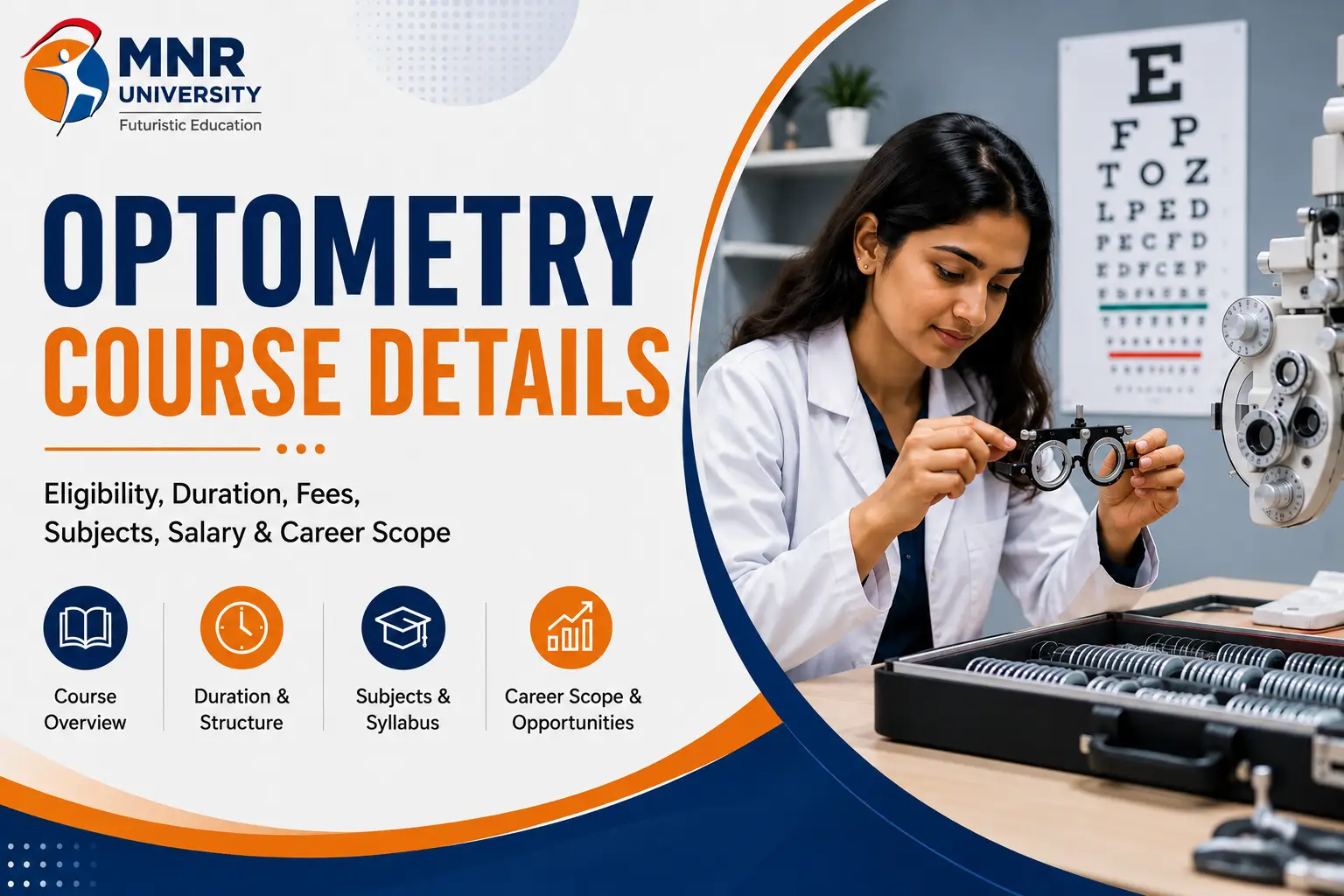
Bachelor in Optometry is a four-year undergraduate healthcare degree that trains students to examine eyes, measure refractive error, fit spectacles and contact lenses, and pick up eye disease at an early stage. The usual structure is three years of academic and clinical study followed by one year of supervised internship. Entry opens after Class 12 with Biology or Mathematics. Graduates practise as clinical optometrists, who are the first point of contact for eye care in most Indian hospitals and optical chains.
Stepping into the field of eye care sounds good, and the curiosity pertaining to the future and career possibilities hovers in the mind of aspirants. This guide sets out the optometry course details that students and parents ask about most often: duration, year-wise subjects, instruments, eligibility, pay figures and the Hyderabad universities that actually run the programme.
A closer look at the industry shows why the timing suits students entering now. An AIIMS-led national study counted 17,849 optometrists against 20,944 ophthalmologists at secondary and tertiary eye care centres in India, a ratio of 0.85 optometrists per ophthalmologist, when the Vision 2020 norm asks for three. India also carries around 4.9 million blind people and 32.9 million people with visual impairment, as recorded by the National Blindness and Visual Impairment Survey 2015-19. The work exists. The people to do it do not, yet.
What are the Bachelor in Optometry course details at a glance?
The table below answers the questions asked in almost every admission call. Every figure is drawn from a named source so that families can check it themselves.
| Detail | What it means for a 2026 applicant | Source |
|---|---|---|
| Degree type | Undergraduate professional degree under allied and healthcare sciences | NCAHP Act, 2021 |
| Duration | 4 years, made up of 3 years of study and 1 year of internship | KNRUHS Allied Health Sciences notification |
| Minimum training hours | 3,600 hours for anyone practising as an optometrist | NCAHP Act, 2021 |
| Study mode | Full time and on campus, with postings inside a teaching hospital | MNR University |
| Eligibility | 10+2 with BiPC or MPC, minimum 50 per cent aggregate | MNR University; Malla Reddy University |
| Minimum age | 17 years as on 31 December of the admission year | MNR University |
| Regulator | Ophthalmic Sciences Council under the National Commission | NCAHP Act, 2021 |
| Occupation code | ISCO 2267, listed as a healthcare professional and not as a technician | NCAHP Act, 2021 |
| Common job titles | Clinical optometrist, refractionist, contact lens specialist, low vision specialist | Optometry Council of India |
Not everyone is aware that optometry became a legally recognised healthcare profession in India only in 2021. The National Commission for Allied and Healthcare Professions Act placed optometrists under the Ophthalmic Sciences Council and fixed a floor of four years and 3,600 hours of education for anyone using the title. Ophthalmic assistants and vision technicians sit below that line, at two years and 2,000 hours. That single rule changed how a family should read the optometry course details on any college website. If the programme runs shorter than four years, it is not an optometry degree, whatever the brochure calls it.
How long is the Bachelor in Optometry course and what is the study mode?
The B.Sc Optometry course at MNR University runs for four years, full time. Three years cover theory, laboratory work and clinical postings. The fourth year is a rotating internship inside an eye hospital, where the student sees patients under supervision rather than sitting in a classroom. It is quite common to hear students ask whether a shorter version exists. A few institutions do run three-year programmes in ophthalmic technology or vision science. Those are different qualifications with a narrower scope of practice, and a graduate of one cannot register as an optometrist. The comparison below sets the options side by side.
Eye care qualifications in India compared by duration and scope
| Qualification | Minimum duration |
Minimum hours |
Scope of practice | Source |
|---|---|---|---|---|
| BSc Optometry or B.Optom | 4 years | 3,600 | Independent eye examination, refraction, contact lens fitting, screening and referral | NCAHP Act, 2021 |
| Diploma in Ophthalmic Assistance |
2 years | 2,000 | Assists an ophthalmologist, cannot practise independently | NCAHP Act, 2021 |
| Vision Technician certificate |
2 years | 2,000 | Basic vision screening and refraction support at primary level | NCAHP Act, 2021 |
| MSc Optometry | 2 years after BSc |
Not specified | Specialist practice, teaching and research | University of Hyderabad |
| MBBS with MS Ophthalmology |
5.5 years plus 3 years |
Not applicable | Medical and surgical treatment of eye disease | National Medical Commission |
From a student’s perspective, the four-year route is the only one that keeps every door open. It leads to registration, to a master’s degree later, and to work abroad, because the four-year structure matches what most other countries accept.
Read more: Optometry Courses After 12th: Eligibility, Duration, Fees and Career Path (2026 Guide)
What does the year-wise Bachelor in Optometry syllabus cover?
Anyone comparing optometry course details across universities should read the year-wise split rather than the subject list alone. The syllabus moves in a straight line from how the eye is built, to how light behaves, to how a patient is examined, to independent practice.
Year-wise Bachelor in Optometry syllabus snapshot
| Year | Core subjects | Clinical and laboratory work | Source |
|---|---|---|---|
| Year 1 | General anatomy and physiology, ocular anatomy, geometrical optics, biochemistry, basic mathematics | Optics laboratory, visual acuity testing, introduction to the eye clinic | MNR University; GITAM |
| Year 2 | Physical and visual optics, ocular physiology, ophthalmic lenses and dispensing, microbiology and pathology | Trial frame refraction, lens fabrication, retinoscopy practice | MNR University; Malla Reddy University |
| Year 3 | Clinical optometry, contact lenses, binocular vision, ocular disease, low vision aids, public health optometry | Supervised outpatient clinics, contact lens fitting, paediatric vision assessment | MNR University; GITAM |
| Year 4 | No new theory papers; case presentations, logbook and viva | Full-time rotating internship across refraction, contact lens, glaucoma and retina clinics | KNRUHS; MNR University |
Foundation years: anatomy, optics and ocular sciences
The first two years look more like a science degree than a hospital course. Students learn the structure of the eye layer by layer, then study how light bends through a lens. This pairing matters. A prescription is a calculation before it is a piece of paper, and a student who never understood geometrical optics will struggle at the trial frame in the third year.
Laboratory sessions run alongside the theory. Students mount lenses, measure powers, and start reading a retinoscope reflex long before they meet a paying patient.
Clinical years: refraction, contact lenses and disease management
The third year is where things become interesting. Students move into outpatient clinics and start examining patients under supervision. Refraction becomes routine. Contact lens work begins, including fitting for irregular corneas. Binocular vision covers squint and lazy eye in children, which is a large part of Indian practice because school screening throws up so many cases.
Ocular disease teaches the student to recognise glaucoma, diabetic retinopathy and cataract, and, just as importantly, to know when to hand the patient over to an ophthalmologist. Ask any experienced professional in the field, and they will tell you that knowing when to refer is what separates a safe optometrist from a risky one.
The internship year
The fourth year is a supervised internship, rotated across refraction, contact lens, paediatric, glaucoma and retina clinics. Students maintain a case logbook and present it for assessment. Many hospitals pay a monthly stipend, and a fair number of interns are offered a job by the department that trained them.
Does BSc Optometry include a hospital internship? Yes. It is a compulsory part of the four-year structure, not an optional add-on, and a degree cannot be awarded without it.
Which skills and instruments do optometry students learn to use?
Employers hire on instrument confidence. A graduate who can run a full examination without hesitation walks into an interview ahead of one who has only read about it. The table lists the instruments a student should be able to handle by graduation.
Instruments used in a Bachelor in Optometry programme and their purpose
| Instrument | What the student uses it for | Usually introduced in | Source |
|---|---|---|---|
| Retinoscope | Measuring refractive error objectively, including in small children who cannot answer questions | Year 2 | MNR University |
| Autorefractor | Producing a quick starting prescription before manual refinement | Year 2 | MNR University |
| Trial frame and lens set | Refining the prescription by subjective response from the patient | Year 2 | Malla Reddy University |
| Slit lamp biomicroscope |
Examining the cornea, lens and anterior chamber under magnification | Year 3 | MNR University |
| Tonometer | Measuring intraocular pressure to screen for glaucoma | Year 3 | MNR University |
| Keratometer and topographer |
Mapping corneal curvature before fitting contact lenses | Year 3 | Malla Reddy Vishwavidyapeeth |
| Direct and indirect ophthalmoscope |
Viewing the retina and optic nerve head | Year 3 | MNR University |
| Perimeter or visual field analyser |
Plotting field loss in glaucoma and neurological cases | Year 3 to 4 | Indian Journal of Ophthalmology |
| Low vision aid kit | Assessing and prescribing magnifiers for partially sighted patients | Year 3 to 4 | MNR University |
Alongside the instruments sit the softer skills, which are harder to teach and easier to notice when missing. Explaining a diagnosis to a nervous parent, keeping a child still for a cover test and writing a clean clinical note are all assessed during the internship year.
What is the eligibility for Bachelor in Optometry in 2026?
Eligibility is the shortest part of any set of optometry course details, and it rarely blocks a serious applicant. A pass in 10+2 with Physics, Chemistry and Biology is the standard route. Several private universities also accept Mathematics in place of Biology, which surprises many families. Not everyone is aware that an MPC student can enter optometry, and that opens the course to a much wider group of applicants.
Bachelor in Optometry eligibility compared across Hyderabad institutions
| Institution | Qualifying exam | Stream accepted | Minimum marks | Admission route |
|---|---|---|---|---|
| MNR University, Sangareddy |
10+2 or equivalent | BiPC or MPC | As notified | Merit, or a valid entrance test score |
| Malla Reddy University | 10+2 or equivalent | BiPC or MPC | 50 per cent | Merit or state or national entrance test |
| Malla Reddy Vishwavidyapeeth |
10+2 or equivalent | BiPC | As notified | Institutional admission |
| KNRUHS affiliated colleges |
Intermediate, Telangana board or equivalent | BiPC with English | As notified by the state | Competent Authority Quota through alliedhs.tsche.in |
| University of Hyderabad | 10+2 or equivalent | PCB or PCM | As notified | University entrance examination |
One question that often comes up is whether NEET is required. It is not. NEET applies to MBBS, BDS and AYUSH courses. Optometry admission runs on Class 12 marks, a state counselling process, or a university-level test, depending on where the student applies. Private university seats are usually open through direct merit, so the application window stays live for longer.
Which Hyderabad universities actually run Bachelor in Optometry?
Here the reality on the ground is somewhat different from what students expect. Many parents and students still believe that the biggest names in Hyderabad higher education must offer every healthcare course. They do not. Most of the institutions that dominate the city rankings are engineering and management campuses with no eye care department at all. The shortlist for optometry is far shorter than the shortlist for B.Tech.
Which institutions offer Bachelor in Optometry or B.Optom in Hyderabad?
| Institution | Offers optometry | Primary academic focus | Source |
|---|---|---|---|
| MNR University, Sangareddy | Yes | Allied and healthcare sciences, engineering and artificial intelligence | mnruniversity.edu.in |
| Malla Reddy University | Yes | Allied health sciences, engineering, management | mallareddyuniversity.ac.in |
| Malla Reddy Vishwavidyapeeth | Yes, as B.Optom | Health sciences | mrvv.edu.in |
| KNRUHS affiliated colleges | Yes, through state counselling | Health sciences | knruhs.telangana.gov.in |
| University of Hyderabad | Yes, as an integrated master’s | Medical sciences and research | medicalsciences.uohyd.ac.in |
| Anurag University | Not listed | Engineering, pharmacy, nursing, agriculture | anurag.edu.in |
| CMR Institute of Health Sciences | Not listed | Medical and nursing education | Institutional listings [VERIFY] |
| BITS Pilani, Hyderabad Campus | No | Engineering, sciences and pharmacy | Institutional listings |
| Mahindra University | No | Engineering, management and law | Institutional listings |
| Woxsen University | No | Business, technology, design and liberal arts | Institutional listings |
| VNR VJIET | No | Engineering | Institutional listings |
| Vasavi College of Engineering | No | Engineering | Institutional listings |
It is worth noting what this means in practice. A student who wants to stay in the Hyderabad region and study optometry is choosing from a handful of campuses, not from fifty. The sensible filter is therefore not brand recall but whether the campus has a working eye clinic attached to it, because that is where the fourth year is spent.
What is the career after Bachelor in Optometry?
Career after BSc Optometry splits into four broad directions: clinical practice, optical retail, industry, and teaching or research. The first two absorb the largest number of graduates. Pay reporting in this field varies a great deal between platforms, so the table shows what each source actually publishes rather than a single tidy figure.
Roles and reported pay after Bachelor in Optometry in India
| Role | What the work involves | Reported pay (INR per year) | Source |
|---|---|---|---|
| Optometrist, all experience levels | Refraction, examination and patient counselling in hospitals and optical chains | About 2.45 lakh, from 253 reported salaries | Indeed India, February 2026 |
| Fresher optometrist | Entry-level clinical work under supervision | About 2.60 lakh | AmbitionBox data cited by GetMyUni |
| Senior optometrist | Independent clinics, complex refraction, junior supervision | Median 4.00 lakh, range 3.45 lakh to 6.00 lakh | PayScale India, 2026 |
| Contact lens specialist | Fitting lenses for irregular corneas, keratoconus and post-surgical cases | 2.50 lakh to 4.50 lakh | GetMyUni |
| Low vision specialist | Rehabilitation and magnifier prescription for partially sighted patients | 5.00 lakh to 8.00 lakh with over three years of experience | GetMyUni |
| Optical retail and dispensing | Store-level examination, dispensing and team management in organised chains | Varies by chain and city | Industry reporting |
| Academic or research optometrist | Teaching, vision science research, clinical trials | Depends on qualification and institution | Optometry Council of India |
Looking at the broader picture, the demand side is easier to read than the salary side. The numbers below come from peer-reviewed journals and national surveys rather than from college brochures.
Demand indicators for optometrists in India
| Indicator | Figure | Source |
|---|---|---|
| Four-year trained optometrists in India | About 9,000 | Indian Journal of Ophthalmology |
| Two-year trained eye care personnel | About 40,000 | Indian Journal of Ophthalmology |
| Four-year trained optometrists needed for full national coverage | 115,000 | Indian Journal of Ophthalmology |
| Optometrists at secondary and tertiary centres | 17,849 | AIIMS national study, Indian Journal of Ophthalmology, 2025 |
| Optometrists per ophthalmologist | 0.85 against a Vision 2020 norm of 3 | AIIMS national study, 2025 |
| Ophthalmologist to population ratio | 1 per 65,221 people | AIIMS national study, 2025 |
| Blind people in India | About 4.9 million | National Blindness and Visual Impairment Survey 2015-19 |
| People with visual impairment in India | About 32.9 million | National Blindness and Visual Impairment Survey 2015-19 |
| Blindness cases in the 50-plus group that were avoidable | About 93 per cent | National Blindness and Visual Impairment Survey 2015-19 |
The commercial side of eye care is growing at the same time. All foreign currency figures below have been converted at the exchange rate of ₹95.10 to one US dollar on 7 August 2026.
Size of the Indian eyewear market, converted to INR
| Metric | Original figure | Converted to INR | Source |
|---|---|---|---|
| India eyewear market, 2025 | USD 11.09 billion | About ₹1,05,466 crore | IMARC Group |
| India eyewear market, projected 2034 | USD 20.86 billion | About ₹1,98,379 crore | IMARC Group |
| Compound annual growth, 2026 to 2034 | 6.66 per cent | Not applicable | IMARC Group |
| Organised eyewear segment growth, FY25 to FY30 | About 19 per cent a year | Not applicable | Kotak Neo market note |
| Average purchase behaviour | About 1.8 pairs every two years | Not applicable | Kotak Neo market note |
It would not be wrong to say that optometry is one of the few healthcare careers in India where the shortage is measurable, published and openly acknowledged by the government’s own survey bodies. That is a comfortable position for a student entering a four-year course in 2026.
Read more: Top 10 Optometry Colleges in Hyderabad with Modern Labs and Hospital Training
What makes MNR University’s Bachelor in Optometry programme different?
Reading the optometry course details published by MNR University, the point of difference is the hospital. The programme runs from the Sangareddy campus in the Greater Hyderabad region, under the School of Allied and Healthcare Sciences. MNR Educational Trust also operates MNR Medical College and Hospital, a 500-bed teaching hospital with a working Ophthalmology department, which means clinical postings happen inside the group rather than at a partner site booked by the hour.
The programme highlights published by the university list refraction training, contact lens work, low vision rehabilitation workshops, ocular disease foundations and internships in multi-speciality eye clinics. Program outcomes are written as instrument competencies, which is a more useful way to read a brochure than a list of adjectives.
MNR University Bachelor in Optometry programme, feature by feature
| Feature | Detail | Source |
|---|---|---|
| Location | MNR Nagar, Fasalwadi, Sangareddy District, Greater Hyderabad, 502294 | mnruniversity.edu.in |
| School | School of Allied and Healthcare Sciences | mnruniversity.edu.in |
| Teaching hospital | MNR Medical College and Hospital, a 500-bed facility with an Ophthalmology department | Institutional records |
| Group scale | MNR Educational Trust network of over 40 academic and healthcare institutions | MNR University press release, April 2026 |
| Legacy | Over 50 years in education | mnruniversity.edu.in |
| International accreditation | Accredited by the Data Science Council of America, granted 7 April 2026 and valid to 6 April 2032, covering computer science programmes | dasca.org |
| Academic collaborations | Partnerships with United States universities, including the University of the Cumberlands | mnruniversity.edu.in |
| Scholarships | Merit-based scholarships for the 2026 intake | mnruniversity.edu.in |
| Entry age | 17 years as on 31 December of the admission year | mnruniversity.edu.in |
Why are students searching for this university in particular? Three reasons come up repeatedly.
- The first is the hospital attachment, because an optometry degree without patient contact is close to worthless in an interview.
- The second is location, since Sangareddy sits inside the Greater Hyderabad belt and keeps students within reach of the city’s eye hospital network without city rents.
- The third is admission simplicity: merit-based entry with scholarships, and no NEET requirement, which makes the course reachable for a BiPC student whose medical entrance did not go to plan.
For many students, that last point is the real one. A NEET result does not have to close the door on a clinical career. Optometry keeps a student in a hospital, in a white coat, with patients, and with a registrable professional title at the end of four years.
Next step for the 2026 intake
Applications for the 2026 to 2027 session at MNR University are open, with merit-based scholarships. Students who want the full optometry course details, the fee structure and the scholarship terms should review the programme page and speak to the admissions office at the Kukatpally centre before the seat matrix closes.
Frequently Asked Questions
The course covers general and ocular anatomy, ocular physiology, geometrical, physical and visual optics, ophthalmic lenses and dispensing, clinical optometry, contact lenses, binocular vision, ocular disease, low vision aids, and public health optometry. Practical work sits alongside every theory paper, and the final year is spent entirely in clinics.
It is a four-year course. The National Commission for Allied and Healthcare Professions Act, 2021 sets a minimum of four years and 3,600 hours for anyone practising as an optometrist. Three-year programmes exist in related fields such as ophthalmic technology, but they carry a narrower scope of practice.
Yes. The fourth year is a compulsory rotating internship inside an eye hospital, usually across refraction, contact lens, paediatric, glaucoma and retina clinics. Students maintain a case logbook, and many hospitals pay a monthly stipend during this year.
Retinoscopes, autorefractors, trial frames and lens sets, slit lamp biomicroscopes, tonometers, keratometers and corneal topographers, direct and indirect ophthalmoscopes, perimeters, and low vision aid kits. Instrument confidence is what employers test at interview.
The published shortage supports it. India has roughly 9,000 four-year trained optometrists against a requirement of 115,000 for full national coverage, according to the Indian Journal of Ophthalmology. Optometrists are also legally recognised healthcare professionals under the 2021 Act rather than technicians.
No. NEET applies to MBBS, BDS and AYUSH programmes. Optometry admission runs on Class 12 marks, state counselling through the health university, or a university-level entrance test, depending on the institution.
Yes, at several private universities. MNR University and Malla Reddy University both accept BiPC and MPC students for the programme. State counselling seats through KNRUHS generally require the Biology stream, so an MPC student should apply through private university admissions.
An optometrist completes a four-year degree and examines eyes, measures refractive error, fits spectacles and contact lenses, screens for disease and refers cases onward. An ophthalmologist is a medical doctor with MBBS and a postgraduate specialisation who treats disease medically and performs surgery.
Reported figures vary by source. Indeed India puts the average optometrist salary at roughly ₹2.45 lakh a year from 253 reported salaries in February 2026, while AmbitionBox data cited by GetMyUni places freshers near ₹2.60 lakh. PayScale reports a median of ₹4.00 lakh for senior optometrists in 2026.
Nationally the established names include the Elite School of Optometry in Chennai, LV Prasad Eye Institute in Hyderabad, and the All India Institute of Medical Sciences in New Delhi. Within the Hyderabad region, the choice set for a four-year degree is narrow and includes MNR University, Malla Reddy University, Malla Reddy Vishwavidyapeeth, the University of Hyderabad, and colleges admitting through KNRUHS counselling. The practical filter is whether a working eye hospital is attached to the campus.
Related Blogs
Are Generic Physiotherapy Degrees Teaching What Clinics Actually Need?
Rehabilitation is not the same anymore. We are seeing a massive change in how hospitals,…
Top 10 Optometry Colleges in Hyderabad with Modern Labs and Hospital Training
Every June, thousands of Telangana students open their Class 12 results and ask the same…
What Makes Neurology Cases So Hard to Diagnose?
The human brain remains the most sophisticated and enigmatic structure in the known universe….
What Is the Career Scope After a B.Sc. in Cardiac Perfusion Technology?
A B.Sc cardiac perfusion technology degree leads to one of the most trusted roles in…
What Is an Anaesthesia Technology Course? Scope, Syllabus & Career Paths in India
Healthcare is one of the fastest-growing sectors in India. New hospitals, specialised clinics, trauma centres,…
How B.Sc. Respiratory Therapy Course Prepares Graduates to Revolutionise Urban Air Quality Management
In growing megacities where every breath counts, a highly specialised wave of healthcare professionals is…