
Physiotherapy Course in Hyderabad: Your Complete Guide to a Rewarding Healthcare Career
Home / School of Allied Sciences / Physiotherapy Course in Hyderabad: Your Complete Guide to a Rewarding Healthcare Career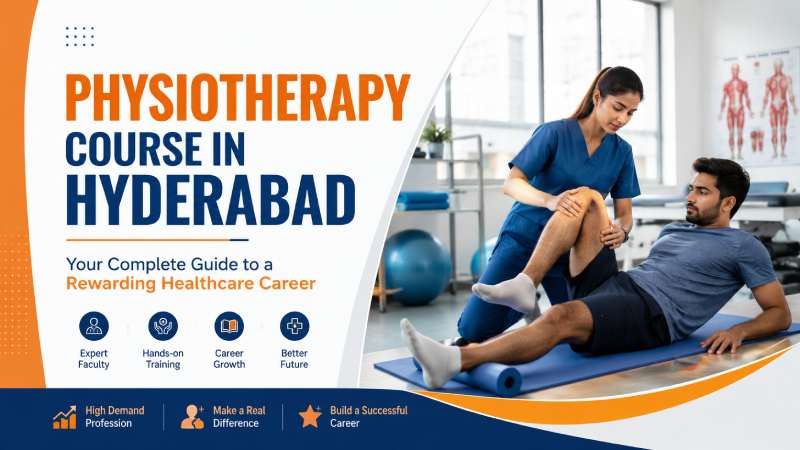
Stepping into the field of physiotherapy is a choice many young students in India are making today. The course sounds good, and the curiosity about the future and career possibilities hovers in the mind of aspirants. Health awareness is rising across the country. More people now visit a physiotherapist for back pain, sports injuries, and recovery after surgery. This has created a steady need for trained professionals.
There is a general notion that South India is quite ahead of others in healthcare education. Hyderabad sits at the centre of this growth. The city has large hospitals, rehabilitation centres, and sports clinics. A physiotherapy course in Hyderabad puts students close to real patients and real practice.
Rehabilitation and preventive healthcare are now part of everyday medicine. Doctors send patients to physiotherapists to restore movement and reduce pain. For many students, this field offers a stable job and the chance to help people every day. This guide covers the course, the subjects, the salary, and the scope, so students can decide with a clear head.
What is a Physiotherapy Course?
Physiotherapy is a branch of healthcare. It helps people move better and live with less pain. A physiotherapist uses exercise, manual therapy, and machines to treat injuries and long-term conditions.
The role goes beyond massage, which is a common myth. Ask any experienced professional in the field, and they will tell you the work involves careful assessment and planning. A physiotherapist checks how a joint moves, finds the problem, and builds a treatment plan.
In modern healthcare, physiotherapists work alongside doctors, nurses, and surgeons. They help stroke patients walk again. They guide athletes back to the field. They support elderly people who struggle with daily tasks. The work matters because it improves the quality of life.
Why Choose a Physiotherapy Course in Hyderabad?
Anyone searching for a physiotherapy course in Hyderabad will find a city rich in hospitals, clinics, and sports centres. Hyderabad has grown into a healthcare hub in South India. The city holds many multi-speciality hospitals and busy rehabilitation units. Students who train here see a wide range of cases early.
Sports and fitness clinics are also spreading across the city. This gives room for clinical training in real settings. A physiotherapy course in Hyderabad often comes with internship slots in hospitals, which helps students build confidence before they graduate.
One question that often comes up is whether the city offers enough clinical practice. The answer is yes. Students often compare the top physiotherapy universities in Hyderabad before they apply. Private universities have expanded their facilities to attract students from different regions to study physiotherapy and explore the possibilities.
The numbers tell a clear story. India has far fewer physiotherapists than the World Health Organization advises.
| Region or benchmark | Physiotherapists per 10,000 people |
| India | 0.6 |
| WHO recommended minimum | 1.0 |
| United States | 7.2 |
Source: Chiratae Ventures; Physiopedia; World Health Organization
This gap means jobs stay open, and demand keeps rising each year.
Bachelor of Physiotherapy (BPT): Course Overview
The main course in this field is the Bachelor of Physiotherapy, known as BPT. It is a full-time undergraduate degree. The course runs for four and a half years. This includes a six-month internship in a hospital.
Students study the human body, movement, and treatment methods. The early years focus on theory and basic science. The later years move towards clinical work and patient care. Skill-building runs through the whole course. By the final year, students treat patients under the watch of senior staff.
| Feature | Detail |
| Course name | Bachelor of Physiotherapy (BPT) |
| Level | Undergraduate degree |
| Duration | 4.5 years (including a 6-month internship) |
| Mode | Full-time |
| Eligibility | 10+2 with Physics, Chemistry, and Biology |
| Higher study option | Master of Physiotherapy (MPT) |
Source: Physiopedia; Careers360
Eligibility Criteria for BPT Admission
The rules for BPT admission are simple. A student must pass Class 12 with science subjects. Physics, Chemistry, and Biology are needed. Most colleges ask for at least 50 percent marks, though the cut-off can change by college. A pass in English is also required.
At MNR University, the admission process is student-friendly. Students register online, verify their email, and submit the form. Merit scholarships are on offer for the Allied and Healthcare Sciences stream. It is worth noting that early applicants often gain better scholarship benefits.
Key Subjects Covered in a Physiotherapy Course
The BPT syllabus is broad. It blends science with practice. Anatomy and Physiology form the base, as students must know how the body is built and how it works. From there, the course moves into movement, therapy, and specialist areas such as neurology and Sports Physiotherapy.
The table below lists the main subjects and what each one covers.
| Subject | What it covers |
| Anatomy and Physiology | Structure and function of the human body |
| Biomechanics | How the body moves and bears load |
| Exercise Therapy | Treatment through planned movement |
| Electrotherapy | Use of machines and currents to ease pain |
| Orthopaedics | Bone, joint, and muscle conditions |
| Neurology | Nerve and brain-related conditions |
| Sports Physiotherapy | Care and recovery for athletes |
| Rehabilitation Sciences | Long-term recovery and daily function |
Source: Indian Association of Physiotherapists; university syllabi
Career Opportunities After a Physiotherapy Course
The career options after this course are wide. A physiotherapist can work in a hospital, a sports club, a clinic, or a rehabilitation centre. Some open their own practice. Others move into teaching and research. South India is quite ahead in this space, with many hospitals and clinics offering jobs.
The table below shows common roles and where they lead.
| Career role | Where they work | Main focus |
| Clinical Physiotherapist | Hospitals and clinics | General patient care |
| Sports Physiotherapist | Sports clubs and academies | Injury care and recovery |
| Rehabilitation Specialist | Rehabilitation centres | Recovery after surgery or trauma |
| Geriatric Physiotherapist | Care homes and home visits | Mobility for elderly people |
| Neurological Physiotherapist | Neurology units | Stroke and nerve recovery |
| Consultant Physiotherapist | Private practice | Independent treatment |
| Academic and Research Roles | Colleges and universities | Teaching and study |
Source: Collegedunia; Indian Association of Physiotherapists
Salary After Completing BPT
Pay in this field grows with experience. A fresher earns a modest amount at the start. With a few years of practice, the salary rises well. Government jobs follow a fixed scale. Private hospitals and private practice can pay more over time. Specialists in sports and neurology often earn the most.
The table below gives a general picture. Salaries change by city, hospital, and skill.
| Career stage or sector | Typical salary (INR) |
| Fresher (BPT graduate) | 2.5 to 3 lakh per year |
| Mid-career (4 to 5 years) | 3 to 5.33 lakh per year |
| Government hospital | 45,000 to 70,000 per month |
| Experienced, private hospital | 80,000 to 1,20,000 per month |
| Senior or specialist (8+ years) | 80,000+ per month |
From an employer’s point of view, a skilled physiotherapist with a specialism is worth more, which pushes pay higher.
Skills Required to Become a Successful Physiotherapist
Good marks alone do not make a good physiotherapist. The job needs people skills too. A therapist must speak clearly and listen with care. Patients are often in pain or worried, so empathy matters a great deal.
Problem-solving is part of daily work. Each patient is different, so the plan must fit the person. Clinical decision-making improves with practice. In practical terms, the best therapists mix knowledge, patience, and a calm manner.
Why MNR University is a Preferred Choice for Physiotherapy Education
MNR University, Hyderabad, has built a solid name in health and science education. The university carries a legacy of more than fifty years. It holds Gold Sustainable Campus status and DASCA-USA accreditation. It is also recognised as Telangana’s first DASCA-USA accredited university.
The BPT programme sits within the School of Allied and Healthcare Sciences. Students learn from experienced faculty in modern laboratories. Three separate labs reflect the hardware and software that graduates will use once they start their careers. The course links theory with clinical practice, and research is part of the learning.
The university also runs academic collaborations with leading U.S. universities. Merit scholarships, internships, and help with placements add real value. From a student’s perspective, this mix of study, practice, and support makes MNR University a solid choice for a physiotherapy course in Hyderabad.
Among the top physiotherapy universities in Hyderabad, MNR University is known for its focus on both academics and student support.
Future Scope of Physiotherapy in 2026 and Beyond
The future of physiotherapy looks bright. India’s population is ageing, and older people need more care. The demand for rehabilitation is set to climb. Sports and fitness are also growing fast, which means more injury care.
Technology is changing treatment too. Tele-rehabilitation and smart tools now reach patients at home. Trained physiotherapists also have global career options, as many countries face the same shortage. Students who finish a physiotherapy course in Hyderabad are well placed to meet this rising demand. The table below shows why the scope keeps widening.
| Growth driver | Key figure or projection | Source |
| Healthcare sector size | US$372 billion (2023) to US$638 billion (2025) | IBEF |
| Population aged 60 and above | 149 million (2022) to 347 million (2050) | India Ageing Report / UNFPA |
| Home healthcare market | US$11.9 billion (2025) to US$27.38 billion (2030) | Mordor Intelligence |
| Fitness industry | About Rs. 37,700 crore (US$4.5 billion) by 2030 | HFA and Deloitte India |
| Demand for healthcare workers | Expected to double by 2030 | IBEF |
Conclusion
Physiotherapy offers a steady and satisfying career. The work helps people heal, move, and live better. A physiotherapy course in Hyderabad gives students strong training, real clinical practice, and a clear path to good jobs.
The need for physiotherapists keeps growing across India and abroad. Salaries rise with skill and experience. For students who care about health and people, this is a wise choice.
MNR University, Hyderabad, brings together a long legacy, modern facilities, and steady support. Students who want a physiotherapy course in Hyderabad would do well to explore the BPT programme at MNR University and take the first step towards a rewarding healthcare career.
Frequently Asked Questions
The Bachelor of Physiotherapy (BPT) runs for four and a half years. This includes a six-month internship in a hospital.
A student needs to pass Class 12 with Physics, Chemistry, and Biology. Most colleges ask for at least 50 percent marks, though the cut-off can vary.
Yes. India has a shortage of physiotherapists, and demand is rising due to an ageing population and growing fitness awareness. Job options are wide in hospitals, sports, and rehabilitation.
A fresher usually earns between 2.5 lakh and 3 lakh per year. Salary grows with experience, specialism, and the type of employer.
Core subjects include Anatomy and Physiology, Biomechanics, Exercise Therapy, Electrotherapy, Orthopaedics, Neurology, Sports Physiotherapy, and Rehabilitation Sciences.
Yes. MNR University, Hyderabad, offers the Bachelor of Physiotherapy (BPT) through its School of Allied and Healthcare Sciences, along with merit scholarships and internships
Yes. Graduates can study a Master of Physiotherapy (MPT) and specialise in areas such as sports, orthopaedics, or neurology.
Related Blogs

After Class 12 Science: Which Degree Offers the Best Career Opportunities in 2026?
Stepping into the final year of Class 12 Science brings a mix of pride and…

Emerging Science Careers in India: Degrees That Employers Will Value in the Next Decade
Science has always drawn curious minds. Yet the kind of science jobs that pay well…
BSc MLT Under NCAHP: Advancing Clinical Diagnostics
Clinical diagnostics form the absolute backbone of modern medical interventions, where precise laboratory results directly…

Can Average Students Build a Career in Neurosciences?
Neuroscience is one of the most rewarding fields of study in India today, and students…
What Is an Anaesthesia Technology Course? Scope, Syllabus & Career Paths in India
Healthcare is one of the fastest-growing sectors in India. New hospitals, specialised clinics, trauma centres,…
Admission in BPT 2026: Eligibility, Fees, Career Scope and How to Choose the Right Physiotherapy College
Physiotherapy has grown into one of the most in-demand health careers in India. Every year,…