
Why Students Are Quietly Choosing ECE IoT After 12th — And What It Really Means in 2026
Home / School of Technology / Why Students Are Quietly Choosing ECE IoT After 12th — And What It Really Means in 2026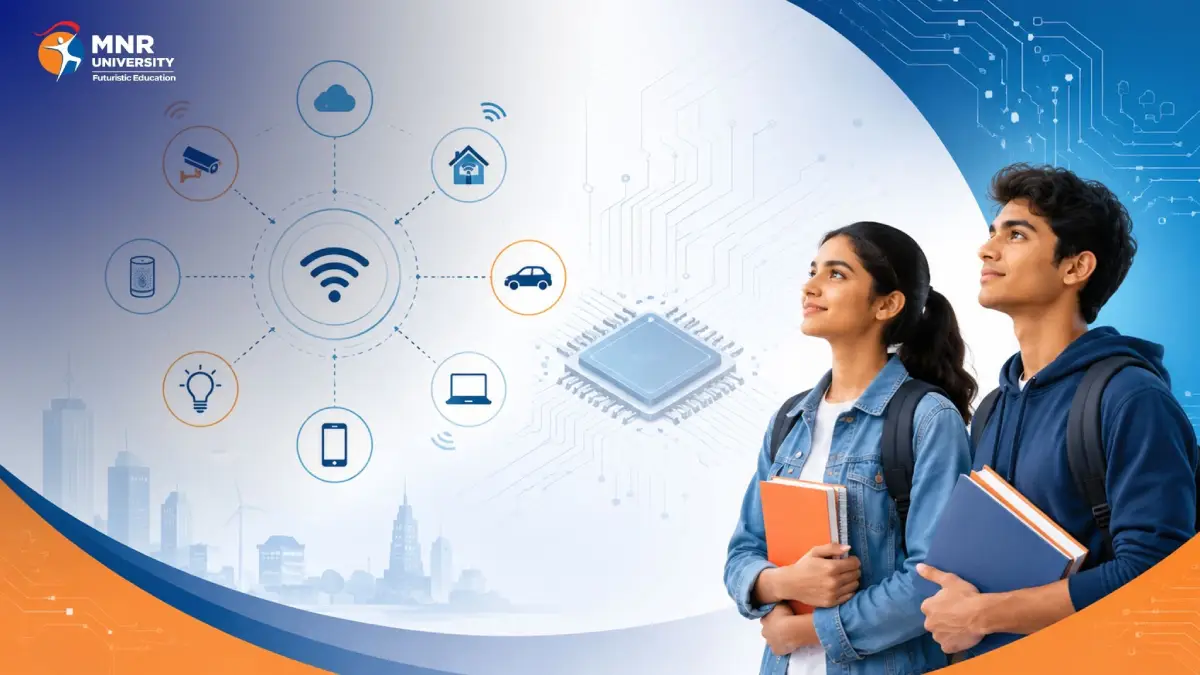
Walk into any career counseling session in Hyderabad this year and you’ll hear a word that wasn’t this common before — IoT. Smart homes, wearables, connected cars, automated factories. Students hear about it on Instagram, on YouTube, sometimes from a cousin who works at a company building “smart” something or the other. And suddenly, B.Tech ECE with IoT specialization is on the table in a way it wasn’t five years ago.
But here’s the honest part. Most students choosing it don’t fully understand what they’re getting into. So, one of the top 10 engineering colleges in Hyderabad now talks about it.
What IoT Actually Is
Forget the formal definitions for a second.
IoT — Internet of Things — is basically the idea that ordinary objects can be made smart enough to sense what’s happening, talk to other devices, and do something about it. Your phone is smart. That’s been true for years. The new thing is your watch being smart. Your fridge. Your factory machine. Your farm’s soil moisture sensor. A streetlight in Hyderabad that knows when to dim itself.
That’s it. That’s the core idea.
The complicated part — and this is what engineers actually work on — is how you make all this happen. How does a tiny sensor in a remote village send data to a server in Bangalore? How does it run for years on a small battery? How do you make sure nobody hacks it? How do you make sense of the millions of data points pouring in?
That’s IoT engineering.
How IoT Actually Works
If you peel back a smart device, you’ll roughly find four things doing their job.
There’s a sensor — the eyes and ears. Temperature, motion, sound, light, pressure, whatever needs to be measured. Then there’s connectivity — Wi-Fi, Bluetooth, cellular, sometimes longer-range stuff like LoRa for farms or large factories. After that, the data travels to some kind of processing — could be the cloud, could be a small computer sitting nearby. And finally, there’s an action — your AC adjusts itself, your phone gets a notification, a machine in a factory shuts down before it breaks.
Sounds simple. It isn’t.
A smart traffic system, for example, isn’t one device. It’s hundreds of sensors, multiple network types, real-time data crunching, and a decision system that has to be right almost every single second. That’s the kind of thing IoT engineers are building. Real systems, with real consequences if they fail.
Why the Scope of IoT in India Is Actually Growing — Not Just Hype
Look, the internet is full of people calling every new field “the next big thing.” So skepticism is fair.
But IoT in India isn’t really speculation anymore. It’s already happening, in places students don’t always notice.
The Smart Cities Mission has been pouring money into urban infrastructure. Hyderabad, Pune, Bhubaneswar, Visakhapatnam — they’re all running IoT-based traffic, waste management, water monitoring, and surveillance projects. Manufacturing companies have started moving toward what’s loosely called Industry 4.0 — machines talking to other machines, predictive maintenance, automated quality checks. Hospitals are putting connected devices on patients to monitor them remotely. Even farmers in parts of Telangana and Andhra Pradesh are using soil sensors to decide when to irrigate.
The country’s IoT market has been growing at a strong double-digit rate for years now. Estimates vary, but most credible reports place the Indian IoT industry crossing several billion dollars by 2027–2028. Whether the exact number is right doesn’t matter. What matters is the direction. It’s going up. And it’s going up across industries — not just in tech parks.
ECE, ECE with IoT, and CSE — What’s the Actual Difference?
This confuses a lot of students, so let’s clear it up.
B.Tech ECE is the broader Electronics and Communication degree. Think circuits, communication systems, signal processing, microcontrollers, VLSI. Solid, foundational, time-tested.
B.Tech ECE with IoT specialization keeps that electronics base but pulls in the modern stuff — sensors, embedded systems, cloud platforms, IoT protocols, some programming (Python, C, sometimes a bit of JavaScript for dashboards), basic data handling, network security. So you’re still an electronics engineer at the core. You just learn to make electronics talk to the internet and to each other.
CSE, on the other hand, is mostly software-first. Algorithms, web, app development, databases, AI, ML.
Now the question students always ask: Is ECE tougher than CSE?
Honest answer — yes, sometimes. ECE has more theory-heavy subjects, more circuit-level thinking, and the math doesn’t disappear after second year like a lot of CSE students hope. But “tougher” is the wrong word. It’s more physical. You’re dealing with real-world signals and hardware, not just code on a screen. Some students love this. Others find it draining. It depends on you.
Real Career Options After ECE IoT
The career of ECE IoT students isn’t limited to one type of job. It branches out more than people realize.
A few of the common paths students go into after graduation:
- IoT Developer — building the software side of IoT systems, dashboards, mobile apps, cloud integration.
- Embedded Systems Engineer — the deep hardware-software role. Writing firmware, working with microcontrollers, optimizing power and performance. Pays well, and there’s a real shortage of good people here.
- IoT Security Specialist — a growing one. The more devices you connect, the more attack surfaces you create. Companies are scrambling for people who can secure them.
- Automation Engineer — usually in manufacturing, working with PLCs, robots, factory-floor IoT systems.
- Data Engineer / IoT Analytics — handling the massive amount of data IoT devices generate.
- Hardware Design Engineer — for those who love the PCB-level, sensor-level work.
- R&D Roles — in companies building new connected products. Slower paced, more research-heavy, deeply satisfying for the right person.
And then there’s the entrepreneurial route, which a lot of ECE IoT students underestimate. The startup scene in India around hardware, EVs, agri-tech, and health-tech is genuinely opening up. You don’t have to wait for a placement to start building.
The Salary Question — Without Sugarcoating
This is where most blogs lie a little. Let’s not.
Freshers in IoT-related roles in India typically start somewhere between ₹3.5 LPA and ₹7 LPA. Tier-1 companies and good product startups can offer ₹8–12 LPA to strong candidates with internship experience and decent projects. Embedded and IoT security roles often pay slightly more than generic developer roles at the entry level — because the talent pool is smaller.
By 3–6 years of experience, salary for IoT engineers usually moves into the ₹8–18 LPA range, sometimes higher if you’ve specialized well in something like industrial IoT, automotive, or security.
Senior IoT engineers and architects comfortably touch ₹25–40 LPA and beyond, especially in product companies, semiconductor firms, and global tech players.
These aren’t fantasy numbers. They’re not top 1% either. They’re roughly what a decent, hardworking engineer with good projects and a couple of internships can expect. Hyderabad in particular has been a strong hiring market — between the semiconductor push, the smart city projects, and the growing presence of automotive and IoT product companies, demand is real. However, choosing one of the top 10 engineering colleges in Hyderabad is more important to build a shining career future.
Future Scope of IoT in India — Where This Is Actually Heading
A few directions are pretty clear by now.
5G + IoT is the obvious one. Faster, more reliable connections mean millions more devices can talk to each other without bottlenecks.
AI + IoT — sometimes called AIoT — is where things get really interesting. IoT generates data. AI makes sense of it. The two need each other. So no, AI is not going to replace IoT engineers. If anything, it’s making the field more powerful.
Edge computing is rising too, because sending every bit of data to the cloud isn’t practical. Devices are getting smarter on their own.
Industrial IoT will keep growing as Indian manufacturing modernizes. And wearables and health-tech are quietly becoming a massive sector — connected glucose monitors, ECG patches, fitness rings, sleep trackers. India has the demographic and the demand for all of it.
If you’re choosing IoT B.Tech 2026 batch onwards, you’re entering at a reasonable time. Not too early — the industry has matured enough to hire. Not too late — there’s still plenty of room to grow with the field.
Choosing Where to Study Matters — But Not for the Reasons You Think
Hyderabad has quietly become one of the better cities for studying IoT and electronics. The semiconductor ecosystem, the presence of automotive R&D, the smart city projects, the startup density — all of it gives students real exposure if they look for it.
When students compare the top 10 engineering colleges in Hyderabad, they usually look at the obvious things — placements, ranking, fees. Those matter. But the underrated factor is the kind of learning environment the college actually offers. Are there active IoT labs? Do students get to work on real boards — ESP32, Raspberry Pi, NodeMCU — beyond just classroom demonstrations? Are there industry collaborations? Are there faculty members who’ve worked on actual projects, not just taught from slides?
That’s what tilts a career, more than rank lists do.
So, Is ECE IoT the Right Choice?
ECE IoT isn’t for everyone. If you genuinely dislike electronics, hate math, and only want to write code in a comfortable chair, CSE is probably a better fit. But if there’s even a small part of you that’s curious about how things actually work — how a sensor knows what it knows, how a drone stays steady in the wind, how a city’s traffic gets managed by data — then this field has a lot to offer.
You won’t be choosing a “safe” career. There isn’t one anymore. Every field is being reshaped by technology. The smartest thing students can do today is pick something that’s likely to grow with technology, not get replaced by it. IoT sits squarely in that zone.
Whatever you choose, choose it with your eyes open. Talk to seniors. Visit campuses if you can. Look past the brochures. Ask the people doing the work what it’s actually like, day to day.
The future is going to be built by people who can connect the physical world to the digital one. If that sounds like something you’d want a hand in — you already know what to look at next.
Follow Us on Facebook | LinkedIn
Related Blogs

Medical Lab Technology: A Growing Career in Healthcare
Hospitals today run on precision. A blood sample taken in the morning often guides a…
Why Internships Have Become a Deciding Factor for Engineering Placements
Stepping into an engineering course is exciting, and most students start dreaming about a good…

B.Tech AI & Data Science in 2026: A Smart Career Choice After 12th
Today, artificial Intelligence has crept into almost everything we touch, from Google Maps to the…

AI Engineer vs Software Engineer: Which Career Path Offers Better Growth?
Many students who love computers reach a point where they must pick a direction. Should…

Future Scope of AI & ML in 2026
The global landscape of technology is moving toward a pivotal intersection where data no longer…

Is Data Science a Good Career in India? Complete Guide
If you scroll through job updates today, you will notice that the field of data…