
Why Is B.Sc MLT One of the Fastest-Growing Healthcare Courses After Class 12?
Home / MNR University / Why Is B.Sc MLT One of the Fastest-Growing Healthcare Courses After Class 12?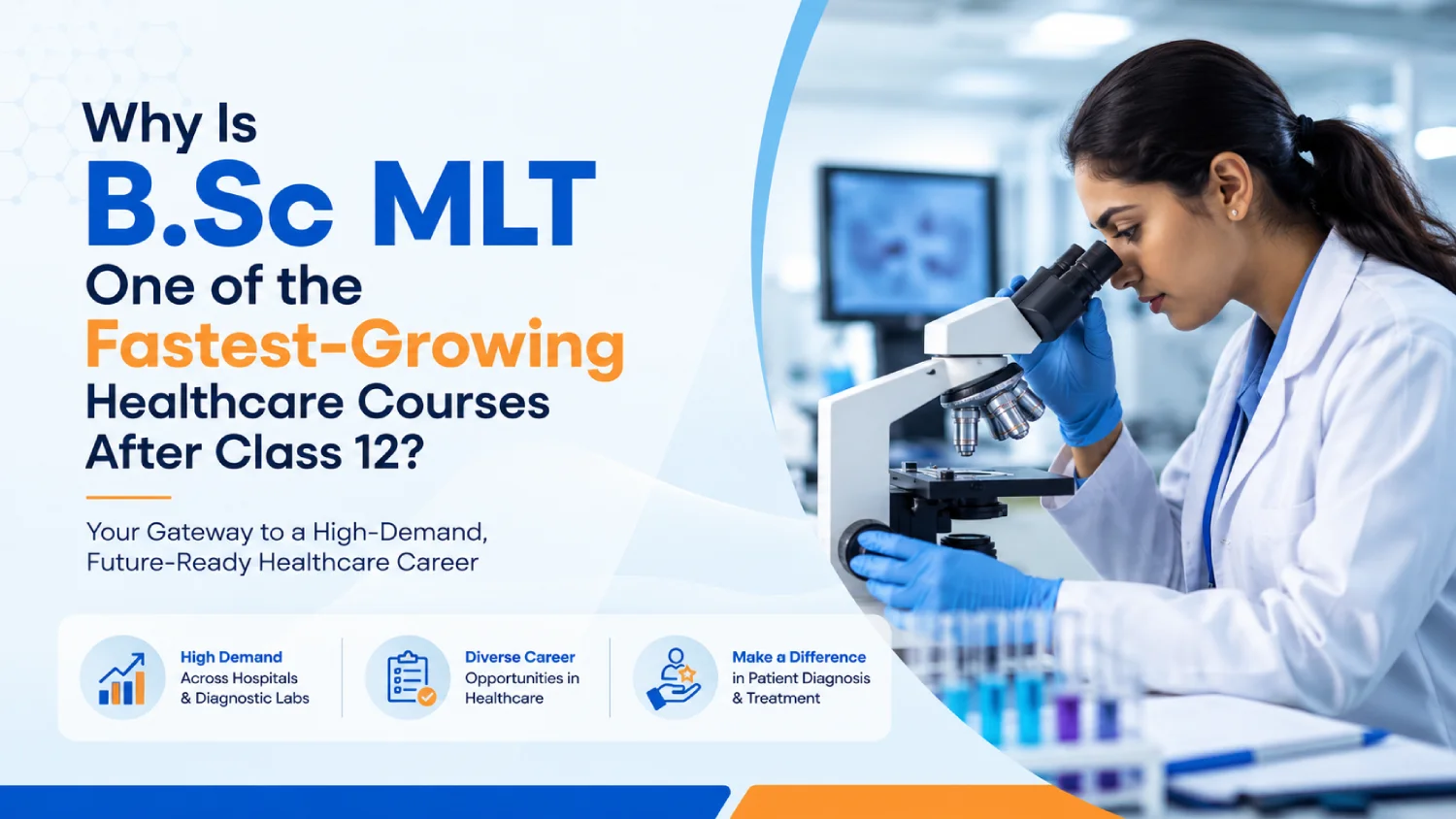
Many students finish Class 12 with science subjects and wonder which healthcare course will give them a stable future. Doctors get most of the attention. Yet behind every diagnosis sits a skilled professional who runs the tests, reads the samples, and confirms what is wrong with a patient. This work belongs to a medical laboratory technologist. A Bachelor of Science in Medical Laboratory Technology, often called B.Sc MLT, trains students for this role. The course is short, practical, and linked to real jobs in hospitals and labs. Its demand keeps rising as India tests millions of people every year for conditions such as diabetes, anaemia, and cancer. This is one reason families now study B.Sc MLT private colleges in Hyderabad with fresh interest. The city has strong hospitals, a growing diagnostic industry, and universities that focus on health sciences. This blog explains what B.Sc MLT is, why it grows so fast, what students learn, and where the course can lead. It also looks at MNR University, Hyderabad, a health-science institution that offers this programme.
What Is B.Sc MLT and Why Does It Matter?
B.Sc MLT is an undergraduate health-science degree. It teaches students how to collect samples, run medical tests, and report results that help doctors treat patients. A laboratory technologist studies blood, urine, tissue, and other samples. These results guide almost every medical decision. So the role sits at the centre of patient care, even though patients rarely meet the technologist. The course matters because no hospital can work without a reliable lab. As India builds more clinics and diagnostic centres, the need for trained lab staff keeps growing.
Why Is B.Sc MLT Growing So Fast in India?
The plain answer is demand. India now tests far greater numbers of patients than before, and the diagnostic industry has expanded at a quick pace. The figures below show how strong this growth has become.
|
These figures point to a clear pattern. The diagnostic sector in India is set to almost double in size by 2030. Health awareness has risen, chronic illness has increased, and preventive check-ups have become common. Each of these trends needs more labs, and every lab needs trained people. That is why B.Sc MLT has become one of the fastest-growing health courses after Class 12.
What Will Students Study in a B.Sc MLT Course?
The B.Sc MLT course blends theory with practical lab work. Students learn the science behind diagnosis and then apply it on real equipment. Core subjects usually cover:
- Pathology, which studies disease and its causes
- Microbiology, the study of bacteria, viruses, and other microbes
- Biochemistry, which looks at chemical processes in the body
- Haematology, the study of blood and blood disorders
- Clinical laboratory methods and quality control
- Laboratory safety and the handling of biohazard material
Most programmes also include hospital training, so students gain real experience before they graduate. This mix of classroom study and clinical practice prepares them for work from the first day of a job.
What Career Options Open Up After B.Sc MLT?
A B.Sc MLT degree leads to several roles across the health sector. Graduates can work in hospitals, private labs, research centres, and public health units. Common job paths include:
- Medical laboratory technologist
- Pathology lab technician
- Clinical research assistant
- Quality control analyst in a diagnostic lab
- Blood bank technician
- Microbiology or biochemistry lab assistant
Some graduates choose higher study, such as an M.Sc in a lab science, and move into teaching or advanced research. Others join the fast-growing diagnostic chains that now operate across Indian cities. Because the field links to constant medical need, jobs tend to stay steady even in uncertain times.
Why Do Students Look at B.Sc MLT Private Colleges in Hyderabad?
Hyderabad has become a strong centre for health education. The city holds large hospitals, busy diagnostic networks, and a growing research base. Students who study B.Sc MLT private colleges in Hyderabad often find good training sites and clear job links nearby. Private universities in the city tend to offer modern labs, hospital tie-ups, and focused career support. For families who want practical learning and local job access, these colleges hold strong appeal. This is why interest in B.Sc MLT private colleges in Hyderabad has risen across recent admission cycles.
What Makes MNR University Different?
MNR University, Hyderabad, offers a B.Sc (Hons) in Medical Laboratory Technology among its allied-health programmes. The university focuses on health and applied sciences, which shapes its teaching style. Points that students and parents often note include:
- A legacy of over fifty years in education
- A four-year B.Sc (Hons) MLT programme that includes clinical training
- A wide range of allied-health courses, such as Radiology and Image Technology, Anaesthesiology and OT Technology, Renal Dialysis Technology, Emergency Medical Technology, and Optometry
- Merit-based scholarships of up to 90 percent on tuition, based on entrance scores
- A curriculum aligned with the National Education Policy (NEP), the National Credit Framework (NCrF), and the United Nations Sustainable Development Goals
- Practice-first learning with industry-focused projects and hospital exposure
- Global exposure through exchange options and short international study tours
These features place MNR University among the noted options when families compare B.Sc MLT private colleges in Hyderabad.
What Is the Eligibility for B.Sc MLT?
Most colleges, including MNR University, ask for a Class 12 pass with science subjects. The usual requirement is 10+2 with Biology, Physics, and Chemistry, with a minimum aggregate of around 50 percent. Some institutions also accept a relevant diploma. Students should check the official website for the latest rules each year, as criteria can change.
What Is the Future Scope of B.Sc MLT?
The future looks steady for lab science. India keeps adding diagnostic centres, and new tools such as molecular testing and AI-assisted analysis create fresh roles. As the diagnostic market grows toward INR 2.98 trillion by 2030, the need for skilled technologists should rise with it. Graduates can also work abroad, since laboratory skills carry across borders. For a student who wants a science career with real demand, B.Sc MLT offers a sound start.
Conclusion
B.Sc MLT gives students a practical route into healthcare without long years of study. The work is meaningful, the demand is strong, and the job options are wide. India tests greater numbers of patients each year, and every test needs a trained hand behind it. For students who want to join this field, the choice of college matters. The B.Sc MLT private colleges in Hyderabad offer modern labs, hospital links, and steady career support, which makes the city a smart place to begin. Among these options, MNR University, Hyderabad, stands out for its health-science focus and hands-on training. A careful look at B.Sc MLT private colleges in Hyderabad can help a student turn a school dream into a real medical career.
Frequently Asked Questions
B.Sc MLT stands for Bachelor of Science in Medical Laboratory Technology. It is an undergraduate health-science degree that trains students to collect samples, run medical tests, and report results that help doctors treat patients.
At MNR University, the B.Sc (Hons) Medical Laboratory Technology programme runs for four years and includes clinical training in a hospital setting.
Students usually need a Class 12 pass with Biology, Physics, and Chemistry, with a minimum aggregate of around 50 percent. Some colleges also accept a relevant diploma.
Core subjects include pathology, microbiology, biochemistry, and haematology, along with clinical laboratory methods, quality control, and laboratory safety.
Graduates work as medical laboratory technologists, pathology lab technicians, clinical research assistants, quality control analysts, blood bank technicians, and lab assistants in hospitals, private labs, and research centres.
India tests more patients every year. The diagnostic labs market was valued at INR 1.54 trillion in FY 2024 and is set to reach INR 2.98 trillion by FY 2030, which raises the need for trained lab staff.
MNR University, Hyderabad, is one option families consider, as it focuses on health and allied sciences and offers hands-on laboratory training. Students should compare several B.Sc MLT private colleges in Hyderabad before they decide.
Yes. Graduates can pursue an M.Sc in a laboratory science and move into advanced research or teaching roles.
Related Blogs

Decoding Cognitive Disorders With Neuroscience Data Analytics
Human brains generate massive amounts of complex electrical information every single second. Capturing and understanding…

10 Game-Changing Advantages of Internet of Things Every Engineering Student Must Know
Every smart watch that counts steps, every home speaker that answers a question, and every…
BSc Optometry Fees in India 2026: Government vs Private Colleges and What Affects the Cost
A career in eye care starts with one practical question: how much does the course…
Why Skilled Medical Lab Technicians Are Rare Despite High Demand
A doctor looks at a patient, but a laboratory professional looks at the truth hidden…

How Can Students Choose the Right CSE College with Placements in South India?
Picking the right engineering college feels like a big decision for most families. Students want…
Bachelor of Optometry (B.Optom) Course Details Explained
Stepping into the field of eye care sounds good, and the curiosity pertaining to the…