
BSc MLT Under NCAHP: Advancing Clinical Diagnostics
Home / School of Allied Sciences / BSc MLT Under NCAHP: Advancing Clinical Diagnostics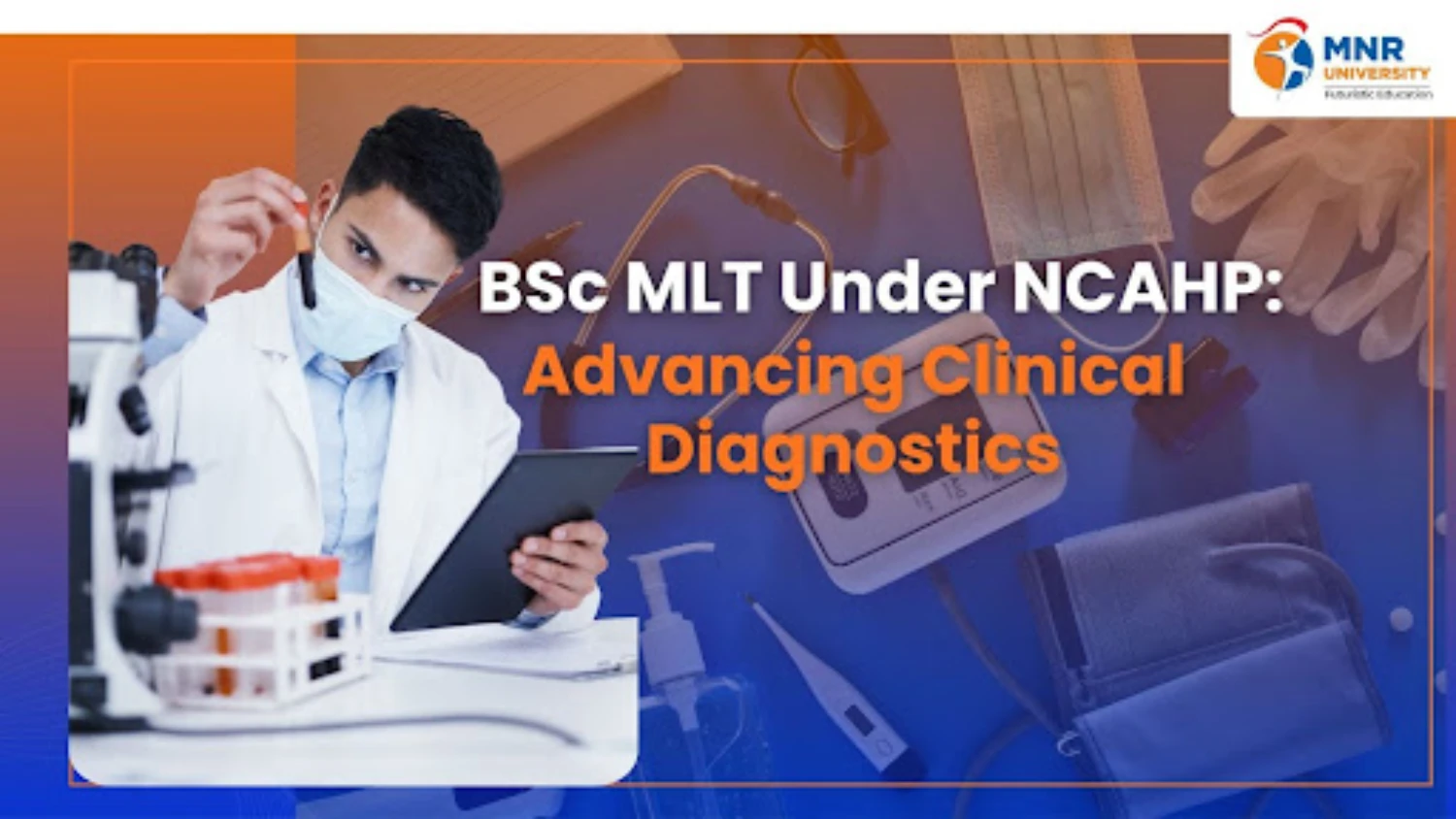
Clinical diagnostics form the absolute backbone of modern medical interventions, where precise laboratory results directly dictate patient treatment plans. The National Commission for Allied and Healthcare Professions (NCAHP) recently established uniform educational benchmarks for medical laboratory technology to elevate these critical analytical practices. These stringent regulations mandate that B.Sc. MLT colleges overhaul their academic frameworks to deliver highly practical skills in complex sample analysis and rigorous quality control. Such systematic upgrades prepare the next generation of laboratory professionals for India’s rapidly expanding diagnostic networks. This transformation ensures that newly qualified technologists enter the healthcare sector ready to manage high-stakes clinical testing.
How Do NCAHP Regulations Reshape Medical Training?
The National Commission currently regulates over fifty allied healthcare professions, establishing definitive academic standards for clinical curricula, faculty credentials, and laboratory infrastructure. Regional state councils oversee local operations to ensure uniform execution of training across the country. Institutions seeking compliance must implement comprehensive operational shifts, transitioning from purely theoretical instruction toward intensive practical laboratory engagement and strict ethical compliance.
Evaluating the landscape of BSc MLT colleges in Hyderabad, one observes a distinct alignment with these national directives to address historical inconsistencies in programme delivery. This regulatory shift substantially raises the competency baseline for entry-level clinical professionals who process vital blood cultures, tissue samples, and biochemical assays daily.
| Regulatory Aspect | Previous Educational Model | Current NCAHP Framework |
|---|---|---|
| Curriculum Structure | Institutions followed highly varied regional syllabi. | Universities implement a standardised national curriculum. |
| Practical Exposure | Programmes offered basic theoretical demonstrations. | Degrees mandate a minimum of fifty percent hands-on training. |
| Clinical Infrastructure | Students utilised standard general science laboratories. | Institutions must provide advanced diagnostic facilities. |
| Professional Conduct | Programmes relied on informal ethical guidelines. | Curricula feature integrated professional clinical codes. |
These structural updates guarantee safer patient outcomes by standardising the exact protocols used to generate critical laboratory reports.
What Are The Core Curriculum And Daily Laboratory Roles in MLT Courses in India?
Academic progression typically requires four comprehensive years, thoroughly blending advanced theoretical concepts with continuous laboratory operations. Students actively learn to process delicate biological samples, calibrate high-resolution optical microscopes, and validate complex test results within strictly supervised clinical environments.
The daily responsibilities of a medical laboratory technologist require meticulous attention to detail and a deep understanding of methodology. These professionals examine bodily fluids and tissue structures to detect underlying pathologies before clinical symptoms manifest fully. Their essential functions directly influence diagnostic accuracy within large hospital networks, dedicated blood banks, and specialised research centres.
- Professionals execute comprehensive blood counts and intricate biochemical analyses using automated clinical arrays.
- Technologists identify microscopic bacterial strains and viral pathogens within complex infection samples.
- Laboratory staff maintain detailed equipment calibration logs to ensure strict regulatory compliance.
- Clinical teams collaborate continuously on internal quality audits to prevent analytical discrepancies.
The curriculum purposefully emphasises job-role-specific skill requirements, enabling learners to both learn theoretical principles and develop practical competencies within the span of the degree.
Why Do Institutions Like MNR University Lead Diagnostic Education?
Delivering a compliant medical laboratory technology programme requires substantial infrastructural investment and profound clinical expertise. Building upon a fifty-year legacy of educational excellence, MNR University provides an exceptionally robust academic ecosystem through its School of Allied and Healthcare Sciences. The institution utilises its two thousand expert faculty members and twenty-five active industry partnerships to facilitate continuous live diagnostics training.
The institutional approach deliberately integrates global clinical perspectives to broaden the professional capabilities of its student body. These strategic academic collaborations offer distinct advantages for individuals pursuing advanced laboratory sciences.
- Partnerships with Cumberland University and Wayland Baptist University facilitate vital academic exchange programmes.
- Agreements with Faulkner University and Campbellsville University provide access to international diagnostic methodologies.
- Collaborations with St. Francis College deliver structured global certification pathways for aspiring clinical technologists.
Comparing regional options, premier B.Sc. MLT colleges stand out by prioritising immediate technological application alongside traditional academic instruction.
| Academic Component | Standard Institutional Approach | The MNR University System |
|---|---|---|
| Technological Access | Students use basic chemical pathology tools. | Learners operate high-throughput diagnostic machinery. |
| Faculty Composition | Programmes rely on general science educators. | Courses are led by specialised clinical pathologists. |
| Career Development | Institutions offer standard graduation pathways. | The university provides integrated global certification options. |
| Industry Connection | Students experience limited hospital interactions. | Programmes feature extensive clinical network integration. |
Graduates from such rigorous environments readily secure positions within massive private diagnostic chains and prominent government testing facilities. Prospective healthcare professionals exploring BSc MLT colleges in Hyderabad must carefully evaluate how well an institution’s curriculum matches these emerging national laboratory standards.
This specific medical sector heavily favours individuals who deeply value precision and methodical execution within their professional lives. By choosing an institution that fully embraces these national and international frameworks, students build a highly resilient foundation for a lifelong career in clinical diagnostics.
To review the complete laboratory science syllabus or discuss specific admission protocols, please contact the university administration directly.
For More Details
Call: +91 85000 54445
Email: admissions@mnruniversity.edu.in
Follow MNR University on Instagram.
Frequently Asked Questions
Candidates must complete their 10+2 education focusing on Physics, Chemistry, and Biology, maintaining a minimum aggregate of fifty percent. Admissions generally proceed through academic merit or specific institutional entrance examinations.
MNR University is highly recognised for its comprehensive laboratory infrastructure and strict adherence to national clinical guidelines.
The commission enforces strict, uniform standards for clinical curricula, mandates minimum practical laboratory hours, and oversees the official registration of qualified healthcare professionals across the country.
The comprehensive degree requires three years of intense academic study followed by a mandatory one-year clinical internship within an affiliated hospital setting.
Yes, the institution leverages its extensive hospital partnerships and dedicated career guidance cells to secure professional laboratory placements for its graduating cohorts.
Related Blogs
Best Optometry Colleges in India in 2026: A Complete Comparison Guide
Every year, thousands of students finish Class 12 with Biology and start looking past MBBS….
Best Healthcare Courses in Hyderabad: 20 Career-Ready Programmes at MNR University
Hyderabad has stepped into a fresh chapter of medical education, and students from every corner…
Anesthesiology & OT Technology Course After 12th: A High-Demand Healthcare Career in 2026!
Inside every operating theatre, one team holds the line between a smooth surgery and a…

Top Career Opportunities After Physiotherapy in India & Abroad
The landscape of healthcare is shifting toward movement-based recovery, making the choice to study at…
Anaesthesiology: A Fundamental Pillar of Modern Surgery
Modern healthcare relies heavily on the steady hands and technical expertise of clinical specialists during…
B. Optometry (Bachelor in Optometry) Course Details: Duration, Syllabus and Career Scope
Bachelor in Optometry is a four-year undergraduate healthcare degree that trains students to examine eyes,…