
What Makes Neurology Cases So Hard to Diagnose?
Home / MNR University / What Makes Neurology Cases So Hard to Diagnose?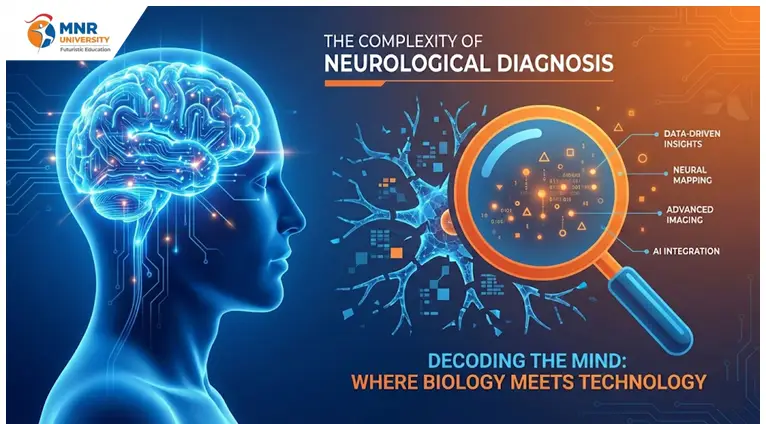
The human brain remains the most sophisticated and enigmatic structure in the known universe. It operates as a biological command centre, firing billions of electrical signals every second to control everything from a heartbeat to a childhood memory. For students fascinated by how we think, feel, and function, the field of neuroscience offers a challenge that is both intellectual and deeply human. We are witnessing a global shift in medicine where the scalpel is being aided by algorithms, and intuition is supported by data. This evolution is creating a demand for professionals who can bridge the gap between biological mystery and technological clarity. It is a serious, high-stakes discipline, yet one that offers immense satisfaction to those who choose to pursue it.
Why Do Clinicians Struggle to Pinpoint the Root Cause?
Diagnosis in neurology is rarely straightforward. Unlike a fractured bone that appears clearly on an X-ray, neurological disorders often hide behind a veil of vague symptoms. A patient might report dizziness or numbness, which could stem from anxiety, a vitamin deficiency, or the early stages of a complex degenerative disease. This ambiguity is what makes the field so demanding. The organ in question is encased in bone, inaccessible to direct touch, and operates on microscopic chemical exchanges that change millisecond by millisecond.
For students exploring B.Sc. Neuroscience Colleges in India, it is vital to understand that this discipline requires a detective’s mindset. You must learn to look past the obvious. The difficulty arises because:
- Symptom Overlap: Many distinct conditions, such as migraines and epilepsy, share remarkably similar warning signs.
- Subjective Reporting: Physicians rely heavily on what patients tell them, which can be inaccurate due to fear or forgetfulness.
- The Latency Period: Neurological damage often begins years before any physical symptoms manifest.
- Biological Variation: Every brain is wired slightly differently, meaning a “textbook case” is actually quite rare in real life.
How Does Technology Close the Gap in Neuroscience?
We are entering an era where AI is going to dominate the world, a development that will significantly impact medical education. The integration of artificial intelligence into healthcare means that future neuroscientists will have tools their predecessors never dreamed of. Advanced algorithms can now sift through terabytes of EEG data to find patterns invisible to the human eye. This is why a modern curriculum must go beyond standard anatomy.
When you look at a comprehensive B.Sc. Neurology course details, you should see a heavy emphasis on neuroimaging and computational neuroscience. It is about learning to speak the language of both neurons and code. At MNR University, the School of Clinical Research, Medical & Health Sciences ensures students are not just memorising parts of the brain but are actively engaging with Brain-Computer Interfaces (BCI) and neuro-ethics. This fusion of tech and biology is the only way to solve the diagnostic puzzles of the future.
Comparative Advantage: The Academic Edge
| Feature | Standard University Approach | The MNR University Edge |
| Global Exposure | Limited to standard partnerships. | Collaborations with Cumberland, Wayland Baptist, Faulkner, Campbellsville, & St. Francis College. |
| Curriculum | Theory-heavy with basic lab work. | Industry-aligned curriculum with a focus on AI, BCI, and Neuroimaging. |
| Mentorship | Standard faculty guidance. | Access to 2,000+ expert faculty members and dedicated industry mentors. |
| Innovation | Basic project submission. | Patent filing support and a dedicated startup incubation centre. |
| Recognition | Regional accreditation. | Ranked #2 in Telangana & #5 All India (Times Engineering Institutes Ranking 2025). |
What Does the Future Hold for Graduates?
The scope for a neuro-technologist extends far beyond the walls of a traditional hospital. As the world grapples with an aging population, the need for early detection of conditions like Alzheimer’s and Parkinson’s is critical. This urgency has opened doors in sectors that were previously unconnected to biology. Graduates are finding roles in pharmaceutical research, cognitive psychology, and even in the development of AI-driven wellness applications.
Choosing the right institution among the various B. Sc. Neuroscience Colleges in India determines whether you will be a passive observer or an active participant in this revolution. Our students do not just watch from the sidelines; they engage in hands-on lab work, exploring neural reflexes and brain behaviour from day one. They leave with the ability to explain neural plasticity and apply statistical tools to real-world datasets. This is education designed for the real world—rigorous, practical, and forward-looking.
If you have the drive to decode the human mind, we have the ecosystem to support you.
Frequently Asked Questions
Candidates must have passed their 10+2 with BiPC or MPC groups from a recognised board. Alternatively, those who have completed a relevant 2 or 3-year Diploma after Class 10 are also eligible. The minimum age is 17 years.
Yes. The curriculum includes internships in research labs and hospitals, ensuring students gain the necessary clinical exposure and understand patient care dynamics.
Students receive training in Neuroimaging, Brain Mapping (using fMRI and EEG), and the application of analytical tools used in modern diagnostics.
Yes, admission for 2026 is open with merit-based scholarships available for deserving candidates.
Hyderabad is rapidly developing into a hub for AI and healthcare technology. This provides students with unique opportunities for industry visits, live projects, and exposure to the latest tech developments.
Related Blogs
Bachelor of Optometry: Jobs, Salary and Future Scope
Every year, thousands of students leave school with a wish to work in healthcare, yet…
Is BPT a Good Career in 2026? The Future Scope of Physiotherapy in India
Healthcare in India places physiotherapy at the heart of patient recovery, and the best physiotherapy…
BSc Optometry Fees in India 2026: Government vs Private Colleges and What Affects the Cost
A career in eye care starts with one practical question: how much does the course…
Decoding Cognitive Disorders With Neuroscience Data Analytics
Human brains generate massive amounts of complex electrical information every single second. Capturing and understanding…
Is Your Code Writing Itself? Why the ‘Human’ Element Matters in a Machine Learning Course in Hyderabad
Code now generates code. Tools like GitHub Copilot churn out lines of code faster than…
Physiotherapy Course After 12th: Everything Students Need to Know
Choosing a career path after school can feel like standing at a busy crossroads. So…