
The Future of Optometry in India: Emerging Technologies, Specialisations and Careers After a Bachelor in Optometry
Home / MNR University / The Future of Optometry in India: Emerging Technologies, Specialisations and Careers After a Bachelor in Optometry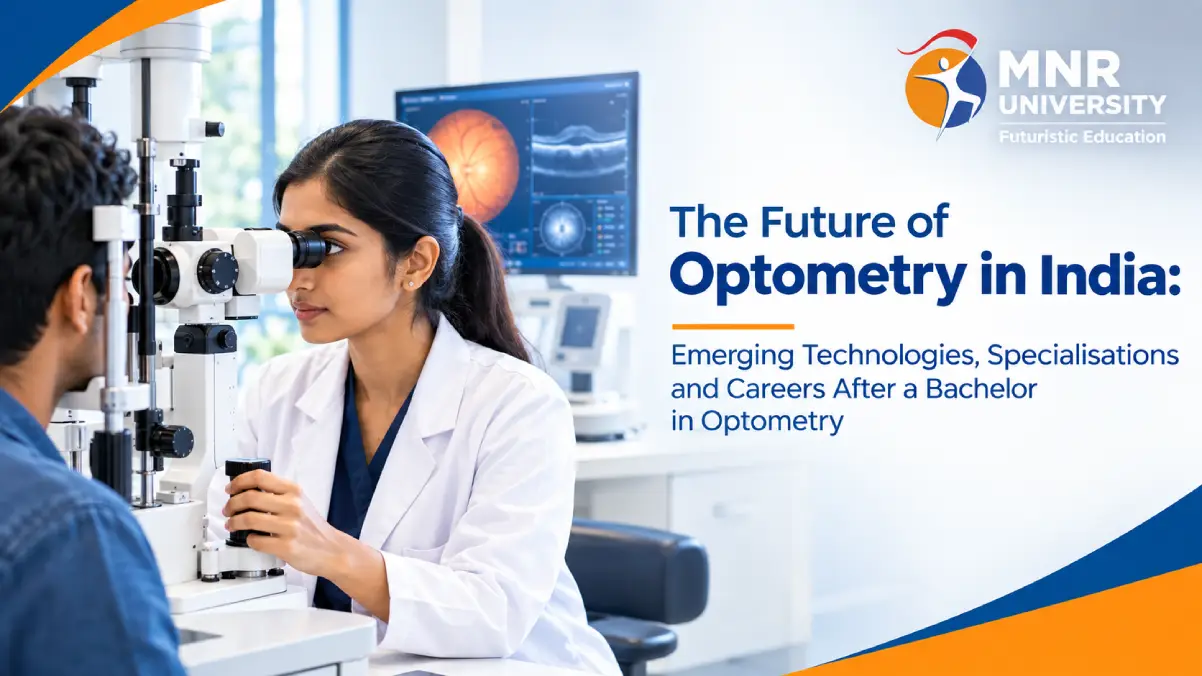
A bachelor in optometry (B.Optom) is a four year degree in eye care, followed by a one year clinical internship. Optometrists test sight, prescribe spectacles and contact lenses, and screen for eye disease. The work is changing fast: AI now reads retinal images, teleoptometry reaches villages, and myopia clinics are opening in every metro. India has about 45,000 optometry and primary eye care workers against a need of roughly 130,000, so demand stays high. Specialisations include contact lens practice, paediatric optometry, low vision rehabilitation and myopia control. Among optometry colleges in Hyderabad, MNR University runs a B.Optom with eye hospital training and a 40 per cent merit scholarship for allied health students.
Introduction
Stepping into the field of eye care sounds good, and the curiosity pertaining to the future and career possibilities hovers in the mind of aspirants. One question that often comes up is whether machines will soon do the eye test on their own. The honest answer is that software has already started reading retinal photographs, yet the person behind the chair matters more than before.
Eye-specialists in India are stretched thin. Around 550 to 600 million Indians need some form of corrective eyewear, going by industry estimates, while the country counts fewer than 20,000 optometrists in its secondary and tertiary eye hospitals. Every new scanner and screening app still needs a trained pair of eyes to read the result and explain it to a worried patient.
That gap is why a bachelor in optometry has quietly become one of the steadier choices in allied health. This guide looks at the technology arriving in clinics, the specialisations opening up, what the pay looks like, how optometry colleges in India compare, and where MNR University in Greater Hyderabad fits into the picture.
What Does an Optometrist Actually Do in India?
Many parents and students still believe that an optometrist simply hands out spectacles. The reality on the ground is somewhat different. An optometrist measures how the eye focuses, fits contact lenses, checks eye pressure, screens the retina for disease, and manages low vision in patients who cannot be helped by surgery.
Optometrist, Ophthalmologist or Optician: Who Does What?
Table 1: The three eye-care roles compared
| Role | Qualification | Main work | Can perform surgery? |
| Optometrist | B.Optom, four years plus one year internship | Eye tests, refraction, contact lenses, screening, low vision care | No |
| Ophthalmologist | MBBS plus MS or MD in ophthalmology | Diagnosis and medical treatment of eye disease, surgery | Yes |
| Optician / Vision technician | Diploma, usually two years | Dispensing and fitting spectacles, basic vision screening | No |
It is worth noting that the law has caught up with the profession. The National Commission for Allied and Healthcare Professions Act, 2021 created a council for ophthalmic sciences, set the four year degree as the standard for the title of optometrist, and made registration compulsory, with penalties that run up to Rs 5 lakh. For students, that Act turned optometry from a loosely defined job into a registered profession.
Why Is the Demand for Eye Care Rising So Quickly?
There is little doubt that the numbers drive this story. The World Health Organization counts at least 2.2 billion people with a near or distance vision impairment, and about 1 billion of those cases were preventable or remain unaddressed. India carries over 20 per cent of the world blind population, along with the highest number of blind children anywhere.
Table 2: Vision and eye-care workforce data
| Indicator | Figure | Source |
| People worldwide with near or distance vision impairment | At least 2.2 billion | WHO fact sheet |
| Cases preventable or still unaddressed | About 1 billion | WHO fact sheet |
| People without the spectacles they need | 88.4 million | WHO fact sheet |
| People with untreated near-vision loss (presbyopia) | 826 million | WHO fact sheet |
| Annual global productivity loss from vision impairment | USD 411 billion, about Rs 39.5 lakh crore | WHO fact sheet |
| Optometrists in Indian secondary and tertiary eye care | 17,849 | AIIMS eye-care survey, reported by Outlook India |
| Ophthalmologists in India | 20,944, about 15 per million people | AIIMS eye-care survey |
| Optometry and primary eye care workers in India | About 45,000 against a need of about 130,000 | India Vision Institute, via Business Standard |
| India share of the world blind population | Over 20 per cent | AIIMS eye-care survey |
The Myopia Curve Every Young Optometrist Will Meet
A closer look at the industry shows that short-sightedness in Indian city children has climbed sharply. One Indian prediction model tracked urban children aged 5 to 15 and found the share with myopia rising from 4.44 per cent in 1999 to 21.15 per cent in 2019.
Table 3: Myopia in urban Indian children aged 5 to 15
| Year | Share of children with myopia | Status |
| 1999 | 4.44 per cent | Recorded |
| 2019 | 21.15 per cent | Recorded |
| 2030 | 31.89 per cent | Projected |
| 2040 | 40.01 per cent | Projected |
| 2050 | 48.14 per cent | Projected |
One could argue that this single table explains the next twenty years of the profession. Almost half of urban school children may need vision correction by 2050, and myopia control clinics are being built around that forecast.
Emerging Technologies Changing the Optometry Clinic
The situation has changed considerably over the last few years. Retinal cameras now fit in a bag, screening runs on a phone, and software reads the images in seconds.
Table 4: Technology in eye care and what it means for an optometrist
| Technology | What it does | What the optometrist does with it |
| AI retinal screening | Reads fundus photographs and flags diabetic retinopathy or glaucoma risk | Confirms the finding, counsels the patient and refers on time |
| Teleoptometry | Links a rural vision centre to a city specialist by video | Runs the local examination and explains the plan in the local language |
| Portable and smartphone fundus cameras | Takes retinal images at a camp or a bedside | Captures usable images and decides who needs the hospital |
| Optical coherence tomography (OCT) | Scans layers of the retina in cross-section | Reads the scan and tracks change between visits |
| Myopia control lenses and orthokeratology | Slows the progress of short sight in children | Fits the lens, measures axial length, follows up for years |
| Digital refraction and auto phoropters | Speeds up the sight test and records data | Checks the result against the patient real world vision |
| Low vision and assistive technology | Magnifiers, screen readers and wearable aids | Trains the patient to use them at home, school or work |
How Good Is AI at Reading an Eye?
Good, within limits. The Aireen study cited by Grand View Research reported 92.1 per cent sensitivity for diabetic retinopathy, ahead of human readers in that test. Kerala has run an AI screening programme called Nayanamritham 2.0, and Google has licensed its diabetic retinopathy model to Indian partners with a target of six million screenings over a decade.
From an employer point of view, this shifts the job rather than shrinking it. Someone still has to dilate the pupil, take a clean image, read the report, break difficult news gently, and bring the patient back in three months. Ask any experienced professional in the field, and they will tell you that the last three of those are the hardest.
Table 5: Money moving into eye care and eye-care technology
| Market | Base value | Forecast value | Growth | Source |
| AI in ophthalmology, global | USD 209.2 mn (about Rs 2,008 crore), 2024 | USD 1,359.1 mn (about Rs 13,047 crore), 2030 | 36.8% CAGR | Grand View Research |
| Eyewear market, India | USD 11.09 bn (about Rs 1,06,464 crore), 2025 | USD 20.86 bn (about Rs 2,00,256 crore), 2034 | 6.66% CAGR | IMARC Group |
| Contact lenses, India, fastest growing segment | Part of the eyewear market above | Segment growth to 2034 | 7.8% CAGR | IMARC Group |
| South India, fastest growing region for eyewear | Part of the eyewear market above | Regional growth to 2034 | 7.1% CAGR | IMARC Group |
It is interesting to observe that South India is the quickest growing market for eyewear in the country. For a student weighing an optometry career in Hyderabad, that regional number is worth more than any national average.
Specialisations After a Bachelor in Optometry
While the course is popular, there is much more to it than most people realise. The first job is usually general practice. Within a few years, most optometrists pick a lane.
Table 6: Specialisations open after a B.Optom
| Specialisation | What the work involves | Where it is practised |
| Contact lens practice | Fitting soft, rigid and speciality lenses, including for keratoconus | Eye hospitals, optical chains, private clinics |
| Paediatric optometry and binocular vision | Squint, lazy eye and reading difficulty in children | Children hospitals, school screening programmes |
| Myopia control | Slowing short sight in children with lenses and lifestyle plans | Dedicated myopia clinics, city practices |
| Low vision rehabilitation | Helping patients use the sight they still have | Rehabilitation centres, NGOs, eye institutes |
| Sports vision | Reaction time, depth judgement and eye training for athletes | Sports academies, performance centres |
| Geriatric and community optometry | Cataract screening and rural vision centres | Vision centres, outreach camps, public health projects |
| Vision science research and teaching | Clinical trials, instrument studies, lecturing after an M.Optom | Universities and eye institutes |
Optometry Career and Salary After a Bachelor in Optometry
For many students, the money question comes first. Indeed India puts the average optometrist salary at about Rs 20,602 a month, which works out near Rs 2.5 lakh a year, from 215 salaries updated in February 2026. Hyderabad sits close to the top of the city list at about Rs 26,006 a month.
In practical terms, the first two years pay modestly and teach a great deal. Pay moves once a graduate picks a speciality, clears an M.Optom, or takes charge of a vision centre. Optometrists who register and work abroad, in the Gulf or in Australia, earn well above Indian levels, though each country sets its own licensing exam.
Table 7: Optometry career paths, pay and how to get there
| Career path | Typical employer | Indicative monthly pay | Next step |
| Clinical optometrist | Eye hospital or multi-speciality hospital | Rs 20,000 to Rs 32,000 (Indeed range) | M.Optom or a speciality fellowship |
| Optometrist, Hyderabad average | City hospitals and optical chains | About Rs 26,006 | Speciality clinic role |
| Contact lens or myopia specialist | Speciality clinic, optical retail chain | Above the general average with experience | Certification and fellowship |
| Vision centre in-charge | NGO or hospital outreach network | Varies with the project | Public health or management route |
| Optical retail and product roles | Eyewear brands and lens companies | Varies with sales component | Business or product training |
| Teaching and research | Universities and eye institutes | As per university scale | M.Optom, then PhD |
| Overseas practice | Gulf, UK and Australia, subject to local licensing | Well above Indian levels | Local registration exams |
Optometry Colleges in India: How Does MNR University Compare?
There is a general notion that South India is quite ahead of others in this particular field, with the emergence of large eye hospitals and optical chains offering a plethora of job opportunities. Fathoming the consequence of this fact, private universities in Telangana have expanded their labs and hospital tie-ups to attract students from different regions to study optometry and explore the possibilities.
Table 8: Top optometry colleges in India for B.Optom (Collegedunia, 2026)
| Rank | College | Location | Total B.Optom fees |
| 1 | AIIMS, New Delhi | Delhi NCR | Rs 4,205 |
| 2 | JIPMER, Puducherry | Puducherry | Rs 93,690 |
| 3 | Christian Medical College, Vellore | Tamil Nadu | Rs 1,39,980 |
| 4 | AIIMS, Bhopal | Madhya Pradesh | Rs 6,365 |
| 5 | GMCH, Chandigarh | Chandigarh | Rs 39,132 |
| 9 | Manipal Academy of Higher Education | Karnataka | Rs 6,58,000 |
Seats at those institutes run into single or double digits. That is why most families also compare private optometry colleges in India that sit closer to home, with a teaching hospital attached and a clear fee structure. In many ways, the hospital matters more than the ranking, because refraction is a skill built on hundreds of patients, not on lecture hours.
Table 9: Optometry options in and around Hyderabad
| Institution | Programme | Fees (indicative) | Note |
| MNR University, Sangareddy (Greater Hyderabad) | Bachelor in Optometry (B.Optom) and M.Optom | See the official fee page | BiPC or MPC accepted; eye hospital internships; up to 40 per cent merit waiver |
| Malla Reddy Vishwavidyapeeth | B.Optom | Rs 2.50 lakh to Rs 6.40 lakh | Deemed to be university |
| GITAM School of Science, Hyderabad | B.Optom | Rs 90,000 to Rs 2.10 lakh | Private university |
| L V Prasad Eye Institute, Hyderabad | PG Diploma in Optometry and Vision Sciences | Rs 30,000 for the course | One and a half years; a well known name for postgraduate eye care |
Table 10: Well-known Hyderabad institutions and whether optometry is on offer
| Institution | Main strength | Optometry degree offered? |
| MNR University | Allied and healthcare sciences, plus engineering and AI | Yes, B.Optom and M.Optom |
| Malla Reddy University | Engineering, allied health sciences | Optometry offered in the group |
| Anurag University | Engineering, pharmacy, medical sciences | Not listed as B.Optom on its main programme list |
| CMR group of institutions | Engineering and health sciences | Check the individual institute |
| BITS Pilani, Hyderabad Campus | Engineering and sciences | No |
| Mahindra University | Engineering, management, law, media | No |
| Woxsen University | Business, technology, design | No |
| VNR VJIET and Vasavi College of Engineering | Engineering | No |
| Kaloji Narayana Rao University of Health Sciences | State health sciences university | Through affiliated colleges |
Why Are Students Searching for MNR University for a Bachelor in Optometry?
It is quite common to hear parents ask about the hospital first, and the campus second. Not everyone is aware that the MNR group has run health sciences institutions on the Sangareddy campus for decades, with a 50 plus year legacy in education behind the university. The optometry programme sits inside the School of Allied and Healthcare Sciences, alongside a Master in Optometry, so a student can stay on for postgraduate study without shifting cities.
Table 11: MNR University USPs and what they mean for an optometry student
| USP | What it means for a B.Optom student |
| Telangana first DASCA-USA accredited university, as stated by MNR | A data science credential that supports AI and analytics learning across schools |
| Gold Sustainable Campus | A green, well kept campus to live and study on |
| 50 plus year legacy in education | Long experience in running health and technical institutions |
| Academic collaborations with US universities | Links with Emporia State, Wayland, Faulkner, Campbellsville, St. Francis and Cumberland |
| Clinical training in eye hospitals | Refraction practice, slit lamps, autorefractors and tonometers on real patients |
| Internships in multi-speciality eye clinics | Supervised practice before the final year ends |
| Low vision rehabilitation workshops | Training for the patients most clinics find hardest to help |
| Three separate technical laboratories | Hardware and software close to what graduates meet in their first jobs |
| Scholarships, internships and a placement cell | Up to 40 per cent tuition waiver for allied health, with job and PG guidance |
Eligibility for the B.Optom at MNR University
- 10+2 with BiPC or MPC from a recognised board or institute, or Class 10 plus a two or three year diploma in a relevant technology.
- Admission on merit, or on valid state, national or international entrance test scores.
- Minimum age of 17 years as on 31 December of the admission year.
From a student perspective, the MPC route matters. A bachelor in optometry is one of the few clinical degrees that a Maths stream student can still enter, and MNR University lists both groups as eligible.
Conclusion
Eye care in India is short of people, not of patients. AI will read more images each year, teleoptometry will reach further into the districts, and myopia clinics will keep filling up. None of that removes the need for someone who can sit with a child, a farmer or a grandmother and get the prescription right.
A bachelor in optometry puts a student in that chair after four years of study and one year in a clinic. For families comparing optometry colleges in India, the questions worth asking are simple: which eye hospitals will the student work in, what equipment is in the lab, and what does the whole course cost. MNR University publishes its eligibility, fee and scholarship details openly, and a campus visit at Sangareddy in Greater Hyderabad answers the rest.
Frequently Asked Questions
A bachelor in optometry, written as B.Optom, is a four year undergraduate degree in eye care, followed by a one year clinical internship. Students learn ocular anatomy, optics, refraction, contact lenses, low vision care and ocular disease. Graduates test sight, prescribe spectacles and contact lenses, and screen for eye disease.
Yes. India has about 45,000 optometry and primary eye care workers against a need of roughly 130,000, going by India Vision Institute figures. The AIIMS eye care survey counted 17,849 optometrists at secondary and tertiary level. The demand is real, and the NCAHP Act 2021 has given the profession a legal footing.
An optometrist holds a four year optometry degree, tests vision, prescribes glasses and contact lenses, and screens for eye disease. An ophthalmologist is an MBBS doctor with a further MS or MD in ophthalmology, who treats eye disease medically and performs surgery. The two work as a team.
No. AI reads retinal photographs and flags likely disease, and one system reported 92.1 per cent sensitivity for diabetic retinopathy. It still cannot examine a patient, fit a contact lens, counsel a worried parent or manage a child with low vision. AI shortens the queue, while the optometrist makes the decision.
Candidates need 10+2 with BiPC or MPC from a recognised board, or Class 10 plus a two or three year diploma in a relevant technology. Admission is on merit or on valid entrance test scores. The minimum age is 17 years as on 31 December of the admission year.
Yes, at MNR University. Its optometry page lists both BiPC and MPC groups as eligible, which is useful for students who studied Maths instead of Biology. Several other optometry colleges in India accept only Physics, Chemistry and Biology, so each prospectus needs checking.
The degree runs for four years of study followed by a one year supervised clinical internship, so about five years before a graduate is ready to register and practise independently. The internship is where most students decide their specialisation.
Common paths are contact lens practice, paediatric optometry and binocular vision, low vision rehabilitation, myopia control, sports vision, geriatric and community optometry, and clinical research in vision science. A Master in Optometry, M.Optom, deepens any one of them.
Indeed India reports an average of about Rs 20,602 a month, roughly Rs 2.5 lakh a year, based on 215 salaries updated in February 2026. Hyderabad averages about Rs 26,006 a month. Pay rises with an M.Optom, a specialisation, hospital experience or a job in the Gulf.
Collegedunia rankings for 2026 put AIIMS New Delhi, JIPMER Puducherry, CMC Vellore, AIIMS Bhopal and GMCH Chandigarh at the top for B.Optom. Seats there are very few, so most students compare private optometry colleges in India on clinical training, labs and fees.
Hyderabad has a strong eye care base, with L V Prasad Eye Institute among the best known names in the country. For a full degree, students look at MNR University, Malla Reddy Vishwavidyapeeth and GITAM, comparing eye hospital tie-ups, lab equipment and total fees.
Yes. MNR University offers a merit based tuition fee waiver of up to 40 per cent for Allied and Healthcare Sciences programmes, which include the Bachelor in Optometry. The scholarships page carries the current rules.
Related Blogs

CBSE Class 12 Result 2026: Everything You Need to Know — and What Comes Next
The CBSE Result season is one of the most defining moments in a student’s academic…

Why Graduates Will Need More Than Just an Academic Degree to Succeed in 2026
Let’s think back to the news headlines: technology giants bypassed recent degree holders in favour…

Career Opportunities After BSc in Neuroscience: Jobs, Salary, and Higher Studies
Stepping into the field of brain science raises one big question for most students. What…
Anaesthesiology: A Fundamental Pillar of Modern Surgery
Modern healthcare relies heavily on the steady hands and technical expertise of clinical specialists during…
Why Is B.Sc MLT One of the Fastest-Growing Healthcare Courses After Class 12?
Many students finish Class 12 with science subjects and wonder which healthcare course will give…
Admission in BPT 2026: Eligibility, Fees, Career Scope and How to Choose the Right Physiotherapy College
Physiotherapy has grown into one of the most in-demand health careers in India. Every year,…