
Computer Vision in 2026: Applications, Career Scope, and Future Opportunities
Home / MNR University / Computer Vision in 2026: Applications, Career Scope, and Future Opportunities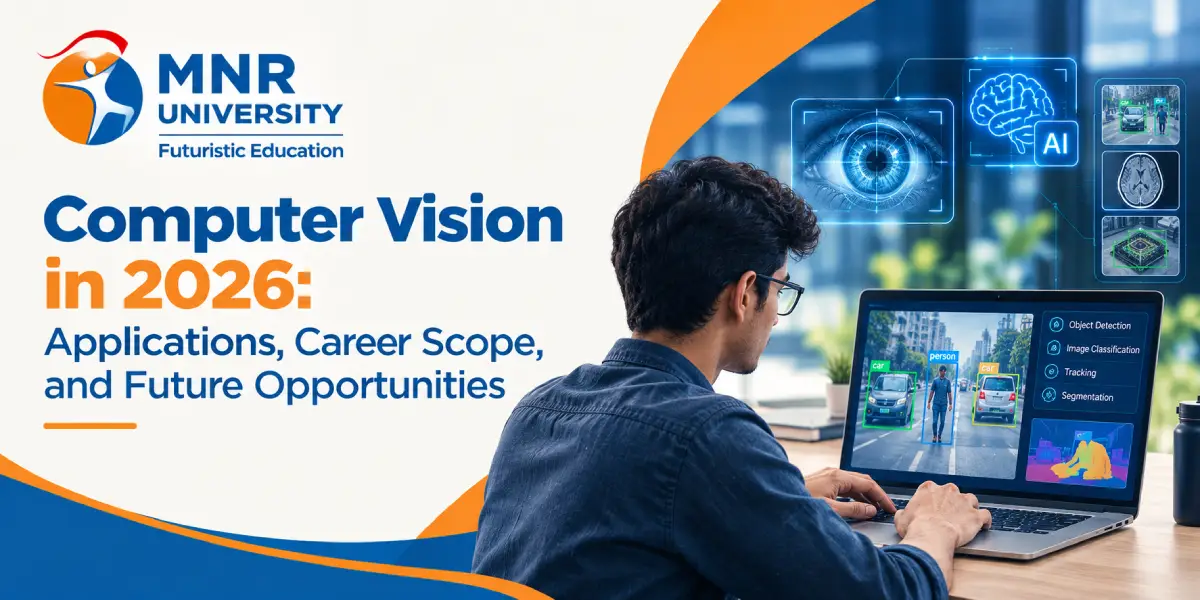
Why Students Are Shortlisting BTech CSE Colleges in Sangareddy? Computer vision is the branch of artificial intelligence that teaches machines to read images and video. In 2026 it runs airport face gates, factory inspection cameras, crop drones and hospital scanners.
India’s computer vision services market stood at USD 380 million in 2025, about ₹3,648 crore, and is growing at roughly 28% a year. Entry-level computer vision engineers in India earn about ₹7–13 lakh a year.
Students enter this field through BTech CSE, usually with an AI, machine learning or data science specialisation. BTech CSE colleges in Sangareddy district are a practical place to study it, because India’s autonomous navigation testbed at IIT Hyderabad, the ICRISAT crop research headquarters and the Patancheru manufacturing belt all sit inside the same district.
Introduction
Stepping into the field of computer science engineering sounds good, and the curiosity pertaining to the future and career possibilities hovers in the mind of aspirants.
A camera at Hyderabad airport looks at a passenger’s face for half a second. The gate opens. No boarding pass. No ID card. No queue.
Thirty kilometres away, a camera above a packing line in Patancheru checks 200 strips a minute and pulls out the two with a crooked seal. In a field nearby, a drone photographs a groundnut crop and marks the patch where a fungus started four days ago.
Three cameras. Three very different jobs. One branch of engineering behind all of them.
That branch is computer vision, and it has become one of the most employable corners of computer science. For many students, the puzzle is where to study it. A closer look at the map throws up an answer that surprises people: Sangareddy district, on the western edge of Hyderabad, already holds the country’s autonomous navigation testbed, a global crop research headquarters and one of Telangana’s oldest factory belts.
What follows covers what computer vision does, what it pays, which skills it asks for, and how BTech CSE colleges in Sangareddy compare on branches, fees and entry rules.
What is computer vision, and how does a machine actually see?
Computer vision is the part of artificial intelligence that turns pictures into decisions. A camera captures light. The software turns that into numbers. A trained model then answers a question about those numbers: what is in this picture, where is it, and what has changed since the last frame?
How is computer vision different from ordinary AI?
Most AI systems read text or tables. Computer vision reads pixels. That makes the work harder in one specific way: a picture of the same object changes completely with light, angle, dust and distance. A model that works in a clean laboratory often fails on a factory floor in May.
What four jobs does every computer vision system do?
Table 1: The four building blocks
| Task | The question it answers | An everyday example |
| Classification | What is this a picture of? | Sorting a photo as healthy leaf or diseased leaf |
| Detection | Where in the frame is the object? | Drawing a box around every helmet on a shop floor |
| Segmentation | Which pixels belong to the object? | Outlining a tumour on an MRI slice |
| Tracking | Where did it move between frames? | Following one vehicle across six traffic cameras |
Where is computer vision already working in India?
A closer look at the industry shows that this is not a laboratory subject any more. It is running on ordinary hardware, in ordinary places, today.
Table 2: Computer vision in daily use across India (2026)
| Where | What the cameras do | Scale or result recorded | Source |
| Airports | Match a live face against a stored template at entry, security and boarding | DigiYatra has handled over 10 crore domestic journeys across 38 airports, with over 2.5 crore app downloads. Since 1 June 2026 it is compulsory for international transit at Delhi, Mumbai, Bengaluru and Hyderabad | Ministry of Civil Aviation, via Khaleej Times |
| Factories | Inspect every item on the line instead of checking samples | Defect escape rates fall from 3–8% down to 0.5–2% | NASSCOM Computer Vision Report 2025, via Opsio |
| Farms | Drone and tractor cameras spot disease, weeds and water stress early | Spraying only where weeds appear cuts chemical use by 50–80% | Lasting Dynamics industry review, 2026 |
| Hospitals | Read X-ray, CT and MRI images and flag suspect areas | Of 1,451 AI medical devices authorised by the US FDA to end-2025, 1,104 (76%) were radiology tools | US FDA list, via The Imaging Wire |
| Roads, shops and warehouses | Read number plates, check shelves, watch safety compliance on existing CCTV | Indian firms such as Intello Labs, ParallelDots, Wobot.ai and Detect Technologies build these systems | Softlabs Group industry listing, 2026 |
How big is the computer vision market in 2026?
Research houses measure different slices, so their totals differ. All dollar figures below are converted at about ₹96 to one US dollar, the rate in mid-September 2026.
Table 3: Market size, with rupee conversions
| Segment | Value now | Projected value | The same figures in INR | Source |
| AI in computer vision, global | USD 23.42 billion (2025) | USD 63.48 billion by 2030, at 22.1% CAGR | ₹2.25 lakh crore → ₹6.09 lakh crore | MarketsandMarkets, August 2026 |
| AI in computer vision, wider definition | USD 55.36 billion (2026) | USD 162.33 billion by 2030, at 30.9% CAGR | ₹5.31 lakh crore → ₹15.58 lakh crore | The Business Research Company, 2026 |
| Machine vision (factory floor only) | USD 21.12 billion (2025) | USD 35.43 billion by 2030 | ₹2.03 lakh crore → ₹3.40 lakh crore | The Business Research Company, 2026 |
| India: computer vision services | USD 380 million (2025), growing about 28% a year | — | About ₹3,648 crore | NASSCOM Computer Vision Report 2025, via Opsio |
One detail matters for students here. Asia Pacific is the fastest-growing region in this market, at 29.8% a year, and Asia-Pacific was already the largest region for factory machine vision in 2025. The work is moving towards India, not away from it.
Why are students shortlisting BTech CSE colleges in Sangareddy?
There is a general notion that South India is quite ahead of others in this particular field with the emergence of a multitude of tech giants offering a plethora of job opportunities. Fathoming the consequence of this fact, private universities have expanded their infrastructure and facilities to attract students from different regions to study computer science and explore the possibilities.
Not everyone is aware that the three biggest uses of computer vision in India each have a physical home inside one district.
Table 4: Sangareddy district’s three computer vision anchors
| What sits in the district | Where | The computer vision field it feeds | Source |
| IIT Hyderabad, on a 576-acre campus, which hosts the NMICPS Technology Innovation Hub on Autonomous Navigation | Kandi | Self-driving vehicles, drones and robotics perception | IIT Hyderabad official contact page; company records |
| ICRISAT, the global headquarters of the International Crops Research Institute for the Semi-Arid Tropics | Patancheru 502324 | Crop health, pest detection and produce grading by image | ICRISAT official contact page |
| The Patancheru industrial belt, a pharmaceutical and manufacturing zone about 18 km from HITEC City | Patancheru | Factory quality inspection and worker safety monitoring | Public records on Patancheru industrial area |
Sangareddy district covers 4,464 sq km across 28 mandals and recorded a nominal district output of about ₹60,401 crore in 2022-23. From a student’s perspective, the useful point is simpler: a final-year project on crop imaging, factory inspection or autonomous navigation can be built where those problems actually exist.
Which BTech CSE colleges in Sangareddy district should a student compare?
Most online lists quietly mix Hyderabad city campuses into this search. The table below keeps only institutions inside Sangareddy district.
Table 5: BTech CSE and allied branches inside Sangareddy district
| Institution | Type | Location in the district | CSE-related branches offered | Source |
| IIT Hyderabad | Government, Institute of National Importance | Kandi | B.Tech CSE and allied computing branches | IIT Hyderabad official site |
| JNTUH College of Engineering, Sultanpur | Government | Sultanpur | B.Tech CSE, AI & Machine Learning | Collegedunia listings |
| MNR University | Private university | Fasalwadi, Sangareddy | B.Tech (Hons) CSE, CSE (AI & ML), CSE (AI & Data Science), ECE (IoT) | MNR University official site |
| Woxsen University | Private university | Kamkole, Sadasivpet | B.Tech CSE, AI & ML, Data Science | Shiksha listings |
| GITAM Hyderabad | Deemed university | Rudraram | B.Tech CSE and allied branches | Public college directories |
| MNR College of Engineering and Technology | Private, JNTUH affiliated | Kandi / Sangareddy | B.Tech CSE, CSE (AI & ML), CSE (Data Science) | KollegeApply listings |
| Ellenki College of Engineering and Technology | Private, JNTUH affiliated | Patancheru | B.Tech CSE and allied branches | TS EAMCET college directory |
| RRS College of Engineering and Technology | Private, JNTUH affiliated | Patancheru | B.Tech CSE and allied branches | TS EAMCET college directory |
How do the fees compare?
Published annual tuition for the 2026-27 cycle. Hostel, mess and transport are charged separately everywhere.
Table 6: Annual tuition, inside the district and nearby
| Institution | In Sangareddy district? | Annual tuition (approx.) | Source |
| JNTUH College of Engineering, Sultanpur | Yes | ₹50,000–55,500 (government) | Collegedunia; Zollege listings |
| MNR College of Engineering and Technology | Yes | About ₹63,000–65,000 | Public college directories |
| MNR University | Yes | ₹2,00,000 | MNR University official fee page |
| IIT Hyderabad | Yes | About ₹2,36,000 including other charges | Public college directories |
| Woxsen University | Yes | ₹3,00,000 tuition (about ₹3,60,000 with other fees) | GetMyUni listings |
| Malla Reddy University | No — Medchal | ₹2,00,000 | Collegedunia / Shiksha listings |
| Anurag University | No — Ghatkesar | ₹2,85,000 | Collegedunia listings |
| Mahindra University | No — Bahadurpally | ₹5,00,000 | Collegedunia listings |
| BITS Pilani, Hyderabad Campus | No — Jawahar Nagar | ₹5.83 lakh, rising about 5% a year | BITS Pilani official fee schedule |
| VNR VJIET and Vasavi College of Engineering | No — Hyderabad city | ₹1.31–1.70 lakh (Category A) | College listings |
Category A seats at fee-regulated colleges cost less. Category B and direct-admission seats cost more. Check every figure on the institution’s own page before payment.
What is the career scope of BTech CSE in computer vision?
One question that often comes up is whether computer vision pays better than general software work. Published ranges say it does, mainly because fewer graduates can do it.
Table 7: Roles and published salary ranges in India (2026)
| Role | What the work involves | Fresher (0–2 years) | With 2–5 years | Source |
| Computer Vision Engineer | Detection, segmentation and tracking models | ₹7–13 LPA (average about ₹8 LPA) | ₹15–22 LPA | Recrew.ai; MeriShiksha |
| Computer Vision Engineer (Glassdoor base pay) | — | Typical band ₹5.47–13 lakh; average base ₹8 lakh | 90th percentile ₹19.6 lakh | Glassdoor India |
| ADAS / autonomous vehicle engineer | Camera perception for cars and drones | — | ₹12–45 LPA in automotive AI | ShiftToTech salary guide |
| Medical imaging AI engineer | Models that read scans | ₹5–11 LPA | ₹12–24 LPA | Win in Life Academy |
| Machine Learning Engineer | General model training and shipping | ₹6–12 LPA | ₹18–30 LPA | MeriShiksha |
| Data Scientist | Finding patterns in data | ₹5–12 LPA | ₹15–28 LPA | MeriShiksha |
Companies hiring for this work in India include Bosch, Continental, Qualcomm, Intel, Samsung R&D, NVIDIA, Siemens Healthineers, TCS Research and ISRO. Skill in detection models such as YOLO and SAM carries a published salary premium of 15–25%. Pay depends on skill, employer and city, so treat these as a guide, never a promise.
Which skills does a computer vision job actually ask for?
Table 8: The skill list
| Skill | Why it matters | Where a student builds it |
| Python with OpenCV | Reading, cleaning and handling images | First and second year laboratory work |
| Linear algebra and geometry | Cameras, projections, distance and depth | Mathematics papers |
| CNNs and vision transformers | The models that do the actual seeing | Deep learning subjects |
| Detection and segmentation models | YOLO, SAM and similar tools run most live systems | Project work and internships |
| Data labelling and dataset quality | A weak dataset beats a clever model every time | Team projects |
| Edge deployment | Indian factories and farms often lack steady connectivity, so models run on the device | Electives and industry training |
| Privacy law | The DPDP Act, 2023 treats face data as sensitive biometric data needing consent | Ethics and law modules |
| Testing under Indian conditions | Changing light, dust and crop variety break laboratory models | Field projects near the campus |
How does a student actually get into these colleges?
Table 9: Entry route and eligibility, Sangareddy district colleges
| Institution | Entry route | Broad eligibility |
| IIT Hyderabad | JEE Advanced, through JoSAA counselling | 10+2 with Physics, Chemistry and Mathematics; JEE Main qualification first |
| JNTUH College of Engineering, Sultanpur | TS EAPCET state counselling | 10+2 with PCM and a valid EAPCET rank |
| MNR University | TS EAMCET / EAPCET or an equivalent state, national or international test; direct application | 10+2 with PCM; minimum age 16 years |
| Woxsen University | Own admission process or JEE Main | 10+2 with PCM |
| GITAM Hyderabad | GITAM Admission Test (GAT) or JEE Main | 10+2 with PCM |
| MNR College of Engineering and Technology | TS EAMCET or TS ECET for lateral entry | 10+2 with PCM |
| Ellenki and RRS colleges, Patancheru | TS EAPCET Category A, or management quota | 10+2 with PCM |
Rules change every cycle, so confirm the route with each institution before applying.
Why do students look closely at MNR University?
MNR University sits at Fasalwadi, inside the same belt described above. Among B.Tech CSE colleges in Sangareddy, two things separate it from most private campuses nearby.
First, the data science teaching carries an outside stamp. MNR University is the first university in Telangana accredited by the Data Science Council of America (DASCA), a vendor-neutral body that checks data science and AI programmes against international knowledge standards. The accreditation was granted on 7 April 2026 and runs to 6 April 2032. When every college advertises an AI branch, an outside check is one of the few claims a parent can verify.
Second, the vision side of the subject has a natural partner on the same campus. The School of Allied and Healthcare Sciences runs degrees in Medical Radiology and Imaging Technology, so a CSE student building a scan-reading model can ask somebody who reads scans for a living.
The School of Engineering, Technology & Artificial Intelligence runs B.Tech (Hons) in CSE, CSE (AI & Machine Learning), CSE (AI & Data Science) and ECE (Internet of Things) at ₹2,00,000 a year for 2026-27, with M.Tech and PhD routes in AI and Machine Learning on the same campus.
The university carries a 50+ year legacy, a Gold Sustainable Campus recognition, academic collaborations with six United States universities including Emporia State, Cumberland and Campbellsville, and scholarships worth up to a 60% tuition waiver. Its laboratories hold three separate sets of hardware and software that graduates meet on their first day at work.
Conclusion
Ask any experienced professional in the field, and they will tell you the same thing. Computer vision rewards people who have seen models fail in the open air, not only in a notebook.
A student who trains a model on clean internet photographs will be surprised on day one at a factory. A student who tests the same model on a dusty line in May, on a crop in poor light, or on a camera mounted at the wrong angle, will already know what the job feels like.
There is little doubt that the future of B.Tech CSE runs through work of this kind. For families building a shortlist of BTech CSE colleges in Sangareddy, the honest filter is a simple one: which campus puts a student close to the problems, gives them a laboratory that is switched on, and can show an outside body has checked the teaching.
Frequently Asked Questions
It is software that reads pictures and video the way people read them. A camera sends an image, and a trained model answers what is in it, where it is, and what moved.
The district holds IIT Hyderabad at Kandi, JNTUH College of Engineering at Sultanpur, MNR University at Fasalwadi, Woxsen University at Sadasivpet, GITAM at Rudraram and several JNTUH-affiliated private colleges. Compare branches, laboratories, fees and entry route rather than rank alone.
The published numbers are healthy. India’s computer vision services market reached USD 380 million in 2025 and grows about 28% a year, while entry-level engineers are quoted at around ₹7–13 lakh.
Roles include computer vision engineer, ADAS engineer, medical imaging AI engineer, robotics perception engineer and machine learning engineer. Manufacturing, agriculture, healthcare, automotive and retail all hire for it.
Glassdoor India puts the average base near ₹8 lakh, with a typical band of ₹5.47–13 lakh and a 90th percentile of ₹19.6 lakh. Recrew.ai reports about ₹15 LPA average at two to five years.
No campus wins on every measure. IITs, IIITs and BITS Pilani lead on research. Students searching for the best B.Tech CSE university in Hyderabad usually end up comparing MNR University, Mahindra, Woxsen, Anurag and Malla Reddy, all of which run AI or data science branches.
No. B.Tech CSE is the usual route, ideally with an AI, machine learning or data science specialisation. Postgraduate study helps for research roles but is not needed for a first job.
Image processing changes a picture, such as sharpening or removing noise. Computer vision draws a conclusion from it, such as naming the object or counting how many there are.
Python with OpenCV, then linear algebra, then convolutional neural networks. After that, practise on detection models such as YOLO and learn to run a model on a small device.
Steady. Asia Pacific is the fastest-growing region for computer vision, at 29.8% a year, and factory machine vision was already largest in Asia-Pacific in 2025. The work is moving towards India.
Related Blogs

How Can Students Choose the Right CSE College with Placements in South India?
Picking the right engineering college feels like a big decision for most families. Students want…
Is BPT a Good Career in 2026? The Future Scope of Physiotherapy in India
Healthcare in India places physiotherapy at the heart of patient recovery, and the best physiotherapy…

How Will Artificial Intelligence Change The Next Decade & How Can You Lead This Space
Right now, machines read patient scans faster than any doctor, predict crop yields before rain…
AI & Machine Learning in Healthcare: From Medical Imaging to Predictive Diagnosis at Private Universities Near Hyderabad
Stepping into the field of AI and Machine Learning sounds good, and the curiosity pertaining…
The Future of Optometry in India: Emerging Technologies, Specialisations and Careers After a Bachelor in Optometry
A bachelor in optometry (B.Optom) is a four year degree in eye care, followed by…
How AI Is Changing Software Engineering: Skills Every CSE Student Needs in 2027
Stepping into the field of computer science engineering sounds good, and the curiosity pertaining to…