
Bachelor of Optometry: Jobs, Salary and Future Scope
Home / MNR University / Bachelor of Optometry: Jobs, Salary and Future Scope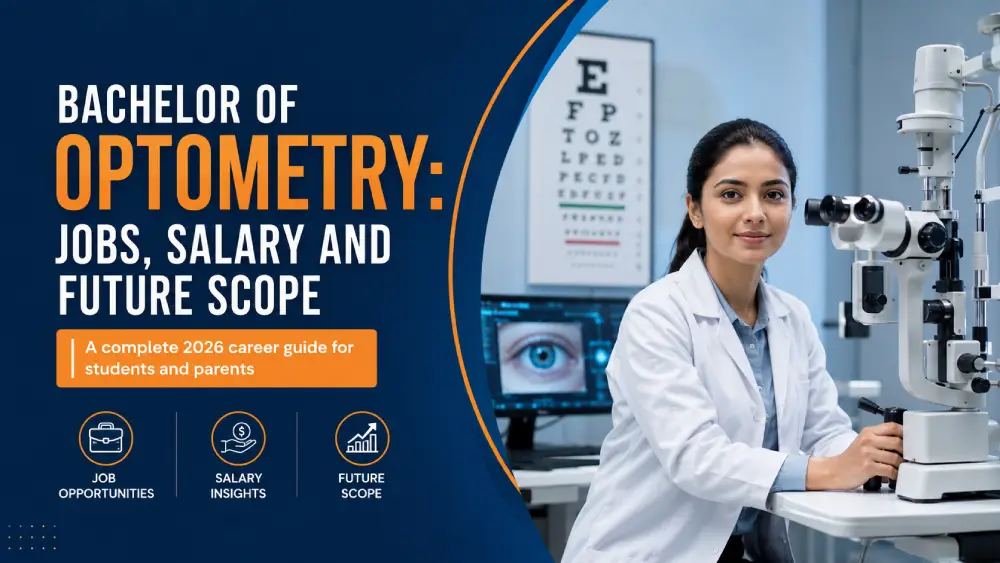
Every year, thousands of students leave school with a wish to work in healthcare, yet very few know about the people who protect one of the body’s most delicate gifts, the eyes. Behind every accurate eye test and every well-fitted pair of spectacles stands an optometrist. This career sits at the centre of modern healthcare, and it is growing faster than most families realise.
India has a vast population that needs eye care, and the country does not have enough trained professionals to meet that need. For a young student who enjoys science and likes helping people, this gap is an open door. A Bachelor of Optometry, often written as B.Optom, can lead to that door. This guide explains what the course covers, who can apply, what graduates earn, and where the field is heading. It also looks at how the best optometry colleges in India prepare students for real clinical work, so that parents who worry about a safe and respected future for their child will find clear answers here too.
What Is the Bachelor of Optometry (B.Optom) Course?
A Bachelor of Optometry is a four-year undergraduate degree in eye and vision care. The first three years cover classroom study and laboratory work, and the final year is a supervised hospital internship. Students learn how the eye works, how to test sight, and how to correct vision problems with spectacles, contact lenses, and other aids.
An optometrist is a primary eye care professional. They examine eyes, measure vision, detect early signs of disease, and guide patients toward the right treatment. When a condition needs surgery, the optometrist refers the patient to an ophthalmologist and often supports the recovery afterwards.
The subject blends biology, physics, and patient care. Anyone who liked science at school and enjoys working with people will feel at home in it. This is why bachelor of optometry programmes have become a popular choice among students who want a healthcare career without the very long study path of an MBBS.
Why Should Students Consider Optometry Colleges in India in 2026?
The simple answer is demand. India faces a serious shortage of trained eye care professionals, and the gap keeps widening each year. The figures below show why this field offers steady work for years to come.
| Indicator | Figure | Source |
| People in India who need vision correction | Over 450 million | Delhi Optometrists Association |
| Optometrists available (2018 estimate) | Around 45,000 | The Hindu Business Line |
| Optometrists the country needs | Around 125,000 | The Hindu Business Line |
| Four year trained optometrists | Around 9,000 | Journal of Optometric Education |
| Optometrist to ophthalmologist ratio | 0.85 (target was 3) | AIIMS national survey, 2025 |
| Avoidable blindness better eye care could prevent | 85.7 per cent | Delhi Optometrists Association |
These numbers explain why good optometry colleges in India report strong placement records. Hospitals, optical chains, and clinics all want qualified staff, and there are not enough graduates to fill every role. For a student, that means a job market with room to grow rather than shrink.
Have a Look at the B.Optom Course Structure and Syllabus
Most students want clear B.Sc optometry course details before they apply, and the plain breakdown below should help. The four years move from basic science to advanced clinical skill.
| Stage | Main Focus |
| Year 1 | Human anatomy, physiology, optics, and basic vision science |
| Year 2 | Ocular anatomy, refraction methods, and optical dispensing |
| Year 3 | Clinical optometry, low vision care, contact lens practice, and eye disease study |
| Year 4 | Full time supervised internship in eye hospitals and clinics |
Across these years, students practise with real equipment such as slit lamps, retinoscopes, and autorefractors. They also build communication skills, because a patient and friendly manner helps nervous people during an eye examination.
Strong vision science programs combine this theory with plenty of hands on hospital time, which is what employers value most. Anyone comparing B.Sc optometry course details across colleges should check the amount of clinical exposure on offer, because practice hours matter as much as lecture hours.
What Are the Eligibility and Admission Requirements for B.Optom?
The entry rules are friendly for most science students. The common requirements are listed below.
- Completion of Class 12 with Physics, Chemistry, and Biology
- A minimum aggregate that varies by college, often around 50 per cent
- An age of at least 17 years at the time of admission
- Admission through merit or a relevant entrance test, depending on the institution
Most colleges admit students directly on merit, while some accept national or state entrance scores. Families should confirm the latest rule with the college office before applying.
What Career Opportunities Open Up After a Bachelor of Optometry?
A B.Optom degree opens several paths, and graduates are not limited to one type of workplace. An eye care professional course of this kind prepares students for both clinical and commercial roles. Common career options include the following.
- Clinical optometrist in hospitals and eye care centres
- Vision consultant in optical retail chains such as large eyewear brands
- Contact lens specialist
- Low vision and rehabilitation expert
- Optometry lecturer or researcher after higher study
- Self employed practitioner running a private clinic or optical store
Graduates may also move into an ophthalmic technology course at postgraduate level, or specialise in areas such as paediatric vision or sports vision. Some join medical device companies that build eye testing equipment.
How Much Can an Optometrist Earn in India?
Pay depends on city, employer, and experience, yet the trend is encouraging. The table below shows common salary ranges drawn from education sector estimates.
| Experience Level | Approximate Annual Salary (INR) | Source |
| Fresh graduate (0 to 2 years) | Rupees 3 lakh to 4 lakh | Career guides, IHS |
| Mid level (3 to 5 years) | Rupees 4 lakh to 6 lakh | Career guides |
| Senior (5 years and above) | Rupees 6 lakh to 8 lakh | Career guides, IHS |
| Specialist or further qualified | Rupees 8 lakh and above | Industry estimates |
These ranges reflect education sector estimates and can shift with skill and location. Optometrists who add a postgraduate degree, or who specialise in contact lenses or low vision, often earn at the higher end. Private hospitals and corporate optical chains tend to pay above smaller setups in the early years.
What Is the Future Scope of Optometry in India?
The outlook is bright for several reasons. Screen use has risen sharply across all ages, and this has increased eye strain and refractive errors among young people. An ageing population also needs regular eye checks for cataract and other age related conditions.
Government health schemes now include eye screening at the primary care level, which creates fresh roles in rural and semi-urban areas. New tools that use artificial intelligence for early disease detection still need trained optometrists to confirm results and care for patients. Machines support the work, yet they cannot replace human judgement.
For a student choosing among optometry colleges in India, this points to a career that should stay in demand for decades.
What Makes MNR University Different for Optometry Students?
MNR University in Hyderabad offers its optometry programme through a health sciences focused campus with hospital access and modern laboratories. A few points stand out for students who compare options.
- A long standing legacy in education spanning over fifty years
- Recognition as one of Telangana’s accredited universities with international academic links
- A green and sustainable campus that has earned environmental recognition
- Academic collaborations with leading universities abroad
- Well-equipped technical laboratories with separate spaces for different practical skills
- Support for scholarships, internships, and placement assistance
Students who want hands-on clinical training will find that MNR University combines classroom study with real hospital practice, which matches what eye care employers look for.
How Can Students Begin Their Optometry Journey at MNR University?
Choosing a career in eye care is a steady and respected decision. The shortage of professionals means strong demand, the salaries grow with skill, and the work brings the reward of helping people see the world clearly.
For students and parents weighing the best optometry colleges in India, the key is to pick a place that offers real clinical exposure, good faculty, and proper laboratory access. MNR University aims to provide all three through its optometry programme in Hyderabad.
Families can visit the official MNR University website or contact the admissions office to learn about the current intake, eligibility, and application steps. A Bachelor of Optometry could be the first step toward a healthcare career that stays meaningful for life, which is why optometry colleges in India deserve a place on every science student’s shortlist.
Frequently Asked Questions
It is a four year programme, which includes a one year supervised hospital internship in the final year.
An optometrist tests vision and prescribes spectacles and lenses, while an ophthalmologist is a medical doctor who performs eye surgery and treats diseases. The two professionals often work together.
Students need Physics, Chemistry, and Biology in Class 12 to be eligible for most optometry colleges.
Yes. India needs far more optometrists than it currently has, so demand for qualified graduates is strong and steady.
Fresh graduates usually earn around Rupees 3 lakh to 4 lakh per year, with pay rising as they gain experience and add specialisations.
Yes. Many graduates run their own optical stores or vision care clinics after gaining a few years of experience.
Most optometry colleges admit students on merit and do not require NEET, though rules differ by college.
Roles include clinical optometrist, contact lens specialist, vision consultant, low vision expert, lecturer, and researcher.
Yes. Graduates can pursue a Master of Optometry, an ophthalmic technology course, or other specialisations to grow their career.
Rising screen use, an ageing population, and new government eye care schemes all point to growing demand for optometrists across India.
Related Blogs

Emerging Technology Careers and Engineering Pathways in 2026
Technology shapes every modern industry across the globe today. Students entering higher education look for…
Career Opportunities After BSc in Neuroscience: Jobs, Salary, and Higher Studies
Stepping into the field of brain science raises one big question for most students. What…
Optometrist Course Details After 12th: Eligibility, Duration, Fees, Salary and Career Scope in 2026
Stepping into the field of eye care after school can feel like a big step….
What Is the Career Scope After a B.Sc. in Cardiac Perfusion Technology?
A B.Sc cardiac perfusion technology degree leads to one of the most trusted roles in…
BSc Optometry Fees in India 2026: Government vs Private Colleges and What Affects the Cost
A career in eye care starts with one practical question: how much does the course…
What Makes Neurology Cases So Hard to Diagnose?
The human brain remains the most sophisticated and enigmatic structure in the known universe….