
Will AI Replace Radiologists? Let’s Decode The Truth
Home / MNR University / Will AI Replace Radiologists? Let’s Decode The Truth
Headlines lately sound like science fiction. You read about algorithms diagnosing diseases faster than humans, and it feels natural to wonder if the role of a radiologist is disappearing. It is not. In fact, the story is quite the opposite. We are witnessing a massive shift, but it is one of partnership, not replacement. The future of medicine looks like a powerful team-up between human insight and digital speed. For students standing at the crossroads of a career decision, this is the most exciting time to enter the field. The tools are getting sharper, but the hands guiding them matter most.
Is the “Robot Doctor” a Myth or Reality?
Technology often creates fear before it creates value. When calculators arrived, mathematicians did not vanish; they just started solving bigger problems. Artificial Intelligence acts the same way in healthcare. It handles the repetitive, tiring work—scanning thousands of images for tiny anomalies—so doctors can focus on what matters: the patient.
AI does not have a heartbeat. It cannot look a frightened patient in the eye and explain a diagnosis with compassion. It cannot understand the subtle context of a patient’s life history that might explain a shadow on an X-ray. This is where you come in. The technology is the engine, but the radiologist is the driver.
The Human Edge: What Algorithms Miss
While software excels at pattern recognition, it lacks judgment. A machine sees pixels & voxels; a radiologist sees a person. The medical field demands critical thinking and ethical decision-making that code cannot replicate.
- Complex Problem Solving: Rare diseases often deviate from standard patterns. Human experts connect unrelated dots that AI might dismiss as noise.
- Emotional Intelligence: Delivering news, good or bad, requires a human touch. Machines cannot offer comfort or reassurance.
- Ethical Responsibility: Who takes responsibility for a diagnosis? A computer program cannot be held accountable. The final call always rests with a human expert.
Man vs. Machine: A Quick Reality Check
Let us break down exactly where the lines are drawn. This comparison shows why the future needs both.
| Feature | Artificial Intelligence | Human Radiologist |
| Speed | Can process thousands of scans in seconds. | Needs time to analyse and review. |
| Accuracy | High for specific, learned patterns. | High for complex, non-standard cases. |
| Context | Zero. Treats data in isolation. | Full. Considers patient history and pain. |
| Empathy | None. It is just code. | An essential part of the job. |
| Adaptability | Needs retraining for new diseases. | Learns and adapts instantly. |
Why Hyderabad is the Launchpad for This Radiology Career
Geography plays a huge role in your career growth. Hyderabad is currently positioning itself as the global capital for Artificial Intelligence. With the Telangana government announcing plans to build a dedicated AI City, the convergence of healthcare and technology is happening right here.
Studying in a hub where tech giants meet top-tier hospitals gives you a front-row seat to this revolution. When you look for B.Sc. radiology colleges in Hyderabad, you are looking for a place that puts you in the centre of this innovation ecosystem. The city offers a unique blend of traditional medical excellence and next-generation tech exposure, making it the ideal training ground for the modern radiologist.
The MNR Advantage: Future-Proofing Your Skills
At MNR University, we understand that tomorrow’s healthcare professionals need more than just textbook knowledge. They need to be tech-literate, adaptable, and clinically sharp. We have designed our curriculum to bridge the gap between classic medical science and modern technological applications.
We are often cited among the best colleges for radiology in India because we refuse to stay stagnant. Our approach is dynamic, ensuring you graduate ready to work alongside AI, not in fear of it.
- 50+ Years of Trust: We have a deep-rooted legacy in education, and as per Times Ranking 2025, we are a top-ranked institution.
- Real-World Exposure: With 25+ industry partnerships and a 2,000+ strong expert faculty, you learn from the best.
- Global Best Practices: Our School of Clinical Research, Medical & Health Sciences integrates global standards, ensuring your degree holds value anywhere in the world.
- Innovation Ecosystem: From advanced laboratories to a dedicated startup incubation centre, we support students who want to invent the future, not just watch it happen.
A Curriculum That Evolves With You
The “School of Clinical Research, Medical & Health Sciences” at MNR University does not teach history; it teaches the future. Our Radiology & Image Technology program covers anatomy and physiology while introducing you to the digital tools transforming the industry. You learn to handle advanced imaging equipment and interpret data with the precision that modern hospitals demand.
We focus on “Industry Integration” through dedicated mentors and live projects. You will spend time in real medical settings, understanding how to apply your skills when lives are on the line. This hands-on approach ensures that when you step out, you are confident and capable.
Ready to Lead the Change?
The question is not if AI will replace you. The question is, will you be the expert who controls the AI? The medical world needs leaders who understand technology but practice with humanity.
Visit the campus to see how labs and learning connect. Walk through our corridors, speak to our mentors, and feel the energy of a campus built for the future.
Follow MNR University on Instagram.
Frequently Asked Questions
Yes, absolutely. AI is a tool that improves accuracy, but it cannot replace the judgment and oversight of a skilled radiologist. The demand for human experts to verify AI findings is actually increasing.
MNR University combines 50+ years of educational excellence with a modern, industry-aligned curriculum. Our focus on practical skills and technology integration prepares students for the real world.
No, you do not need to be a coder. However, understanding how technology works is beneficial. Our courses are designed to make you comfortable with the advanced machines and software used in hospitals today.
Graduates can work in hospitals, diagnostic centres, and research labs. With experience, you can move into specialised imaging fields or hospital management roles.
Related Blogs

Most Students Choose the Wrong Degree—Here’s What Top Universities Do Differently
Each year, students across India enter university with strong hopes and mixed information. Degree choices…
Is Your Code Writing Itself? Why the ‘Human’ Element Matters in a Machine Learning Course in Hyderabad
Code now generates code. Tools like GitHub Copilot churn out lines of code faster than…
Is Machine Learning More About Maths Than Coding?
We often look at applications like ChatGPT or self-driving cars and assume they run…
5 Global Universities Waiting to Accept You Through MNR’s 2026 Exchange Program
Ten years back, earning a degree from a good university in your home city was…
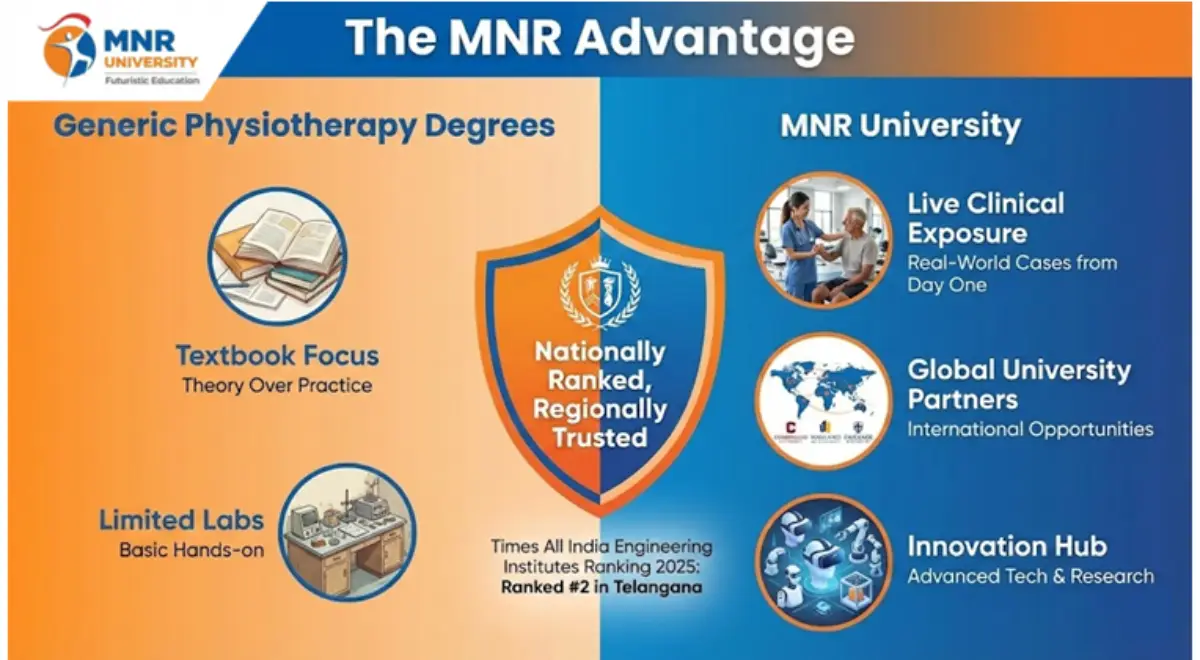
Are Generic Physiotherapy Degrees Teaching What Clinics Actually Need?
Rehabilitation is not the same anymore. We are seeing a massive change in how hospitals,…
Is Data Science Becoming Too Crowded for Fresh Graduates?
Everyone is talking about Data Science. It feels like a modern gold rush, with everyone…