
BSc Radiology Admission Process 2026: A Step-by-Step Guide for Students and Parents
Home / School of Allied Sciences / BSc Radiology Admission Process 2026: A Step-by-Step Guide for Students and Parents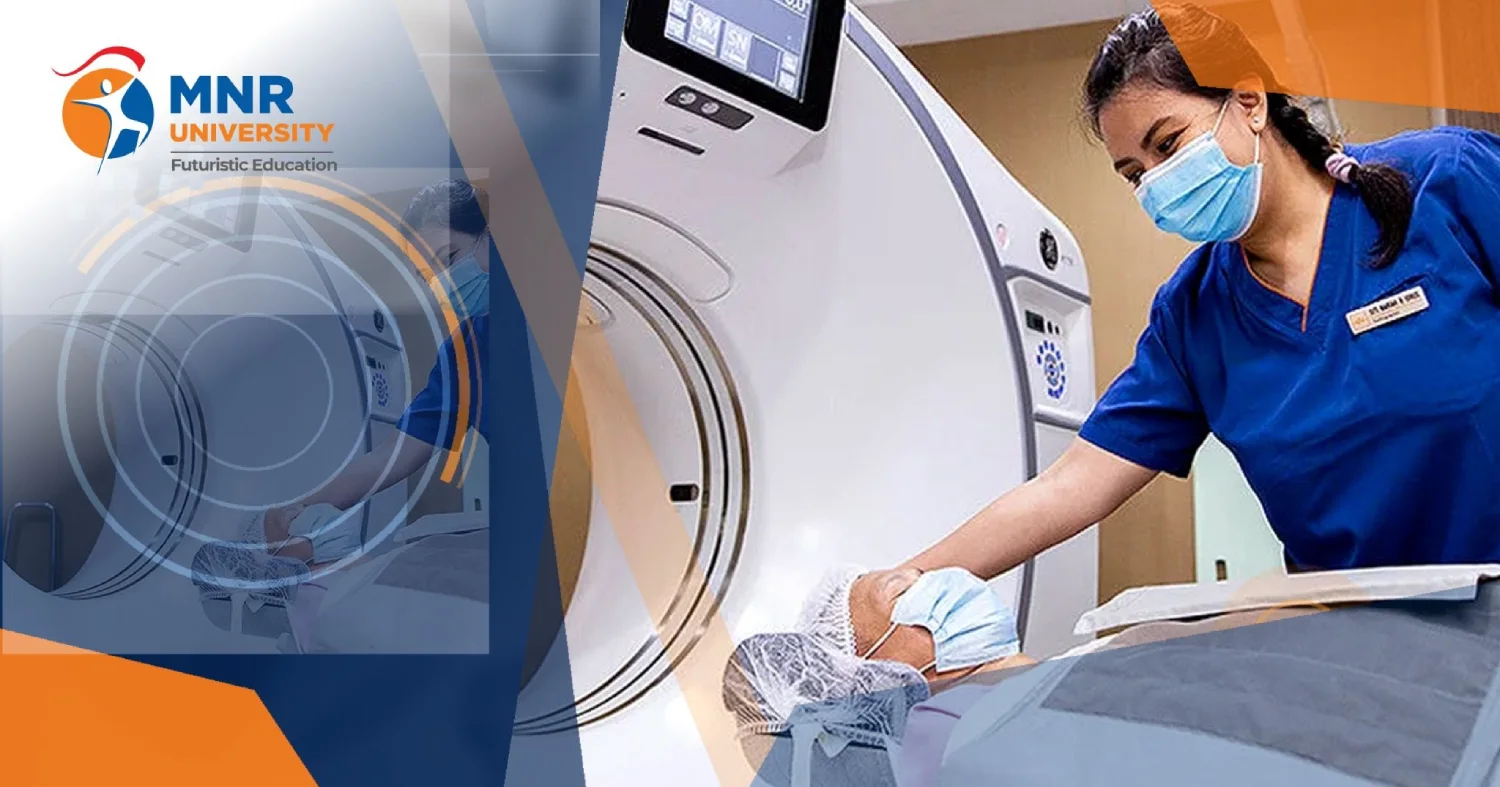
Every March, a familiar scene plays out in Telangana homes. The Intermediate exams finish, the BiPC certificate sits on the table, and nobody is quite sure what happens next if MBBS does not work out.
Radiology answers that question quietly and well. Here is the direct answer first. The BSc radiology admission process in 2026 runs on two separate tracks, and the two do not share a calendar. Private universities such as MNR University accept direct applications on merit through their own portal, with admissions for 2026 to 2027 already open. Government and aided seats across Telangana are filled by the Kaloji Narayana Rao University of Health Sciences, through online registration and web-based counselling at alliedhs.tsche.in.
Most students lose a year because they wait on one track while the other quietly closes. A student who understands both can apply to both.
This guide walks through the BSc radiology admission process step by step: who is eligible, which documents to keep ready, what the state counselling calendar looked like last cycle, and what a graduate earns once the four years are done.
What is the BSc radiology admission process in 2026?
The radiology and imaging technology course is a four year undergraduate degree that includes clinical training inside a working hospital. Two admission tracks lead to it in Telangana, and a student is free to pursue both at the same time.
The two admission routes compared
| Point of difference | Private university route (example: MNR University) | Telangana state counselling route (KNRUHS) |
|---|---|---|
| Who runs it | The university itself, through its own admissions portal | Kaloji Narayana Rao University of Health Sciences, Telangana |
| Where to apply | admissions.mnruniversity.edu.in | alliedhs.tsche.in |
| Selection basis | Merit, or a valid state, national or international entrance score | State merit position built from uploaded certificates |
| Counselling | Not applicable, the university processes the application directly | Web-based counselling in phases, with web options |
| Application fee | As notified by the university | INR 2,500 for OC and BC, INR 2,000 for SC and ST, per course, plus bank charges |
| Tuition fee | Set by the university, with merit scholarships available | As notified by the Government of Telangana |
| Typical window | Open through the admission season, 2026 to 2027 currently open | Registration in late October, counselling from December onward |
| Best suited to | Students who want an early confirmed seat | Students chasing a subsidised government aided seat |
The gap between the two calendars is what catches families out. Private university admissions open early in the year and stay open through the season. State registration in Telangana opened only at the end of October last cycle and closed inside eleven days, with the final merit list arriving two months after that. A student who waits on the state track alone spends most of the year holding nothing.
What is the difference between a radiologist and a radiographer?
This is the single biggest confusion in the subject, and it changes what a family should expect. A radiologist is a medical doctor who finished MBBS and then an MD in radiodiagnosis, and who reads the scan and signs the report. A radiographer, also called an imaging technologist, holds a BSc and operates the X-ray, CT, MRI and ultrasound machines that produce those images.
Many parents and students still believe the two are the same job. They are not. The BSc route does not lead to the MD title. What it does lead to is a clinical job in four years rather than eleven, inside the same department, working beside the same doctors.
Who can apply for a radiology and imaging technology course?
Entry rules look similar on paper, but one difference decides where a student can apply. Some private universities accept both the BiPC and the MPC group. State counselling in Telangana is built around Intermediate candidates who studied biology.
Eligibility for BSc Radiology and Imaging Technology
| Requirement | MNR University | Telangana state seats through KNRUHS |
|---|---|---|
| Qualifying exam | 10+2 pass with the BiPC or MPC group from a recognised board | Intermediate 10+2 with Botany, Zoology, Physics, Chemistry and English |
| Alternate route | Class 10 plus a two or three year diploma in a related technology | Intermediate with a bridge course in biology and physical science |
| Minimum marks | Merit based | As notified by KNRUHS for the cycle |
| Minimum age | 17 years as on 31 December of the admission year | 17 years as on 31 December of the admission year |
| Nationality | Indian nationals and eligible overseas candidates | Indian national, PIO or OCI card holder, with Telangana local status rules |
| Selection | Merit, or a valid entrance test score | State merit position, then web options and seat allotment |
| Course length | Four years | Four years |
What does the four-year radiology course actually contain?
The first year covers human anatomy, physiology and radiation physics, which is where most students discover that the subject sits closer to physics than to biology. The second and third years move on to radiographic technique, patient positioning, contrast studies and the separate modalities, meaning X-ray, CT, MRI and ultrasound. Radiation safety protocols run through all four years rather than sitting in one paper. The last stretch is clinical, spent inside a hospital imaging department under supervision. While the course is popular, there is much more to it than most people realise, because a technologist who positions a patient badly produces a scan nobody can read.
What is the step-by-step BSc radiology admission process at a private university?
MNR University publishes three steps on its programme page. In practice, a few more follow once the form is submitted, and knowing them saves a family two or three phone calls.
Step-by-step application at MNR University
| Step | What the student does | What to watch for |
|---|---|---|
| 1. Register | Click Apply Now on the programme page and enter basic details | Use an email address the student checks daily, not a parent’s old one |
| 2. Check the email | A link arrives on the registered email to begin the application | Check the spam folder before assuming the mail has not come |
| 3. Verify and apply | Open Verify and Start Your Application and fill in the form | Enter names and dates of birth exactly as printed on the SSC certificate |
| 4. Upload documents | Attach scanned marks memos, certificates and photographs | Scans should be clear, complete and under the size limit |
| 5. Verification and offer | The university checks eligibility and issues an offer | Note the deadline printed on the offer letter, it is usually short |
| 6. Fee payment and reporting | Pay the admission fee and report to the campus with originals | Apply for merit scholarships before paying, not after |
Three mistakes account for most rejected applications. A name spelt differently on the SSC certificate and on the form is the commonest, and it is the hardest to fix later. Blurred or partial scans of marks memos come second. The third is missing the offer deadline, which is often only seven to ten days long. It is quite common to hear families say they were still deciding when the seat went.
Which documents should a student keep ready?
One question that often comes up is what to carry. Families who assemble the folder in April rather than October rarely miss a deadline.
Document checklist for BSc radiology admission
| Document | Why it is asked for | Needed for |
|---|---|---|
| SSC or Class 10 marks memo | Serves as the proof of date of birth | Both routes, mandatory |
| Intermediate or 10+2 marks memo | Establishes subject eligibility and merit | Both routes |
| Transfer certificate | Confirms the student has left the previous institution | Both routes |
| Study certificates for the last several years | Establishes local or non-local status in Telangana | State counselling route |
| Caste certificate, where applicable | Category seat and fee concession | State counselling route |
| Income certificate, where applicable | Fee reimbursement and scholarship claims | Both routes |
| Aadhaar card | Identity verification at counselling and reporting | Both routes |
| Passport size photographs | Application form and identity card | Both routes |
| Migration certificate | Required when the board is outside Telangana | Both routes, where applicable |
Source: KNRUHS registration instructions for B.Sc. Allied Health Sciences and standard private university admission requirements. Confirm the current list against the live notification before scanning.
How does the Telangana state counselling route work?
The state route runs on published dates, and it moves fast once it starts. The 2026 to 2027 notification had not been issued when this guide was written, so the table below sets out the 2025 to 2026 calendar, which is the best available guide to timing.
KNRUHS allied health admission calendar, 2025-26 cycle
| Stage | What happened | When |
|---|---|---|
| Notification issued | KNRUHS announced admissions under the competent authority quota | 28 October 2025 |
| Online registration | Applications and certificate uploads at alliedhs.tsche.in | 29 October to 8 November 2025 |
| Registration fee | INR 2,500 for OC and BC, INR 2,000 for SC and ST | Paid at registration |
| Provisional merit list | Prepared from eligibility and uploaded certificates | After verification |
| Final merit list | Eligible candidates published on the KNRUHS website | 29 December 2025 |
| Web options, phase one | Candidates chose colleges and courses online | From 8 January 2026 |
| Seat allotment and university fee | Allotted candidates paid the university fee and reported | After each phase |
Source: KNRUHS admission notifications for the 2025-26 academic year. Dates for 2026-27 will differ. Check knrush.telangana.gov.in and alliedhs.tsche.in for the current notification.
It is worth noting that the registration and processing fee is charged per course. A student registering for radiology and for two other allied health courses pays three times.
Merit position on the state track is built from the uploaded certificates rather than from a separate entrance exam. Local status counts as well, which is why study certificates for the preceding years are asked for. Candidates who studied outside Telangana should read the local status rules in the prospectus closely before registering, because a wrong claim can cost the seat after allotment.
What should families check among the top colleges for radiology courses?
A brochure will list machines. A campus visit shows whether those machines are switched on and how many students share one of them. A closer look at the industry shows that the gap between colleges is clinical, not academic.
What to inspect before accepting a radiology seat
| What to check | The question to ask | Why it decides the outcome |
|---|---|---|
| Imaging equipment training | How many students share one X-ray or CT console? | Employers test whether a graduate can position a patient, not recite theory |
| Modern diagnostic labs and facilities | Are the CT, MRI and ultrasound units working and in use? | A display machine teaches nothing |
| Clinical internships in top hospitals | Which hospital, from which year, and is it in writing? | The first job reference usually comes from the internship hospital |
| Radiation safety protocols | Are dosimeter badges issued to students during postings? | Radiation safety is a legal duty, not a classroom topic |
| Faculty | How many teachers are practising radiologists or senior technologists? | Reporting skills are learnt from people who report daily |
| Regulatory position | Is the programme built to NCAHP norms? | Registration with the state allied health council depends on it |
| Fee and scholarship | What is the total four year cost after scholarships? | The published tuition fee is rarely the full figure |
Source: National Commission for Allied and Healthcare Professions norms, Atomic Energy Regulatory Board radiation safety requirements and institutional prospectuses, August 2026.
Radiation safety protocols deserve more attention than families usually give them. Any facility using X-ray equipment works under Atomic Energy Regulatory Board rules, staff who work near radiation sources wear monitoring badges, and ultrasound practice in India is separately governed by the PCPNDT Act. A college that treats all of this as one theory paper is preparing students for an exam rather than for a job.
Why are students searching for MNR University?
Three reasons come up repeatedly on enquiry calls. Families want a health science degree that does not hang on a NEET rank. They want the clinical training arranged by the university rather than left to the student to chase. They want the fee to sit within reach, with a scholarship route if the marks are good.
MNR University teaches the programme through its School of Allied and Healthcare Sciences at MNR Nagar, Fasalwadi, in Sangareddy district within Greater Hyderabad, with an admissions office at Kukatpally. The published programme covers practice on X-ray, CT, MRI and ultrasound, modern diagnostic labs and facilities, clinical internships in hospitals, radiation safety protocols covering safe radiation dose limits and patient shielding, image analysis and reporting, teaching by radiologists and imaging specialists, and the growing use of AI in imaging.
MNR University compared with named Hyderabad competitors
| Point of comparison | MNR University | Malla Reddy University | Anurag University | CMR Institute of Health Sciences |
|---|---|---|---|---|
| Degree | BSc Radiology and Imaging Technology, four years | BSc allied health programmes, four years | BSc allied health programmes, four years | BSc allied health programmes, four years |
| Admission route | Direct application on merit or entrance score | Merit with a personal interview | Merit | KNRUHS counselling |
| Entry stream | 10+2 BiPC or MPC, or Class 10 plus a relevant diploma | 10+2 BiPC or MPC | 10+2 with biology | 10+2 with biology |
| Named imaging training | X-ray, CT, MRI and ultrasound practice, published on the programme page | Departmental laboratories | Departmental laboratories | Departmental laboratories |
| Radiation safety teaching | Named on the programme page, covering dose limits and shielding | Part of the syllabus | Part of the syllabus | Part of the syllabus |
| AI in imaging | Named as a programme highlight | Not published | Not published | Not published |
| Fee support | Merit scholarships open for the 2026 to 2027 intake | Institutional scholarships | Institutional scholarships | State fee reimbursement where applicable |
| Other credentials | Telangana’s first DASCA (USA) accredited university, over 50 years in education, academic tie-ups with US universities | NAAC A+, UGC and AICTE approved | NAAC accredited state private university | KNRUHS affiliated college |
Source: institutional websites and client supplied notes, August 2026. Competitor programme details change each intake and should be re-checked before publication.
What does the job market look like after the course?
A closer look at the numbers explains why imaging keeps hiring. India has roughly one radiologist for every one lakh people, and every one of those doctors depends on technologists to produce the images they read.
From an employer’s point of view, the shortage is not only of doctors. Every CT and MRI unit installed needs trained hands to run it, and installations have grown faster than the number of trained technologists.
Demand for imaging professionals in India
| Indicator | Figure | INR equivalent | Source |
|---|---|---|---|
| Practising radiologists in India | About 20,000 to 22,000 for 1.4 billion people, roughly one per lakh | Not applicable | Radiology and Imaging Association of India, cited 2026 |
| India diagnostic imaging devices market, 2024 | USD 713.99 million | About INR 621 crore | Credence Research, 2025 |
| Same market, 2032 forecast | USD 1,186.41 million at 6.55 per cent a year | About INR 1,032 crore | Credence Research, 2025 |
| India diagnostic labs market, 2027 forecast | USD 25,667 million at 11.65 per cent a year | About INR 2.23 lakh crore | ResearchAndMarkets, India Diagnostic Labs Market |
| Hospitals as end users of imaging equipment, 2025 | 65.42 per cent share | Not applicable | Mordor Intelligence, 2026 |
| Fastest growing end user, 2026 to 2031 | Diagnostic imaging centres, 7.74 per cent a year | Not applicable | Mordor Intelligence, 2026 |
| South India share of the imaging equipment market, 2025 | 29.12 per cent, the largest of any region | Not applicable | Mordor Intelligence, 2026 |
| Ayushman Bharat PM-JAY allocation, 2025 | INR 9,406 crore, widening cover for advanced imaging | Already in INR | Mordor Intelligence, 2026 |
Currency converted at USD 1 = INR 87, rounded, August 2026.
Pay follows the same pattern as most allied health work. The first job is modest, the third is not, and a named speciality such as MRI, CT or cath lab work moves the number fastest.
Radiography pay in India and abroad, converted into INR
| Where and at what level | Local figure | INR equivalent | What it actually requires | Source |
|---|---|---|---|---|
| India, fresher | INR 2.5 lakh to 4 lakh a year | Already in INR | BSc degree and internship | FindMyCollege, 2026 |
| India, average across experience | INR 3.07 lakh a year, range 1.19 lakh to 10 lakh | Already in INR | BSc degree | PayScale India, 2026 |
| India, MRI, CT or cath lab specialist | INR 8 lakh to 15 lakh a year | Already in INR | BSc plus speciality experience | FindMyCollege, 2026 |
| India, government post, Pay Level 6 | INR 35,400 to 1,12,400 a month band | Already in INR | BSc Radiography plus AERB and PCPNDT registration | Government recruitment listings, 2026 |
| United States, starting | USD 65,000 to 95,000 a year | About INR 56.6 lakh to 82.7 lakh | ARRT credential and state licensure | Radiology career guide, 2026 |
| United Kingdom, starting | GBP 28,000 to 40,000 a year | About INR 31.4 lakh to 44.8 lakh | HCPC registration, NHS Band 5 or 6 | Radiology career guide, 2026 |
| Canada, starting | CAD 70,000 to 95,000 a year | About INR 44.1 lakh to 59.9 lakh | CAMRT registration and provincial licence | Radiology career guide, 2026 |
| Australia and New Zealand, starting | AUD 75,000 to 110,000 a year | About INR 42.8 lakh to 62.7 lakh | AHPRA registration | Radiology career guide, 2026 |
Converted at USD 1 = INR 87, GBP 1 = INR 112, CAD 1 = INR 63, AUD 1 = INR 57, rounded, August 2026. Overseas figures require registration and licensing that an Indian BSc alone does not provide, and they are not comparable without adjusting for cost of living.
How should a family plan the BSc radiology admission process?
Three moves settle it. Assemble the document folder by April, because the state window opens and closes inside two weeks. Apply on both tracks, since a private offer costs nothing to hold while the counselling merit list is awaited. Then visit the campus on a working day and count the students standing around one console.
For the most part, the students who end up unhappy are the ones who accepted whichever college replied first. A fortnight of checking beats four years of regret.
In practical terms, the BSc radiology admission process rewards the family that starts early and applies twice. Prospective students can view the programme highlights, eligibility and scholarship details on the MNR University radiology page and apply for the 2026 to 2027 intake.
Frequently Asked Questions
Two routes lead to a seat. Private universities such as MNR University accept direct applications on merit or a valid entrance score through their own portal, and admissions for 2026 to 2027 are open. Telangana government and aided seats are filled by KNRUHS through online registration and web-based counselling at alliedhs.tsche.in. A student may apply on both tracks.
A 10+2 pass is needed. MNR University accepts the BiPC or MPC group, or Class 10 with a two or three year diploma in a related technology. Telangana state seats require Intermediate with Botany, Zoology, Physics, Chemistry and English. The minimum age is 17 years as on 31 December of the admission year.
Four years, including clinical training. This is the standard duration for allied health degree courses in Telangana under the National Commission for Allied and Healthcare Professions.
At MNR University, yes. The published eligibility accepts both the BiPC and the MPC group. Telangana state counselling seats are built around Intermediate candidates who studied biology, or those who completed an approved bridge course in biology and physical science.
A radiologist is a medical doctor who completed MBBS and an MD in radiodiagnosis, and who reads scans and signs reports. A radiographer, or imaging technologist, holds a BSc and operates the X-ray, CT, MRI and ultrasound equipment. Both work in the same department, but the BSc route does not lead to the MD title.
The SSC marks memo as proof of date of birth, the Intermediate marks memo, transfer certificate, study certificates, Aadhaar card and passport photographs. Caste and income certificates are needed where applicable, and a migration certificate is required for boards outside Telangana.
In the 2025 to 2026 cycle KNRUHS charged INR 2,500 for OC and BC candidates and INR 2,000 for SC and ST candidates, per course, with bank charges extra. Allotted candidates paid a separate university fee. Figures for 2026 to 2027 will be confirmed in the fresh notification.
Common roles are radiology imaging technologist, X-ray technologist, CT technologist, MRI technologist, cath lab technologist, mammography specialist, radiotherapy technologist, PACS administrator and application specialist with imaging equipment brands. Government radiographer posts are also open through NHM, ESIC, railways, AIIMS and state recruitment.
About INR 2.5 lakh to 4 lakh a year in India. PayScale reports an all-experience average near INR 3.07 lakh, with a range of INR 1.19 lakh to 10 lakh. Specialists in MRI, CT or cath lab work typically reach INR 8 lakh to 15 lakh.
Registration with the state allied and healthcare council applies under the NCAHP Act. Roles that involve radiation sources fall under Atomic Energy Regulatory Board rules, and a Radiation Safety Officer certification is required for nuclear medicine and radiotherapy work. Ultrasound work is also governed by the PCPNDT Act.
Related Blogs
Anaesthesiology: A Fundamental Pillar of Modern Surgery
Modern healthcare relies heavily on the steady hands and technical expertise of clinical specialists during…

Anesthesiology & OT Technology Course After 12th: A High-Demand Healthcare Career in 2026!
Inside every operating theatre, one team holds the line between a smooth surgery and a…

Top B.Optometry Colleges in Telangana 2026: Rankings, Fees and Admission Guide
Telangana has a growing number of colleges offering a Bachelor in Optometry. One of the…
How B.Sc. Respiratory Therapy Course Prepares Graduates to Revolutionise Urban Air Quality Management
In growing megacities where every breath counts, a highly specialised wave of healthcare professionals is…
Admission in BPT 2026: Eligibility, Fees, Career Scope and How to Choose the Right Physiotherapy College
Physiotherapy has grown into one of the most in-demand health careers in India. Every year,…
Best Optometry Colleges in India in 2026: A Complete Comparison Guide
Every year, thousands of students finish Class 12 with Biology and start looking past MBBS….